CR-V Honda Hybrid Cars Family Review SUV
In-depth analysis of the Honda CR-V e:HEV: the most refined family hybrid SUV under 45,000 euros?
 Iván Navarro
11 July 2026
6 min.
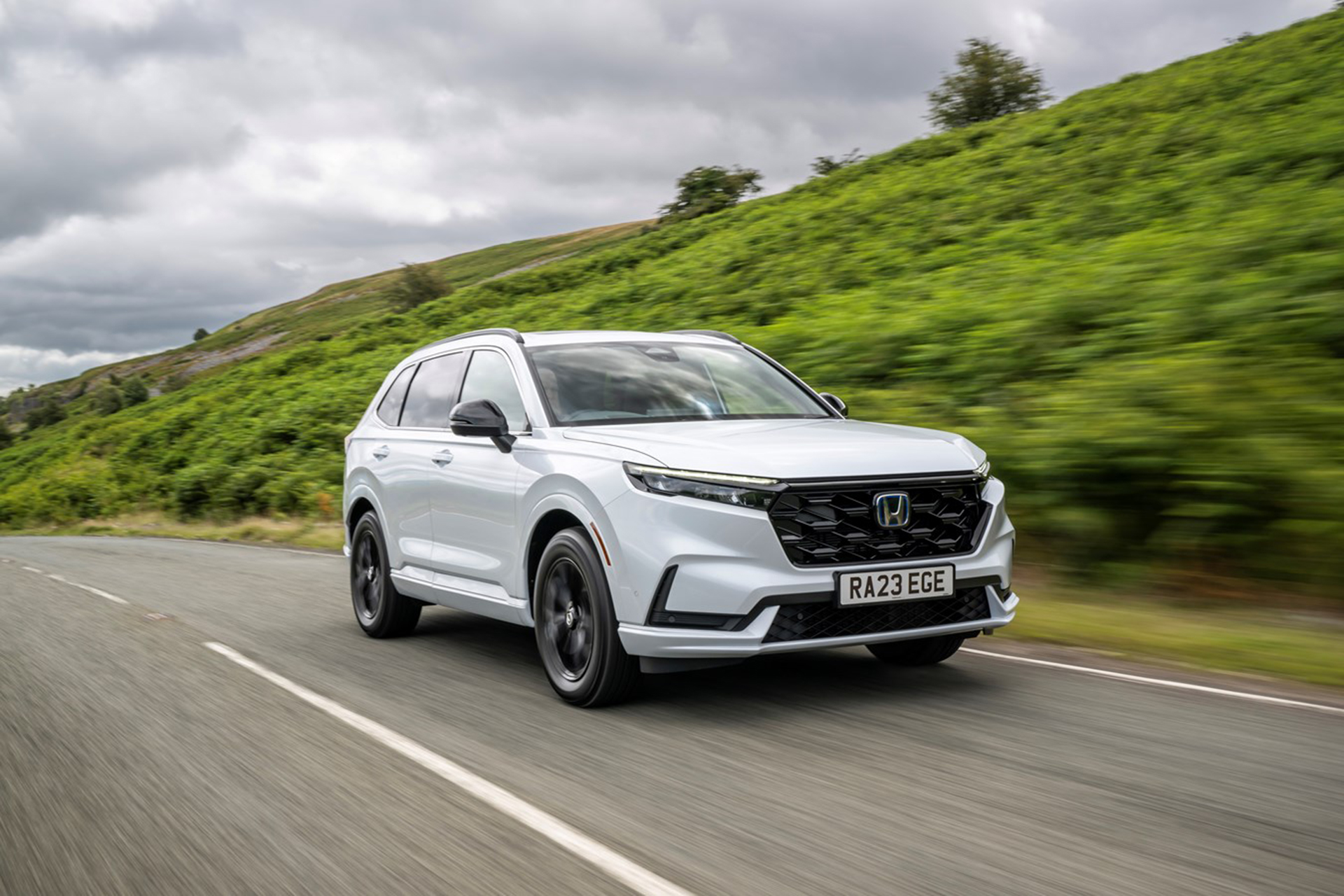
We test the Honda CR-V e:HEV, a 184 CV family hybrid SUV that redefines refinement in its segment. We pit it against Toyota, Nissan, Hyundai and Kia to see whether it justifies its price.
The family hybrid SUV has become the most hotly contested ground in the Spanish market. And on that ground, the Honda CR-V e:HEV arrives with a proposition that steers clear of the noise: mechanical refinement, a hybrid system that Honda has been refining for more than a decade, and an image earned through reliability rather than slogans. The question is whether all of that justifies sitting slightly above the psychological barrier of 45,000 euros.
Before getting into the details, an editorial note: we have decided to leave BYD out of this analysis. In our view, other Asian brands—including several Chinese ones—are refining hybrid proposals better suited to European tastes and with more efficient powertrains in real-world use. This is an editorial decision, not a judgement on the brand.
Honda CR-V e:HEV, the sixth generation of the Japanese family SUV
The CR-V is no longer that tall utility vehicle of the nineties. The sixth generation stretches the silhouette to 4,690 mm, sharpens its lines and adopts a more sober, almost premium formal language. No gimmicks. The wheelbase has grown and with it the sense of a large, comfortable car, designed to eat up motorway kilometres without complaint.
Exterior design and perceived quality
A clean front end, horizontal bonnet, thick pillars that lend visual solidity. It is not a car that shouts. And that, to my taste, plays in its favour in a segment saturated with chrome grilles and sharp headlights. The perceived quality when opening the door —weight, sound, the feel of the handle— sits a step above the average. You can tell Honda has worked on the details.
Interior, ergonomics and rear seats
This is where the CR-V plays its strongest card. Horizontal dashboard, physical controls for the climate system (bless them), a well-integrated 9-inch screen and a driving position that adjusts like a tailored suit. The rear seats are among the most generous in the segment: two adults of 1.90 m travel without brushing the roof and with legroom worthy of a D-segment saloon. That said, it is a strict five-seater—anyone looking for seven seats will have to look elsewhere.
e:HEV hybrid engine: how the i-MMD system works
Honda’s i-MMD system is, in essence, an electric car with a petrol generator. The naturally aspirated 2.0 engine rarely drives the wheels directly; its main function is to power the generator that charges the small battery (≈1 kWh) and feeds the electric motor. Only at motorway cruising speed does it engage mechanically via a clutch. And the result in practice? A linear, electric delivery of torque, without the jerks typical of a conventional CVT. Refined is the word.
Performance and dynamic behaviour
With 184 CV combined, the CR-V e:HEV covers 0-100 in around 9 seconds and reaches 184 km/h. It is not an SUV for demanding drivers through corners—the chassis prioritises comfort—but it responds with composure, moves little under acceleration, and the steering has a pleasant feel, though it asks for a bit more weight at high pace.
| Power kW | Power CV | Top speed | Range | Consumption | Label | Fuel |
|---|---|---|---|---|---|---|
| 140 kW | 184 CV | 180 km/h | ≈900 km | ≈6 l/100 km | ECO | Hybrid |
Real-world consumption and efficiency in town and on the road
The homologated figure hovers around 6 l/100 km. In real use, on a mixed route such as Madrid–Toledo with the return via the A-42, it ranges between 5.8 and 6.4 l/100 km. In town, where the i-MMD system works almost like a pure electric car, we have recorded figures of 5.2. On sustained motorway at 120, it rises to 7. Consistent and predictable.
Technological equipment and Honda Sensing safety
Honda Sensing comes as standard: autonomous emergency braking, adaptive cruise control with Stop&Go, lane-keeping assist, sign recognition. Apple CarPlay and Android Auto integration is wireless. Wireless charging pad, power tailgate, and tri-zone climate control on the upper trims. Little to fault.
Price and positioning against rivals
The CR-V e:HEV starts at around 45,445 euros RRP, slightly above the 45,000 barrier. This is its commercial weak point. Prices are indicative, without dealer discounts or promotions.
Toyota RAV4 — from ≈43,500 €
The volume benchmark of the segment. Its hybrid has been refined for decades and remains the reliability yardstick. Less refined on the move than the Honda, but more affordable and with an unbeatable after-sales network.
| Power kW | Power CV | Top speed | Range | Consumption | Label | Fuel |
|---|---|---|---|---|---|---|
| up to 163 kW | up to 222 CV | 180 km/h | ≈850 km | ≈5.8 l/100 km | ECO | Hybrid |
Nissan X-Trail e-Power — from ≈35,800 €
The X-Trail with e-Power technology shares the philosophy of the Honda: a combustion engine acting as generator, electric traction. Good refinement, seven-seat option. Its real-world consumption, however, does not quite match that of the CR-V.
| Power kW | Power CV | Top speed | Range | Consumption | Label | Fuel |
|---|---|---|---|---|---|---|
| 150 kW | 204 CV | 170 km/h | ≈750 km | ≈6.4 l/100 km | ECO | Hybrid |
Hyundai Tucson HEV — from ≈35,900 €
The most affordable of the group, and probably the best equipped per euro spent. Striking design and a five-year warranty. Less refined than the Honda in its hybrid system, but very competitive.
| Power kW | Power CV | Top speed | Range | Consumption | Label | Fuel |
|---|---|---|---|---|---|---|
| 169 kW | 230 CV | 193 km/h | ≈800 km | ≈6.3 l/100 km | ECO | Hybrid |
Kia Sportage HEV — from ≈34,500 €
Technical sibling of the Tucson, with a more aggressive aesthetic approach and a seven-year warranty. Good value for money in terms of equipment, although in acoustic refinement it trails the Honda.
| Power kW | Power CV | Top speed | Range | Consumption | Label | Fuel |
|---|---|---|---|---|---|---|
| 169 kW | 230 CV | 193 km/h | ≈800 km | ≈6.3 l/100 km | ECO | Hybrid |
Comparative summary table
| Model | CV | 0-100 | Consumption | Price from | Score /10 |
|---|---|---|---|---|---|
| Honda CR-V e:HEV | 184 | 9 s | 6.0 l | ≈45,445 € | 8.7 |
| Toyota RAV4 | up to 222 | 8.1 s | 5.8 l | ≈43,500 € | 8.5 |
| Nissan X-Trail e-Power | 204 | 8.0 s | 6.4 l | ≈35,800 € | 8.2 |
| Hyundai Tucson HEV | 230 | 8.0 s | 6.3 l | ≈35,900 € | 8.3 |
| Kia Sportage HEV | 230 | 8.0 s | 6.3 l | ≈34,500 € | 8.1 |
Verdict: is the Honda CR-V e:HEV worth it?
Yes, with caveats. It is probably the most refined family hybrid SUV in the segment below 50,000 euros. The smoothness of the i-MMD system, its dynamic composure and its perceived quality are solid arguments. Its Achilles’ heel is the price: sitting above 45,000 euros puts it out of reach for buyers who will find 80% of the car in the Tucson or Sportage for considerably less. Anyone who prioritises refinement over cost will find here the most mature choice.
Frequently asked questions
How much does the Honda CR-V e:HEV really consume?
In mixed real-world use, between 5.8 and 6.4 l/100 km. In town it can drop below 5.3 thanks to predominantly electric operation; on the motorway at 120 km/h it sits close to 7 l/100 km.
Is there a seven-seat version of the Honda CR-V?
No. The sixth generation is sold in Spain exclusively as a five-seater. Anyone needing seven seats should look at the Nissan X-Trail e-Power or alternatives in a higher segment.
What environmental label does the CR-V e:HEV have?
The DGT ECO label, as it is a self-charging hybrid with CO₂ emissions below 140 g/km. It allows access to ZBE zones with the usual restrictions for this category.
What is the starting price of the Honda CR-V e:HEV in Spain?
The recommended RRP starts at around 45,445 euros, excluding dealer discounts, occasional promotions or purchase aid. Prices are indicative and may vary depending on trim level and options.
Technical specifications of this car

 Kia offers an electric range of 10 models, 50 versions and 400 possible combinations
 The seven finalists for the 2027 European Car of the Year (COTY) are exclusively electric
 Peugeot E-208 GTi: a battery-powered toy that revives the spirit of the 1980s sports cars
Deja un comentario