Clase V Mercedes Multivan Sprinter Volkswagen Electric Cars Comerciales Comparisons Furgonetas
Mercedes-Benz Sprinter vs Volkswagen Crafter: a duel between premium large diesel vans for professional fleets
 Iván Navarro
25 November 2026
7 min.
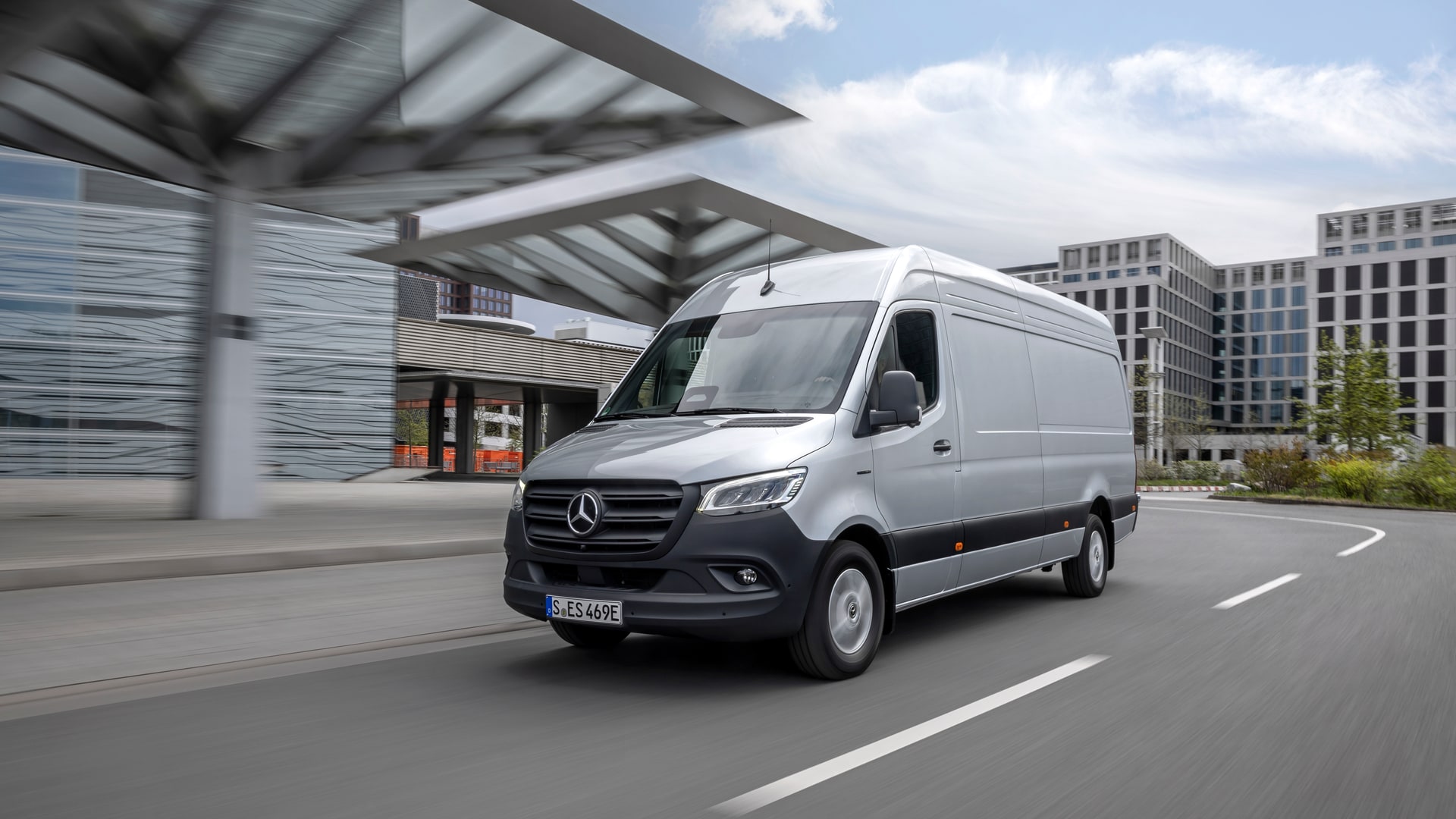
Few purchasing decisions weigh as heavily on a fleet’s bottom line as choosing the right large van. This is not an aesthetic whim or a showroom car: we are talking about the tool that will run eight, ten, twelve hours a day, loaded to the limit, for years. In that field, Mercedes-Benz and Volkswagen have been competing for the Spanish professional customer for decades, with two proposals that, in 2026, have taken slightly different paths. One bets on electrifying part of its urban range. The other still relies on the time-tested diesel, refined until it is almost beyond criticism.
Mercedes-Benz Sprinter: price from approximately €58,100 and technical specifications
For many fleet managers, the Sprinter is synonymous with the premium large van. The variant we analyse here is the Furgón 314 136 56kWh Base, an electric version with a 56 kWh battery designed for urban delivery routes and last-mile distribution, not for inter-provincial journeys. It is worth saying plainly: with a homologated range of around 220 km, this Sprinter does not compete on long motorway trips; it competes on something else—zero emissions in the urban core, unrestricted access to low-emission zones, and a label that some town councils already require for city-centre deliveries.
| Model | ||||||
|---|---|---|---|---|---|---|
| Mercedes-Benz Sprinter Furgón 314 136 56kWh | 100 kW | 136 CV | ≈120 km/h | ≈220 km | ZERO | Electric |
The indicative RRP starts at around €58,100, a figure that should be read for what it is: the manufacturer’s recommended price, without dealer discounts, without one-off campaigns and without public purchase aid such as the Plan Auto+, whose conditions should always be checked on the official website because they change frequently.
Volkswagen Crafter: price from approximately €43,900 and technical specifications of the 2.0 TDI 140 CV
The Crafter in question is the 30 Furgón Medio L3H2 2.0 TDI 140 FWD, the most classic approach and, for a good part of Spanish commercial transport, still the most practical today. Diesel, front-wheel drive, 140 CV—a power figure practically identical to the 136 CV of the electric Sprinter, although the way that torque is delivered feels completely different at the wheel—and a top speed of 160 km/h that makes it suitable for motorway driving without strain.
| Model | ||||||
|---|---|---|---|---|---|---|
| Volkswagen Crafter 30 Furgón Medio L3H2 2.0 TDI 140 FWD | 103 kW | 140 CV | ≈160 km/h | ≈8.5 l/100 km | C | Diesel |
With a homologated consumption of 8.5 l/100 km and CO₂ emissions of 220 g/km, the Crafter is not the cleanest van in its segment on paper, but it is the one that lets you plan a 600 km route without thinking about where to recharge. Its starting RRP is around €43,900, more than €14,000 below the electric Sprinter we have taken as reference. That difference is not minor for a fleet of twenty or thirty units.
Load capacity and versatility for fleets
Here the comparison becomes more complicated because we are measuring different configurations. The Crafter in L3H2 bodywork offers the medium-to-high volume typical of the segment, designed for bulky parcels and furniture, with good side and rear accessibility. The electric Sprinter, being a variant oriented to urban delivery, prioritises manoeuvrability and a comfortable loading height over maximum gross volume. For someone delivering in central Madrid or Barcelona, that approach makes sense. For someone connecting industrial estates 200 km apart, probably not.
Real-world consumption: diesel versus electrification
The most honest thing we can say is that they do not compete in the same usage league. The 8.5 l/100 km of the Crafter translates into a predictable, stable cost per kilometre, with no infrastructure surprises. The electric Sprinter depends entirely on where and how you charge: at a fleet-owned charging point, the cost per kilometre can drop noticeably; relying on a public fast charger, the equation changes considerably. With a range of around 220 km, it covers intensive urban shifts without problems, but it demands well-planned routes if it leaves the city, something we already discussed when analysing the medium diesel vans with the best payload-to-price ratio on the Spanish market.
Technology and active safety
Both brands have brought to their large vans much of the technology that used to be exclusive to passenger cars: lane-keeping assistants, emergency braking, rear-view cameras and real-time fleet management connectivity. The difference usually lies in the details of the interior finish and the integration of the multimedia system, where Mercedes-Benz tends to offer a somewhat more refined experience—a direct inheritance from its passenger car range—while Volkswagen prioritises functional robustness over dashboard aesthetics.
Maintenance and total cost of ownership for fleets
For a fleet manager, the purchase price is only the first figure in a longer equation. The Crafter’s diesel benefits from an extensive network of workshops and spare parts throughout Spain, known service intervals and an engine lifespan well proven over six-figure mileages. The electric Sprinter drastically reduces mechanical maintenance—no filters, no engine oil, no clutch to wear out—but shifts part of the expense to battery management and to investment in private charging infrastructure, a cost that is not always properly accounted for at the initial budgeting stage.
Comparison table: Mercedes-Benz Sprinter vs Volkswagen Crafter
| Model | ||||||
|---|---|---|---|---|---|---|
| Mercedes-Benz Sprinter 314 136 56kWh | Electric | 136 CV | ≈220 km range | ≈€58,100 | 8 | 3 |
| Volkswagen Crafter 2.0 TDI 140 FWD | Diesel | 140 CV | ≈8.5 l/100 km | ≈€43,900 | 6 | 9 |
Which van should you choose for your fleet?
There is no absolute winner, and anyone who presents it as such is oversimplifying. If the operation is urban, with short, repetitive routes, access to private charging points and the need to drive without restriction in low-emission zones, the electric Sprinter solves a very specific problem that diesel can no longer solve in some cities. If, on the other hand, the fleet needs real range, predictable costs and a service network that does not fail in the middle of a national route, the Crafter remains the most reasonable choice in its segment, with an upfront saving of more than €14,000 per unit. We already discussed this same tension between electrification and traditional combustion when comparing the Volkswagen Multivan and the Mercedes-Benz V-Class, and the pattern repeats: the star brand bets heavily on electrification in its urban versions, while Volkswagen prefers to go step by step.
Frequently asked questions
Which van has the better starting price, the Sprinter or the Crafter?
The Volkswagen Crafter 2.0 TDI 140 FWD starts from an indicative RRP of around €43,900, compared with approximately €58,100 for the electric Mercedes-Benz Sprinter 314 136. Both figures are manufacturer’s recommended prices, without dealer discounts or public aid.
Is the electric Mercedes-Benz Sprinter suitable for long routes?
That is not its strong point. With a range of around 220 km, it is designed for urban delivery and last-mile distribution, not for inter-provincial journeys, where the Crafter’s diesel is far more practical.
What is the real-world consumption of the Volkswagen Crafter 2.0 TDI 140 CV?
Its homologated consumption is around 8.5 l/100 km, with approximate CO₂ emissions of 220 g/km, typical figures for a large diesel van with L3H2 bodywork.
Are there public grants to buy these vans in Spain?
Yes, through the Plan Auto+, although the amounts and requirements change over time. It is advisable to always check the plan’s official website before closing the purchase, as the specific amounts should not be taken as final.

 Kia offers an electric range of 10 models, 50 versions and 400 possible combinations
 The seven finalists for the 2027 European Car of the Year (COTY) are exclusively electric
 Peugeot E-208 GTi: a battery-powered toy that revives the spirit of the 1980s sports cars
Deja un comentario