Bigster Corolla Corolla Cross CR-V Dacia Ford Honda Kuga Toyota Hybrid Cars Comparisons Buying Guides SUV
How to Choose a Compact Hybrid SUV for City Driving and Long Trips in 2026: Real-World Consumption and Ride Comfort
 Dani Montesinos
25 November 2026
7 min.
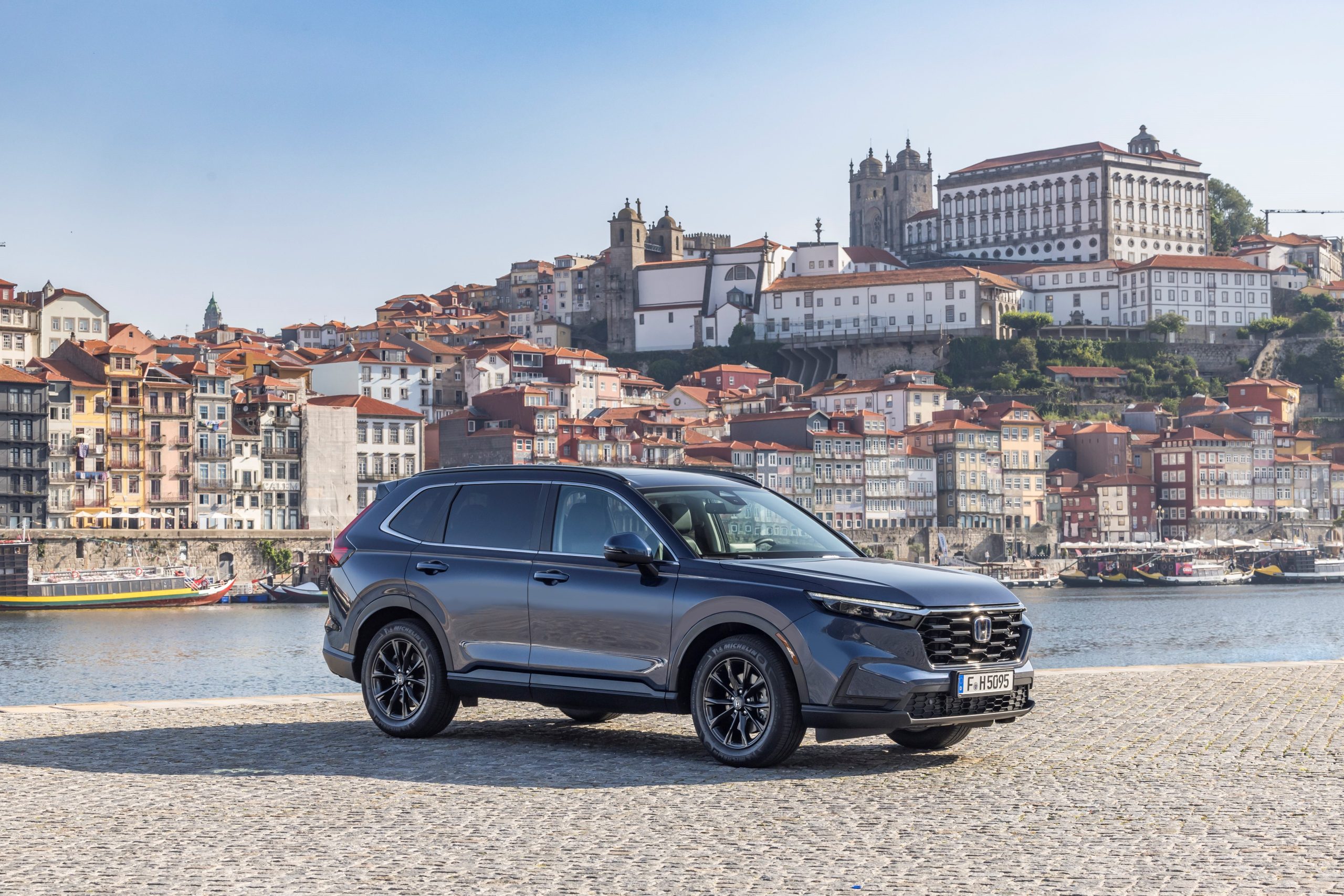
A practical guide to choosing the best compact hybrid SUV in 2026, with real-world consumption in town and on the motorway, ride comfort and value for money
A compact hybrid SUV has to do two things well that rarely go hand in hand: move nimbly around town and not run out of steam on a 400-kilometre motorway trip. Most manage the first. The second is where the good ones stand apart from those that only look the part on paper.
By 2026 the segment is more mature than ever, with full hybrid powertrains that no longer need a plug and that distribute the load well between the combustion and electric motors depending on the type of road. This guide compares six models sold in Spain right now, with consumption data, ECO label and ride comfort, to answer one very specific question: which is the best compact hybrid SUV 2026 for the real use you will give it.
What a hybrid SUV for city and road driving must deliver in 2026
The ECO label on the sticker is not enough. An SUV that performs well in both scenarios needs three things: a hybrid system capable of running in electric mode at motorway speeds without sending consumption soaring, a suspension that absorbs expansion joints well without going soft in corners, and a boot that is not cut back too much by the batteries. This is where some models lose points without the brochure telling you.
Real-world consumption, measured on mixed routes and not only on WLTP homologation figures, is the variable that most often skews comparisons. And ride comfort — the feeling that the car does not wear you out over 300 kilometres, let alone 30 — weighs more than it seems when choosing.
Toyota Corolla Cross: the benchmark for real-world consumption — from €37,100
Toyota has dominated this territory for years, and the Corolla Cross does not break the run. Its 1.8-litre hybrid system delivers smooth driving around town, with long stretches in pure electric mode, and keeps consumption under control on the motorway too, although there you notice the combustion engine working harder than one would like.
| Model | Power (CV) | Power (kW) | Consumption | Label | Fuel |
|---|---|---|---|---|---|
| Toyota Corolla Cross 1.8 Hybrid | 140 | 103 | 4.8 l/100 km | ECO | Hybrid |
Hyundai Tucson Hybrid: the right balance between space and agility — from €31,445
The Tucson solves the habitability and boot equation well, one of the most generous in the segment, with a more forceful engine response than the Corolla Cross. That said, consumption on the open road rises a notch compared with Toyota, which is logical given its greater available power.
| Model | Power (CV) | Power (kW) | Consumption | Label | Fuel |
|---|---|---|---|---|---|
| Hyundai Tucson 1.6 T-GDI HEV | 239 | 175 | 5.8 l/100 km | ECO | Hybrid |
Kia Sportage Hybrid: the Korean cousin with more character behind the wheel — from €27,770
It shares its platform and mechanics with the Tucson, but the Sportage feels a little firmer in its suspension, which translates into more grip in corners at the cost of some comfort on uneven asphalt. For those who travel more than they drive around town, this may be just the nuance that tips the balance.
| Model | Power (CV) | Power (kW) | Consumption | Label | Fuel |
|---|---|---|---|---|---|
| Kia Sportage 1.6 T-GDI HEV | 239 | 175 | 5.6 l/100 km | ECO | Hybrid |
Honda CR-V e:HEV: the quietest in the comparison — from €46,745
Honda bets on a hybrid of a different architecture, with the electric motor carrying almost all the propulsion load in urban use. The result is remarkable soundproofing and very linear power delivery. The entry price, however, sits well above the rest, and you need to weigh whether that jump is worth it.
| Model | Power (CV) | Power (kW) | Consumption | Label | Fuel |
|---|---|---|---|---|---|
| Honda CR-V e:HEV | 184 | 135 | 5.6 l/100 km | ECO | Hybrid |
Ford Kuga Hybrid: plenty of power for overtaking on the road — from €31,076
The Kuga is the most powerful of the six, and you notice it when merging onto a motorway or overtaking on a conventional road. In exchange, consumption in town does not drop as much as the Corolla Cross’s when traffic is dense and the combustion engine kicks in more often.
| Model | Power (CV) | Power (kW) | Consumption | Label | Fuel |
|---|---|---|---|---|---|
| Ford Kuga 2.5 Duratec FHEV | 180 | 132 | 5.3 l/100 km | ECO | Hybrid |
Dacia Bigster Hybrid: the option with the best price-to-equipment ratio — from €28,420
Dacia has done its homework with the Bigster: a compact SUV — strictly speaking, it already borders on the mid-size C segment — with efficient hybrid mechanics and a price that puts all the others in another league. It does not have the interior finish of a Honda or the smoothness of a Toyota, but for anyone prioritising total cost of ownership it is hard to argue with the decision. In fact, we have already analysed it against the Dacia Duster Hybrid, and the Bigster comes out stronger on space.
| Model | Power (CV) | Power (kW) | Consumption | Label | Fuel |
|---|---|---|---|---|---|
| Dacia Bigster Hybrid 155 | 155 | 115 | 4.9 l/100 km | ECO | Hybrid |
Real-world consumption: city versus motorway
This is where catalogue figures fall short. On the urban cycle, Toyota and Dacia drop below 5 litres with ease thanks to systems that prioritise electric mode at low speed. On a sustained 120 km/h motorway run, the picture changes: all of them rise, but the Ford Kuga and the Honda CR-V hold up better because they distribute power more efficiently at constant speed. The gap between best and worst on the motorway is around 1 litre per 100 km, which over a 600-kilometre journey is noticeable in your wallet.
Ride comfort: suspension, soundproofing and ergonomics
The Honda CR-V wins on soundproofing, with less road noise at cruising speed than its rivals. The Toyota Corolla Cross offers the best-balanced suspension for mixed use, neither too soft nor too harsh. The Kia Sportage is the firmest, aimed at those who enjoy driving more than those who want to isolate themselves from the road.
Ranking by user profile: urban, traveller and family
For pure urban use, the Toyota Corolla Cross and the Dacia Bigster take the crown for consumption and manoeuvrability. For the regular motorway traveller, the Ford Kuga or the Honda CR-V offer more power reserve and less acoustic fatigue. And for a family profile, prioritising boot space and rear seats, the Hyundai Tucson and the Kia Sportage remain the most versatile. Something similar to what we already saw in our ranking of urban hybrid SUVs with ECO label, where the balance between consumption and space made the difference.
Summary comparison table
| Model | Price from | Consumption | Label | Score (1-10) |
|---|---|---|---|---|
| Toyota Corolla Cross | €37,100 | 4.8 l/100 km | ECO | 8.7 |
| Hyundai Tucson Hybrid | €31,445 | 5.8 l/100 km | ECO | 8.0 |
| Kia Sportage Hybrid | €27,770 | 5.6 l/100 km | ECO | 8.1 |
| Honda CR-V e:HEV | €46,745 | 5.6 l/100 km | ECO | 8.3 |
| Ford Kuga Hybrid | €31,076 | 5.3 l/100 km | ECO | 8.2 |
| Dacia Bigster Hybrid | €28,420 | 4.9 l/100 km | ECO | 8.5 |
Grants, warranty and taxation to consider
When buying, it is worth checking the current conditions of the Plan Auto+ on the official website, as the amounts and requirements change with each call. The ECO label, common to all six models, gives access to parking and traffic advantages in much of Spain’s cities, something that in certain capitals already makes the difference between buying a car or not. Warranty also matters: Toyota and Kia offer the longest coverage in the group, no small argument for a purchase planned over eight or ten years.
Frequently asked questions
What is the best compact hybrid SUV 2026 for the city?
The Toyota Corolla Cross and the Dacia Bigster Hybrid stand out for their lowest real-world consumption on the urban cycle, with figures close to 4.8–4.9 l/100 km.
Which compact hybrid SUV uses the least fuel on the motorway?
The Ford Kuga Hybrid and the Honda CR-V e:HEV maintain the most stable consumption at sustained motorway speeds, with figures around 5.3–5.6 l/100 km.
Which compact hybrid SUV offers the best value for money in 2026?
The Kia Sportage starts from €27,770, slightly below the Dacia Bigster and with sufficient equipment for daily use.
Do all these models have an ECO label?
Yes, all six models compared — the Toyota Corolla Cross, Hyundai Tucson, Kia Sportage, Honda CR-V, Ford Kuga and Dacia Bigster, in their hybrid versions — carry the DGT ECO label.
Technical specifications of the cars in this article

 Kia offers an electric range of 10 models, 50 versions and 400 possible combinations
 The seven finalists for the 2027 European Car of the Year (COTY) are exclusively electric
 Peugeot E-208 GTi: a battery-powered toy that revives the spirit of the 1980s sports cars
Deja un comentario