Bayon Ford Hyundai Puma S-Cross Suzuki Vitara Hybrid Cars Comparisons SUV
Suzuki S-Cross vs Suzuki Vitara hybrids: which efficient SUV-B offers the better consumption-to-price ratio in 2026
 Iván Navarro
13 November 2026
6 min.
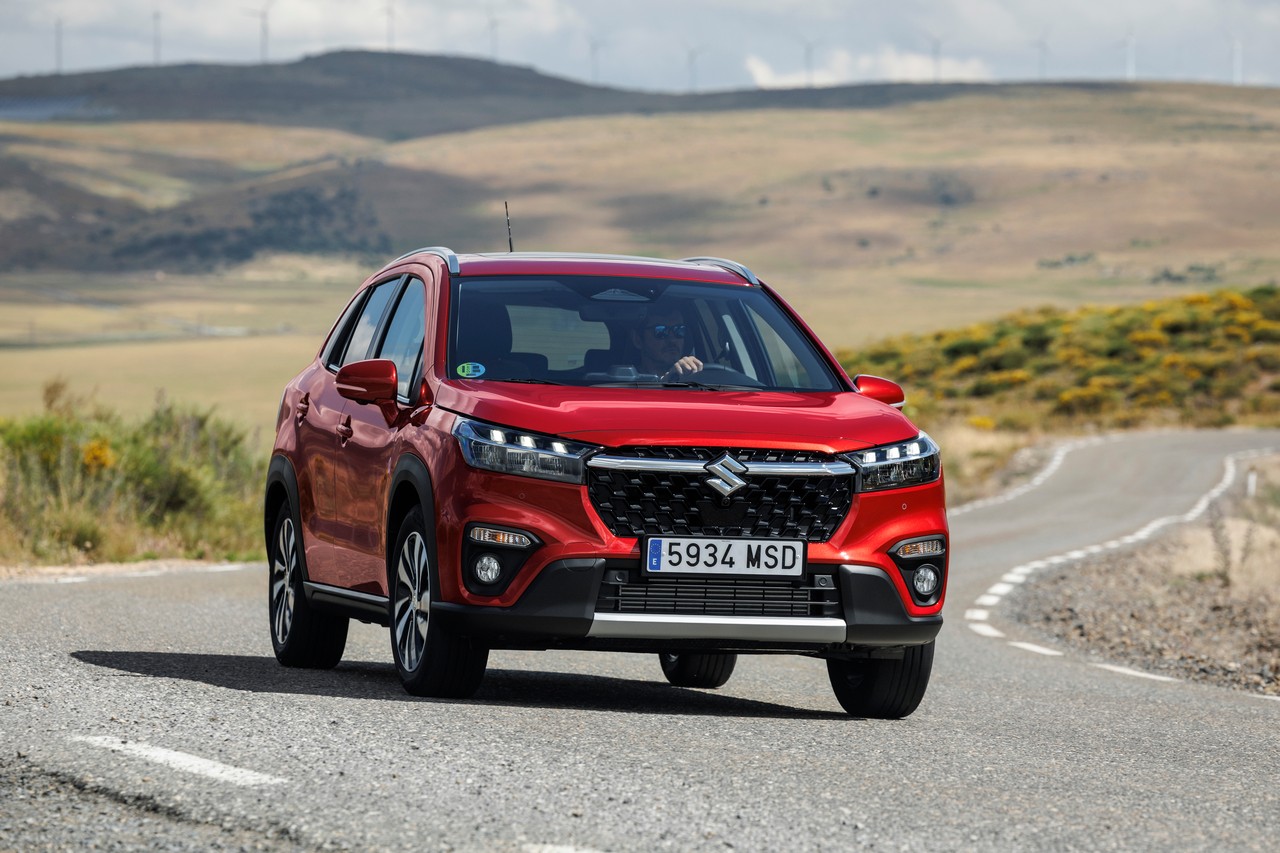
Same engine, almost identical consumption, and yet more than 3,100 euros difference at the starting price. It’s that simple — and that awkward for anyone who has to choose — is the dilemma between the Suzuki S-Cross and the Suzuki Vitara in their 2026 hybrid versions. Both fit the same 1.4 Boosterjet 115 hp mild hybrid engine, both are homologated at around 5.3-5.4 l/100 km, and both carry the Suzuki Hybrid badge on the tailgate. The question is not which one burns less. It’s which one is worth more for what it costs.
Suzuki S-Cross hybrid 2026: specs and price from 30,800 €
The S-Cross is the largest SUV-B in the Suzuki range in Spain, and it shows in everything: a more stylised body line, a higher rear end and a driving position that feels a step more SUV than crossover. Its starting price is around 30,800 € RRP, not counting dealer discounts or promotions.
| Model | Power (kW) | Power (hp) | Top speed | Consumption | CO₂ | Fuel |
|---|---|---|---|---|---|---|
| Suzuki S-Cross Mild Hybrid 1.4T 115 S1 | 85 kW | 115 hp | 185 km/h | 5.4 l/100 km | 121 g/km | Petrol/electric mild hybrid |
Suzuki Vitara mild hybrid: specs and price from 27,600 €
The Vitara is more compact, more urban in spirit, and starts at around 27,600 € RRP — the more affordable of the two SUV-Bs in the Suzuki range with this powertrain. It shares virtually the entire drivetrain with its bigger sibling, but in a shorter and lighter body.
| Model | Power (kW) | Power (hp) | Top speed | Consumption | CO₂ | Fuel |
|---|---|---|---|---|---|---|
| Suzuki Vitara Mild Hybrid 1.4T 115 S1 | 85 kW | 115 hp | 180 km/h | 5.3 l/100 km | 119 g/km | Petrol/electric mild hybrid |
Shared mechanics: the 115 hp 1.4 Boosterjet mild hybrid
There are no surprises or fine print here: the 1.4 Boosterjet turbo engine with light electric assistance is identical on paper. Same power, same torque, same 48V architecture that recovers energy during deceleration and assists the combustion engine during take-off. The difference in top speed — 185 km/h for the S-Cross versus 180 km/h for the Vitara — is more down to the aerodynamics and weight of each body than to any different power tuning.
Curiously, Suzuki has chosen not to differentiate its two SUV-Bs mechanically. It opted for a single powertrain and let size, equipment and positioning do the rest of the commercial work.
Real-world consumption: are there differences between the S-Cross and the Vitara?
On paper, barely a tenth. The Vitara’s homologated 5.3 l/100 km against the S-Cross’s 5.4 l/100 km are practically identical, and CO₂ emissions also match at around 119-121 g/km. On the road, the lighter and more compact Vitara tends to perform better in dense urban traffic, where the S-Cross’s extra weight shows a little more when braking and pulling away repeatedly. On the motorway, with the S-Cross’s aerodynamics working in its favour, the gap almost disappears entirely.
For anyone with mixed journeys and no fixed preference for either, real-world consumption should not be the deciding factor. It is, in fact, the only area where this duel practically ends in a draw.
Size, boot and interior space: where the premium shows
This is where the price difference starts to be justified. The S-Cross offers a more generous loading area and roomier rear seating, which is appreciated by families with older children or by those who regularly carry luggage. The Vitara, for its part, is more agile in urban manoeuvres and parking, where a few centimetres less overall length means fewer turns of the steering wheel in a tight car park.
It is not a huge difference, but it is noticeable as soon as you sit in the rear seats of each.
Equipment: what justifies the 3,200 € difference
Suzuki reserves for the S-Cross a trim level geared more towards comfort on long journeys, with better perceived soundproofing and a driving position with somewhat more refined materials. The Vitara does not fall short on safety electronics or connectivity, but its approach is more functional and less aspirational. Anyone seeking a day-to-day SUV-B without further pretensions will find everything they need in the Vitara; anyone who wants the car to also “accompany” them on long trips will better understand the price jump of the S-Cross.
Consumption-to-price ratio: which is the better buy in 2026?
With identical mechanics and homologated consumption, the Vitara wins the mathematical equation: you pay less for the same litre saved every 100 km. The S-Cross, on the other hand, turns those extra 3,200 € into space, equipment and a slightly more polished driving experience. It is not that one is a better car than the other — it is that they answer different questions with the same engine.
| Model | Price from | Power | Consumption | Highmotor score |
|---|---|---|---|---|
| Suzuki Vitara Mild Hybrid | ≈27,600 € | 115 hp | 5.3 l/100 km | 8.3/10 |
| Suzuki S-Cross Mild Hybrid | ≈30,800 € | 115 hp | 5.4 l/100 km | 7.8/10 |
Highmotor verdict
If the criterion is purely the cost per kilometre driven, the Vitara takes the recommendation: practically identical consumption, less money upfront. But anyone who values boot space, rear legroom and a slightly more refined finish should not rule out the S-Cross on the starting figure alone — there the premium has a fairly clear reason to exist. It is worth remembering, though, that both prices are the manufacturer’s recommended RRP, without dealer discounts or promotional finance offers, which usually bring the final bill down by around 2,500-3,000 euros in both cases.
Anyone coming from a city car looking to step up to an SUV-B without blowing the budget can find more context in our comparison of the Hyundai Bayon versus the Ford Puma hybrid, where the efficiency approach below 25,000 € is tighter still than in this internal Suzuki duel.
Frequently asked questions
What is the price difference between the Suzuki S-Cross and the Suzuki Vitara hybrids?
The Vitara starts at around 27,600 € RRP and the S-Cross at around 30,800 € RRP, an approximate difference of 3,200 euros with the same mild hybrid powertrain.
Do the Suzuki S-Cross and the Suzuki Vitara consume the same?
Practically the same: the Vitara is homologated at 5.3 l/100 km (119 g/km CO₂) and the S-Cross at 5.4 l/100 km (121 g/km CO₂), as they share the same 115 hp 1.4 Boosterjet mild hybrid engine.
Which hybrid SUV-B from Suzuki has the better consumption-to-price ratio in 2026?
The Suzuki Vitara offers the better consumption-to-price ratio, homologating even a tenth less consumption than the S-Cross with a lower starting price; the S-Cross offsets its premium with more space and equipment.
Which engine powers the mild hybrid range of the Suzuki S-Cross and Vitara?
Both use the same 1.4 Boosterjet turbo engine with a 48V mild hybrid system, with a maximum output of 115 hp (85 kW).
Technical specifications of the cars in this article

 Kia offers an electric range of 10 models, 50 versions and 400 possible combinations
 The seven finalists for the 2027 European Car of the Year (COTY) are exclusively electric
 Peugeot E-208 GTi: a battery-powered toy that revives the spirit of the 1980s sports cars
Deja un comentario