Hyundai Santa Fe Hybrid Cars Comparisons SUV
Mazda CX-80 vs Hyundai Santa Fe: which seven-seat family SUV-D offers better design and comfort in 2026
 Iván Navarro
13 November 2026
5 min.
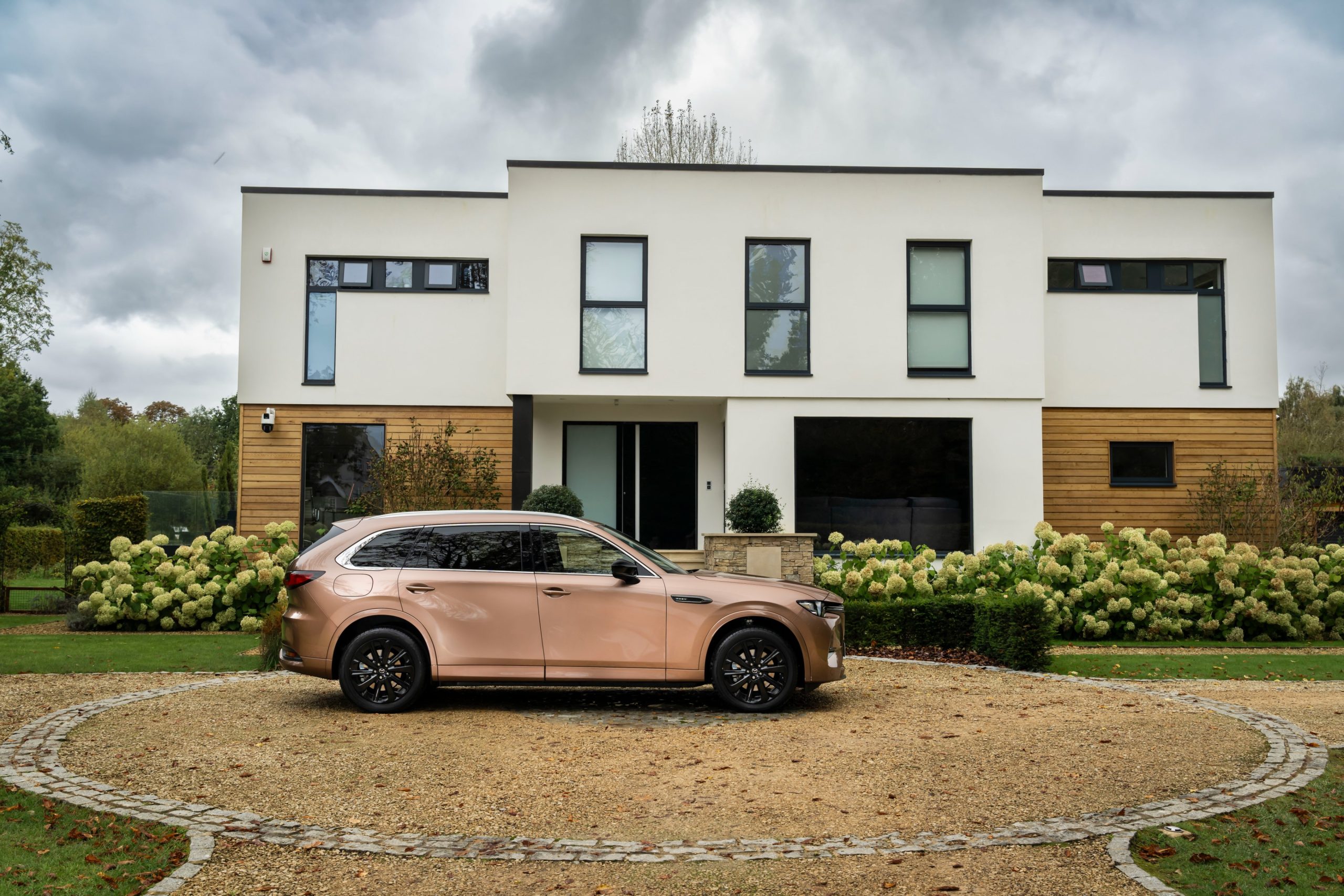
We compare the Mazda CX-80 mild-hybrid diesel AWD with the Hyundai Santa Fe petrol hybrid to find out which of the two seven-seat SUV-Ds offers better design, comfort and value for money in 2026.
There are segments where the decision comes down to numbers. And then there is the seven-seat family SUV-D, where the car also has to win over whoever sits in the back, the one who loads the bags and the one who pays the insurance. The Mazda CX-80 and the Hyundai Santa Fe compete precisely there, although they come from quite different philosophies: one bets on diesel mechanics with all-wheel drive and a Japanese premium finish, the other on a petrol hybrid designed to cover a lot of ground without complicating your life at the workshop.
Exterior design: Japanese elegance versus Korean presence
The CX-80 stretches the Kodo design language that Mazda has been refining for a decade: long bonnet, narrow rear pillars and proportions that resemble an elongated saloon more than a conventional SUV. It is the kind of design that ages well, discreet but purposeful.
The Santa Fe plays a different card. Its front, with the pixel-style light pattern and that almost squared-off silhouette, aims for a different effect: looking bigger and more robust than it actually is. It works, especially on trims with larger wheels. It is a matter of taste, but if we have to pick, the Mazda appeals more to those who want sobriety, and the Hyundai to those who want to stand out in the school car park.
Mazda CX-80 from €62,775 RRP: specifications and equipment
The relevant entry version in Spain is the MHEV 3.3 e-Skyactiv D 254 Exclusive-Line AWD, with automatic gearbox and all-wheel drive as standard. It is an unusual approach in this segment: a mild-hybrid diesel, a six-cylinder inline engine and four-wheel drive as standard rather than as an expensive option.
| Engine | Power (kW) | Power (CV) | Top speed | Consumption | CO₂ | Fuel |
|---|---|---|---|---|---|---|
| 3.3 e-Skyactiv D | 187 kW | 254 CV | 219 km/h | 5.6 l/100 km | 146 g/km | Diesel/electric mild hybrid |
That consumption of 5.6 l/100 km is, for a car of over two tonnes with all-wheel drive, a figure that impresses on the spec sheet. We will have to see whether it holds up on the motorway, loaded with seven passengers and luggage, which is where these SUVs tend to lose their composure.
Hyundai Santa Fe from €56,140 RRP: specifications and equipment
The Hyundai Santa Fe is offered with the HEV 1.6 TGDi 239 Maxx variant, also with automatic gearbox and stop-start. In this configuration there is no diesel and no all-wheel drive as standard: the approach is petrol hybrid, more oriented to those who drive in town and on medium journeys than to those who do motorway miles every day.
| Engine | Power (kW) | Power (CV) | Top speed | Consumption | CO₂ | Fuel |
|---|---|---|---|---|---|---|
| 1.6 TGDi HEV | 176 kW | 239 CV | 196 km/h | 6.4 l/100 km | 144 g/km | Petrol/electric hybrid |
Curiously, despite consuming almost a litre more per 100 km, the Santa Fe emits less CO₂ than the CX-80. It is the usual paradox between diesel and petrol: the former uses less fuel but its carbon footprint per litre is higher.
Comfort and space: the third row put to the test
This is where the Mazda plays its best cards. The CX-80 was designed from the outset with a wheelbase intended to accommodate seven real seats, rather than stretching a five-seat SUV. Its suspension, with more travel than the Santa Fe’s, absorbs road imperfections better, and Spanish roads are not exactly German autobahns.
The Santa Fe is not short on space, but its third row feels more suited to short trips than to a five-hour journey with teenagers behind. For those who want to understand what makes a third row genuinely usable by adults, it is worth reviewing how to choose a family SUV with a third row usable by adults, because wheelbase is not everything: the backrest angle and seat height matter almost as much.
In terms of perceived quality, the Mazda once again sits a step above, something we already reflected in our ranking of seven-seat SUVs with the best interior: denser materials, finer fit and less exposed hard plastic.
Price and equipment: who offers more for less?
The Santa Fe starts at €56,140 compared with €62,775 for the CX-80, a difference of more than €6,600 that is not minor. That said, the Mazda includes all-wheel drive as standard in this configuration, which offsets part of the price gap if it is valued as a genuine purchase argument.
The prices shown are the manufacturer’s recommended retail prices, excluding offers, dealer discounts and one-off campaigns, and should always be checked on the official website before closing any deal. Buyers considering public aid can check the current conditions of the Plan Auto+, which vary by autonomous community.
Comparative summary table
| Model | Power | Consumption | CO₂ | Price from | Design | Comfort | Overall score |
|---|---|---|---|---|---|---|---|
| Mazda CX-80 | 254 CV | 5.6 l/100 km | 146 g/km | €62,775 | 8.5 | 8.7 | 8.4 |
| Hyundai Santa Fe | 239 CV | 6.4 l/100 km | 144 g/km | €56,140 | 7.8 | 7.9 | 7.9 |
Highmotor verdict: which one to choose?
If budget comes first and use is mostly urban with the occasional getaway, the Santa Fe does the job without fuss and saves more than €6,600 upfront. But if the family covers real mileage, travels with the third row occupied and values a cabin that feels more carefully finished to the touch, the CX-80 justifies its higher price with all-wheel drive as standard and a diesel consumption that, on paper, is hard to match in this segment.
Frequently asked questions
Does the Mazda CX-80 have all-wheel drive as standard across all its versions?
In the MHEV 3.3 e-Skyactiv D 254 Exclusive-Line configuration analysed here, yes: AWD comes included as standard, at no extra cost.
Is the Hyundai Santa Fe HEV cheaper to maintain than the Mazda CX-80?
As a petrol hybrid versus a mild-hybrid diesel, the Santa Fe usually means cheaper servicing, although the CX-80 offsets part of that cost with lower fuel consumption.
Which of the two has the lower CO₂ emissions?
The Hyundai Santa Fe, at 144 g/km compared with the Mazda CX-80’s 146 g/km, despite consuming slightly more fuel.
What is the price difference between the two models?
Exactly €6,635 in recommended RRP: the Santa Fe starts at €56,140 and the CX-80 at €62,775, always as official figures before discounts.
Technical specifications of this car
 Kia offers an electric range of 10 models, 50 versions and 400 possible combinations
 The seven finalists for the 2027 European Car of the Year (COTY) are exclusively electric
 Peugeot E-208 GTi: a battery-powered toy that revives the spirit of the 1980s sports cars
Deja un comentario