The Audi A6 Sportback e-tron breaks every aerodynamic record
Óscar Sanz
7 August 2024
3 min.
Audi once again surprises us with the lowest drag coefficient in its entire history, this time thanks to the new A6 Sportback e-tron
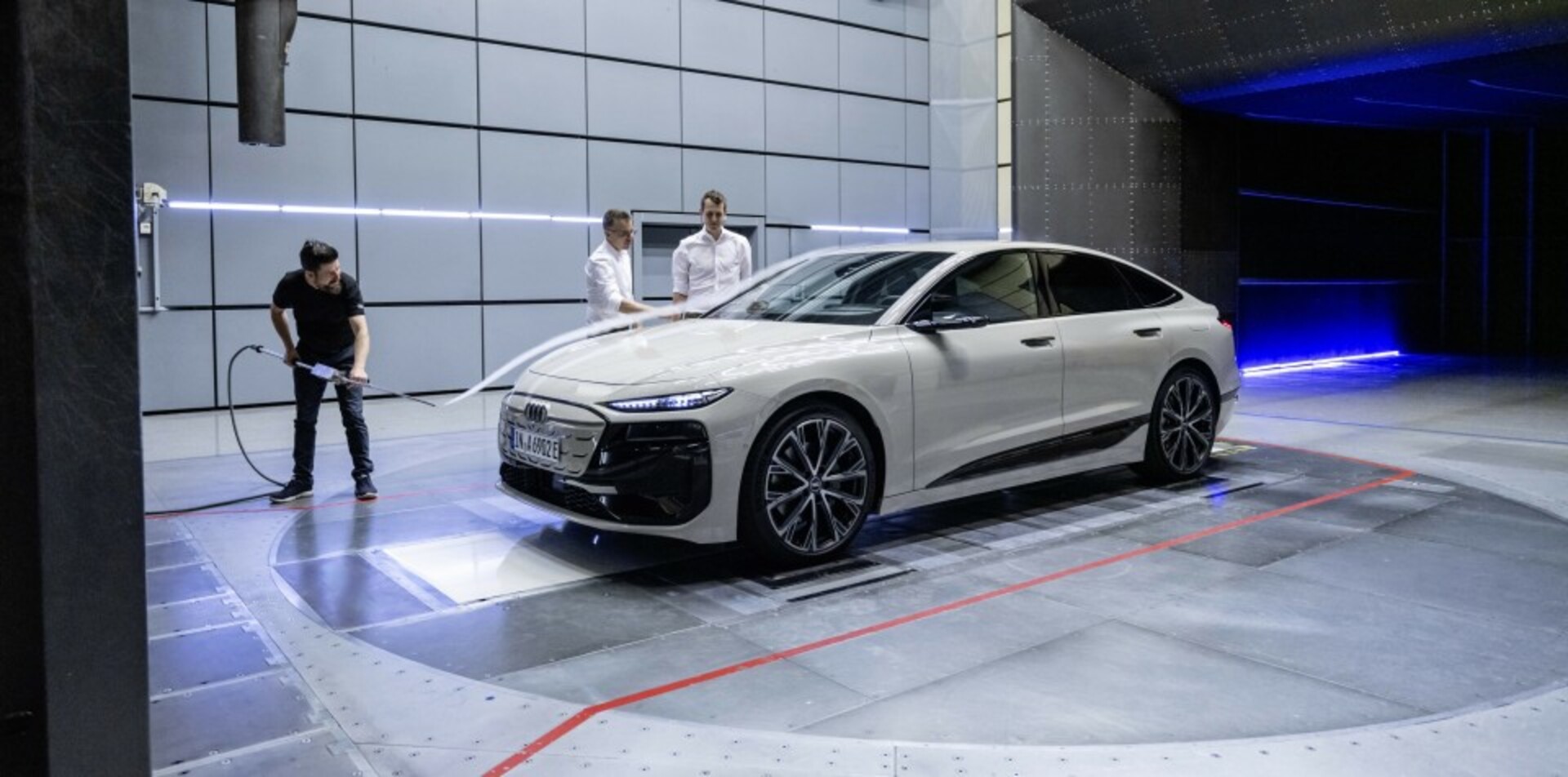
Audi has once again outdone itself with the launch of the A6 Sportback e-tron, a new fully electric model that boasts an impressive aerodynamic coefficient (Cx) of 0.21, the lowest ever achieved by the brand. An achievement that places the A6 Sportback e-tron at the forefront of aerodynamic efficiency within the Group Volkswagen, and they will surely use the same techniques on future models.
The key behind this advance is an obsessive attention to detail and interdisciplinary collaboration. Andreas Lauterbach and Matteo Ghelfi, aerodynamics specialists at Audi, together with wheel designer Andreas Valencia, explain how this record was achieved through an iterative process involving more than 1,300 simulations and countless hours in the wind tunnel.
“From the start of the project, we set ourselves very ambitious targets in terms of efficiency and range. The last thousandth of a point of Cx is the hardest to achieve, but in the end, we exceeded our expectations,” says Lauterbach.
History of aerodynamics at Audi
Audi’s commitment to aerodynamics is not new. From the NSU Ro 80 of 1967, with a Cx of 0.35, to the Audi 100 (C3) of 1983 with a Cx of 0.30, the four-ring brand has been at the forefront of aerodynamic design. The third-generation Audi 80 (B3) reached a Cx of 0.29, and now the A6 e-tron arrives to dethrone all its predecessors with a Cx of 0.21.
Key technical innovations
The advances in the A6 Sportback e-tron are the result of a series of technical innovations. The vehicle’s shape, with a slim glasshouse and a sloping roofline, is fundamental to its aerodynamic performance. In addition, the car’s underbody, with optimised curvatures and reinforcing ribs, and the rear diffuser, play crucial roles.
“We examined every curve individually. The underbody of the A6 Sportback e-tron is largely covered, and we optimised many parts, including the wheel spoilers and the 3D bumpers,” explains Ghelfi.
Wheels designed for efficiency
The wheel design has also been an essential part of the project. Andreas Valencia, the wheel designer, details how specific aerodynamic wheels in 19, 20 and 21 inches have been developed for the A6 e-tron. These wheels not only meet stability requirements, but also contribute significantly to the vehicle’s aerodynamic efficiency.
“We want the wind to flow along a surface rather than a set of geometric shapes. That’s why we have developed wheels with aero blades made from a special plastic,” notes Valencia.
Results
The results of these efforts are clear: the A6 Sportback e-tron not only achieves a Cx of 0.21, but the A6 Avant e-tron, its estate variant, achieves a Cx of 0.24, placing it as the leader in its category.
Impact on range
Every small adjustment to the design has had a significant impact on the vehicle’s range. For example, optimising the aerodynamic bevels at the rear improved the Cx by 0.008 points, adding eight extra kilometres of range. The cold air intake under the Singleframe contributed an improvement of 0.012 points, equivalent to about 12 more kilometres of reach.
 Óscar Sanz
7 August 2024
3 min.


 Peugeot E-208 GTi: a battery-powered toy that revives the spirit of the 1980s sports cars
 New Lexus ES: luxury grows and goes electric
 First contact with the Dacia Sandero Hybrid 155: power and efficiency from €19,890