The Ioniq 5 4WD is put to the test in the desert and passes the tests successfully
 Victor Alós Yus @sepelaci
30 May 2024
3 min.
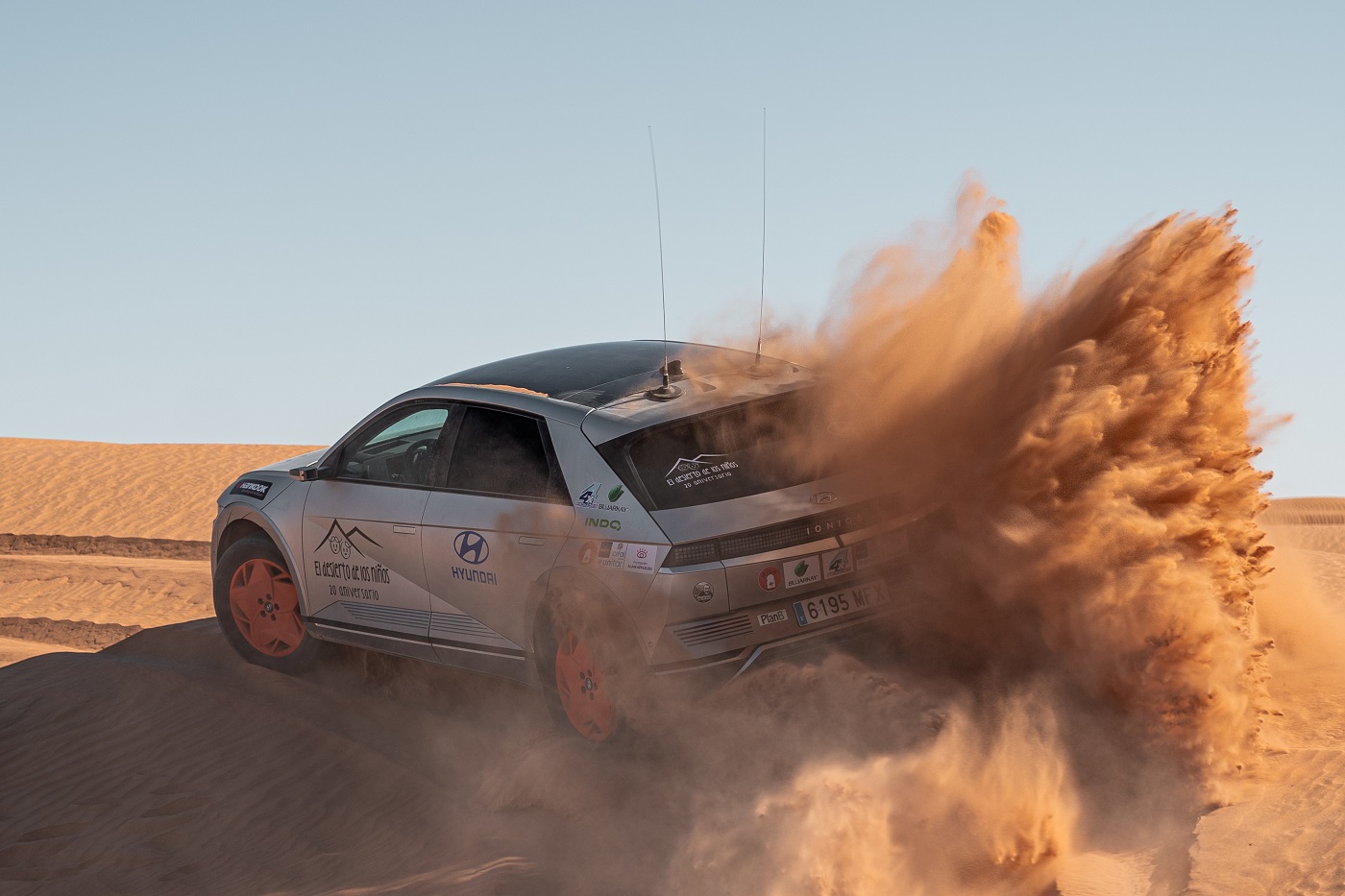
This version of the model has faced the rigours of the desert, which poses many challenges for any vehicle, and the Korean electric car has overcome them.
The year 2023 saw the debut of the Hyundai Ioniq 5 4WD, although it was a charity adventure known as The Children’s Desert. Now, it has returned to the same place to test itself in a new round of challenges to demonstrate that its two electric motors are capable of facing the rigours of the desert.
The all-wheel drive of this model comes from the combination of an electric motor at the front that delivers a power of 74 kW, while the rear motor offers a power of 165 kW. The total output of the model is 239 kW, equivalent to 325 CV. With this configuration, there is no problem facing the harsh conditions found in the desert.
With its two electric motors, the car can move with great freedom across the dunes. The immediate power it delivers allows it to overcome the dunes without too many problems. The different driving modes offered by the model have been tested to analyse its performance. According to the brand, the Sport mode provides immediate traction, with all the power available to the driver.
For its part, in ECO mode the Ioniq 5 4WD can navigate between the dunes with great confidence and very pleasant smoothness. The variable 4×4 system optimises performance in low-grip conditions. As a result, a safe and exciting driving experience is achieved on any type of terrain.
The torque, essential for moving over difficult terrain
The distribution of the 605 Nm of torque is key to the Ioniq 5 4WD moving so freely over these terrains. It is distributed variably between the two axles and ensures that each drive unit has the necessary strength to face the challenges of the terrain. The desert dunes, which exceed normal obstacles in difficulty, pose no great problem for this electric model.
Sufficient range to move over such terrain
The 77.4 kWh lithium-ion battery allows a range of 454 kilometres on the WLTP combined cycle. Its homologated average consumption is 19.1 kWh per 100 kilometres. In these tests, the drivers managed to keep consumption figures at similar levels. For this test, the suspension of the test unit has been raised by five centimetres to avoid impacts with stones. The battery has also been protected with a special cover, to prevent problems from accidental impacts.
The charging capacity of the Ioniq 5 is up to 240 kW, which allows the batteries to be charged to 80% of their capacity in just 18 minutes. In the The Children’s Desert test, several fast chargers were installed on some of the main roads in northern Morocco.
Improvements to face the desert
To overcome the challenges of the desert, the Ioniq 5 has been fitted with Hankook all-season tyres of larger size which, together with the raised suspension, allow it to perform better on difficult terrain. These improvements reduce the range, because the weight has increased. However, to compensate, energy efficiency has been improved, so the results are similar to those of a road version.
In this new edition of The Children’s Desert, the Ioniq 5 has once again become a car to be reckoned with, one that can face very demanding terrain conditions without problems.
https://youtu.be/HR2xDy3LJAE?si=D-jhFZpSLEOv_55Y


 Kia offers an electric range of 10 models, 50 versions and 400 possible combinations
 The seven finalists for the 2027 European Car of the Year (COTY) are exclusively electric
 Peugeot E-208 GTi: a battery-powered toy that revives the spirit of the 1980s sports cars
Deja un comentario