This classic car turns 75 years old as a popular icon with more than 5 million units sold
 Victor Alós Yus @sepelaci
25 September 2023
4 min.
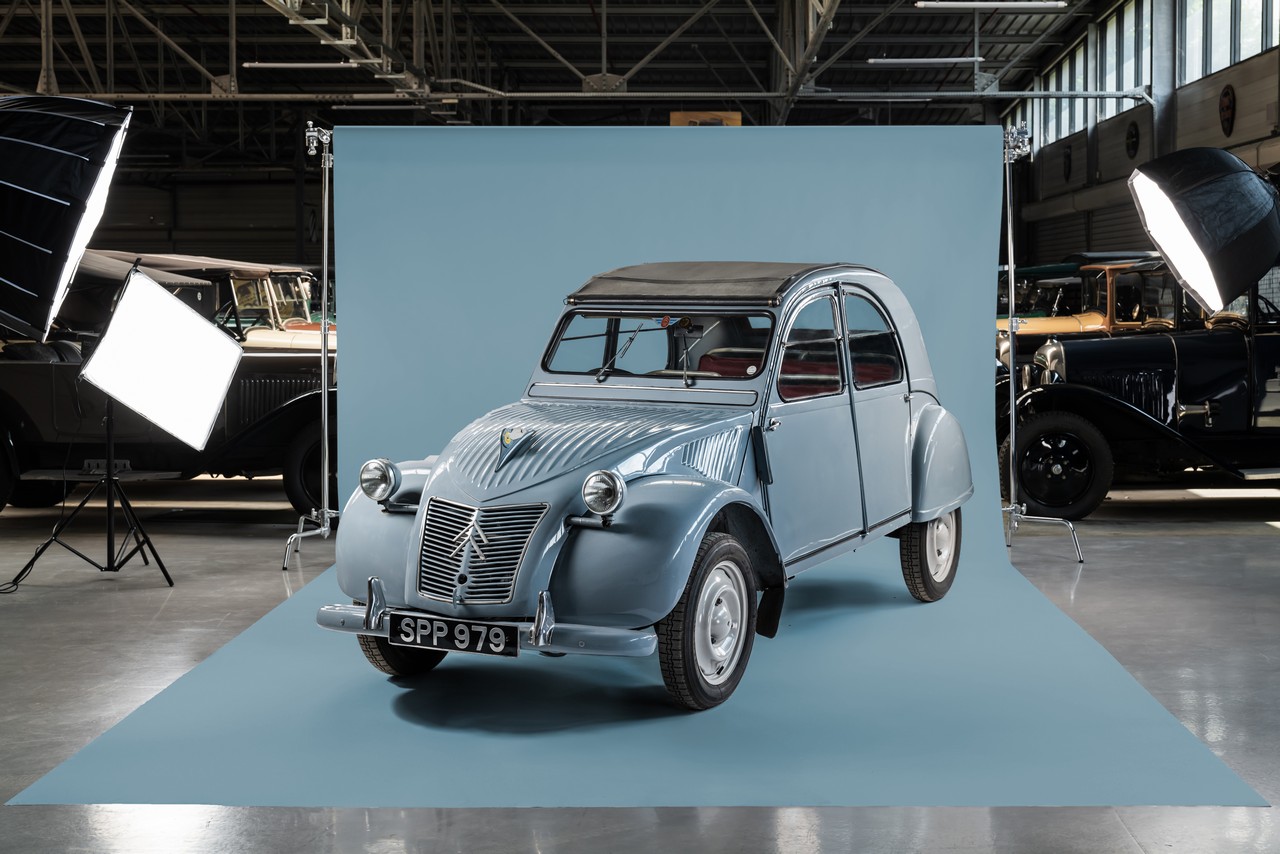
The last unit of this model left the factory in 1990, yet it remains one of the great icons of the automotive industry and a much-loved classic
There are many models that, although they were born decades ago, are still cars that almost everyone recognises. Many of us have even had the chance to ride in one of them, because although they stopped being manufactured a long time ago, these are cars that have a place at classic car shows and there is even one in the garage of many motoring enthusiasts. And these are not especially luxurious cars; they were designed to improve mobility at a low price.
The Citroën 2 CV was one of those models born so that everyone could own a car without having to spend too much money. This year marks 75 years since this model went on sale, and to celebrate it the French brand has wanted to pay tribute to it. To do so, it staged a photo shoot in which eight versions of the 2 CV were photographed and given back the style they have always had.
The origins of the 2 CV
This model was launched at the Paris Motor Show in 1948, but its origins date back a few years earlier. The predecessor of the 2 CV emerged from the TPV project, “Toute Petite Voiture“. It aimed to offer a light car designed to serve as an economical means of transport, so that workers could also own a car of their own. This was in 1936, and what emerged in 1939 was a car that weighed only 350 kg, could carry four people and 50 kg of luggage, and reached a top speed of 50 km/h.
Galería de fotos -
CITROËN 2 CV 75º ANIVERSARIO
250 units of this prototype were built, but the outbreak of the Second World War forced the project to be cancelled. In fact, all the cars built up to that point were destroyed, except four, which were stored at the Citroën Test Centre in La Ferté-Vidame.
After its launch, the French found a car with a very attractive design, powered by a 375 cc two-cylinder engine, capable of reaching 50 km/h. Its success came from discovering that it was a vehicle that could be used for many purposes, thanks to its modularity, lightness, agility and comfort.
Its success was such that during the 1950s the waiting list to get a 2 CV was six years long. Over the years it has become an automotive icon, and it still lives on in many garages.
Ten versions of the 2 CV
The Citroën 2 CV has had ten special editions, which could be seen both in France and in other European countries, such as the Spot, the Charleston and the Cocorico, among others. The van version, known as the 2 CV AU, arrived in 1952, and in 1954 the 2 CV AZ was launched, which used a 12 CV engine and a new clutch. It also took part in several raids, such as the 16,500 km Paris-Kabul-Paris raid in 1970, the 13,500 km Paris-Persepolis raid in 1971 and the 8,000 km Africa raid from Abidjan to Tunis in 1973.
The last 2 CV left the Mangualde factory in Portugal at 4 in the afternoon on 27 July 1990. It had been on the market for 42 years and had recorded 5,114,969 units produced up to that point, of which 1,246,335 were van versions.
The eight models chosen for the photo shoot were the following:
- The 2 CV 6 by Hermès, dressed inside and out by Hermès, was shown at the Paris Motor Show in 2008 to commemorate the 60th birthday of the 2 CV.
- The 2 CV 6 Spécial, one of the last 2 CVs produced at the Levallois plant in 1988.
- The 2 CV Spot, Citroën’s first special edition, of which 1,800 units were built, with two-tone upholstery and a body based on a design by stylist Serge Gevin.
- The 2 CV A, one of the 250 prototypes built in 1939 for the Motor Show, which was ultimately cancelled because of the Second World War. One of the four surviving vehicles in the Citroën Conservatory.
- The 2 CV A Berline (1950), identical to the one Pierre Boulanger presented at the opening of the Paris Motor Show in 1948.
- The 2 CV A with right-hand drive, built in Slough (United Kingdom) from 1953. It had a sheet-metal boot and folding rear windows. To this day, it is the oldest British 2 CV in Europe.
- The 2 CV AZU, a 2 CV van produced from 1954 until March 1978, with a large load capacity and “wardrobe” style rear doors to make loading easier.
- The 2 CV 4 x 4 “Sahara”, with four-wheel drive and two engines that allow it to tackle slopes of more than 40 per cent on sand.


 Kia offers an electric range of 10 models, 50 versions and 400 possible combinations
 The seven finalists for the 2027 European Car of the Year (COTY) are exclusively electric
 Peugeot E-208 GTi: a battery-powered toy that revives the spirit of the 1980s sports cars
Deja un comentario