What if the hydrogen car were the solution? BMW maintains that the electric car alone is not enough
 Antonio Roncero @roncero_antonio
16 August 2023
5 min.
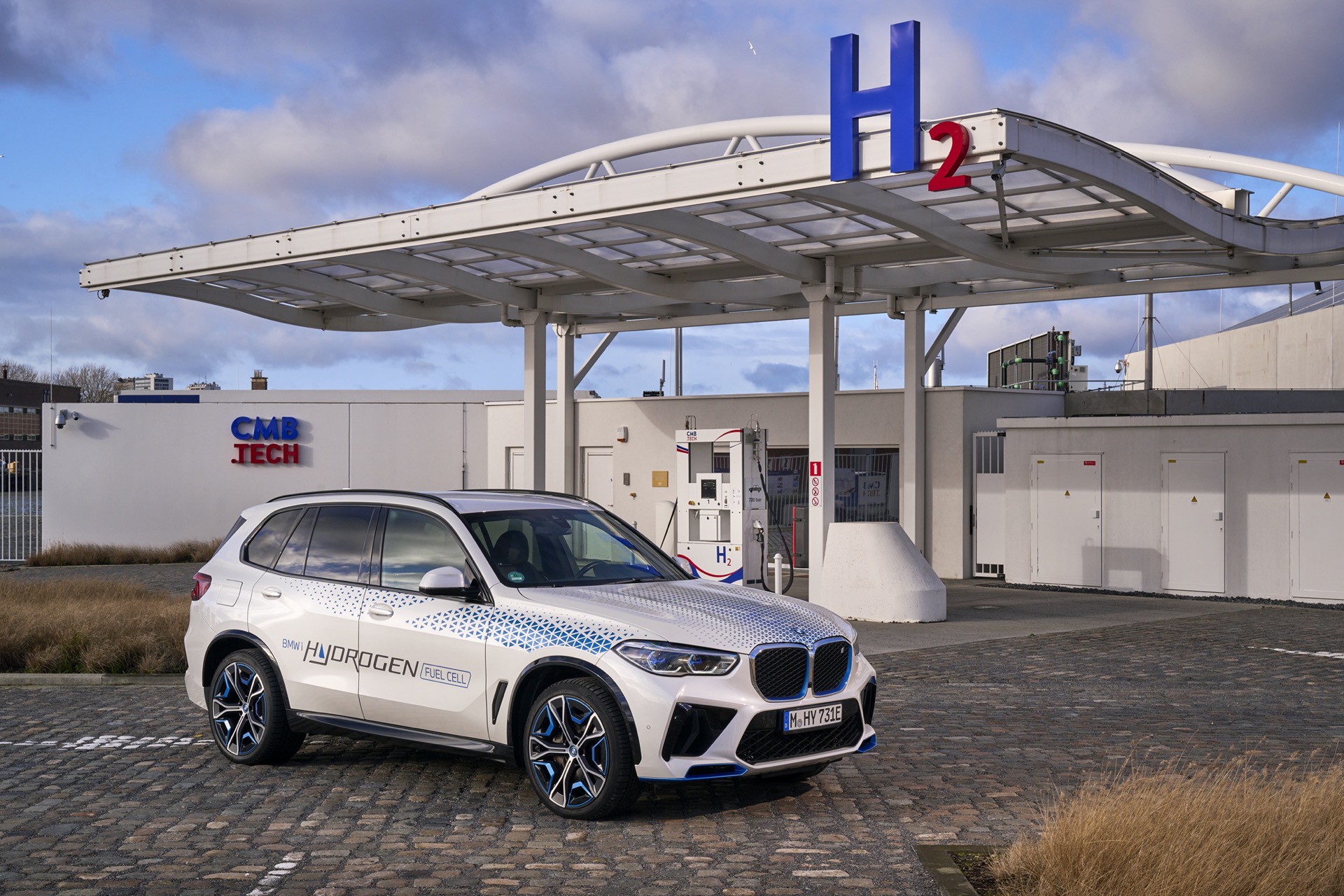
According to the results from the fleet of BMW iX5 Hydrogen currently on the road, the hydrogen car could be a genuine future alternative provided the right infrastructure were put in place.
For four years BMW has been developing its hydrogen car, the BMW iX5 Hydrogen. Today, after several test phases, a pilot fleet of nearly 100 units of the iX5 Hydrogen is running in the United Kingdom. For BMW, this project is crucial: the German brand considers hydrogen to be “the missing piece of the puzzle for achieving emission-free mobility”, as it is convinced that battery-electric technology alone is not enough. And naturally, the user is once again faced with the doubt: better electric car or hydrogen car?
That the technology exists and works is a proven fact, not only thanks to BMW. There are the Hyundai Nexo and the Toyota Mirai, in addition to the iX5 Hydrogen itself. The results of the pilot fleet tests back this up, beyond the car’s own technical characteristics. To recall: in combination with the fifth-generation BMW eDrive powertrain the brand uses in its electric cars, which includes the electric motor, transmission and power electronics integrated into a compact housing, the iX5 Hydrogen incorporates a battery developed specifically for this model, along with the fuel cell stack and its corresponding tanks.
It runs on hydrogen, but it is an electric car
The result is an electrically driven car, since it is the electric motor that drives the wheels. The difference from battery-electric cars is that here the energy to power the electric motor is generated on board thanks to the fuel cell. The drivetrain reaches a maximum output of 295 kW (401 CV), which makes it the most powerful hydrogen car. The electric motor also works as a generator during coasting or braking phases, sending the recovered energy to the battery.
The output of the fuel cell system is 125 kW (170 CV), while the output of the battery system is 170 kW (231 CV), resulting in the system’s 401 CV total. This allows the ix5 Hydrogen to accelerate from 0 to 100 km/h in 6 seconds, with a top speed of 180 km/h. The two hydrogen tanks placed under the floor, one longitudinally and another transversely at the rear, provide a combined capacity of 6 kg of hydrogen stored in gaseous form at 700 bar of pressure. With a WLTP consumption of 1.2 kg of hydrogen per 100 km, the total range exceeds 500 km.
Refuelling the tanks takes just three or four minutes. And here lies, today, one of the main advantages of fuel-cell electric cars over battery-electric ones, especially for long-distance journeys. As for industrialisation and production, BMW already has everything sorted: the iX5 Hydrogen is manufactured at the Group’s pilot plant in Munich, where its Research and Innovation Centre is also located. BMW purchases the individual fuel cells from Toyota, with whom it has held an agreement since 2013 in this regard, and handles their assembly to produce a complete fuel cell system.
For these reasons BMW is committed to hydrogen
In summary: the hydrogen car has all the advantages of electric driving, such as strong acceleration, zero local emissions and smooth, silent operation, with one main benefit: its short refuelling time to get back to the maximum range. But at BMW they go further.
According to the German brand, a fuel cell electric vehicle (FCEV) needs up to 90% fewer critical raw materials than a battery-electric car. And although in terms of efficiency an electric car slightly outperforms an FCEV, for BMW costs and flexibility matter more than efficiency. In this sense, BMW proposes two scenarios for Europe regarding hydrogen infrastructure through to 2050, envisaging a mix of BEVs and FCEVs, in which the cost would be 20% lower in the worst case, and up to 34% more favourable for FCEVs. In other words: developing a combined infrastructure of charging points for electric cars and fuel-cell cars would be more cost-efficient than focusing solely on electric cars.
That said, BMW believes its iX5 Hydrogen has everything needed to become the ideal solution for customers who do not have easy access to electric charging, who require high flexibility because they travel frequently, who live in very cold countries and would not be affected by the range loss of battery-electric cars, or who regularly tow a caravan and need a vehicle with a large towing capacity.
BMW ix5 Hydrogen – Image gallery


 Peugeot E-208 GTi: a battery-powered toy that revives the spirit of the 1980s sports cars
 New Lexus ES: luxury grows and goes electric
 First contact with the Dacia Sandero Hybrid 155: power and efficiency from €19,890
Deja un comentario