Audi e-tron: grueling tests for the new all-electric quattro drive in Namibia
 Guillermo Lopez
16 October 2018
7 min.
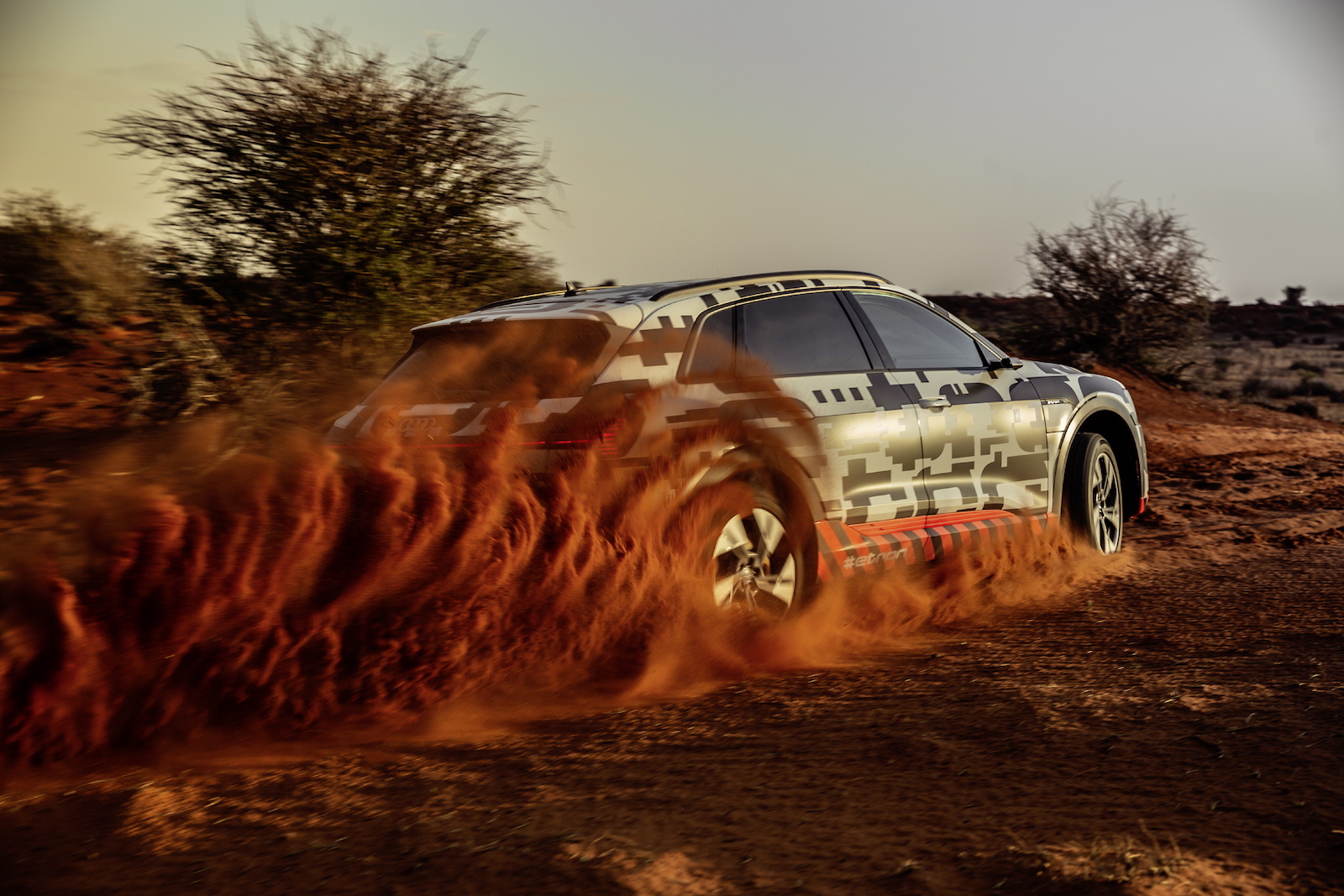
Building on the Audi e-tron Prototype, Audi continues to develop its new all-electric quattro drive, which will soon debut in the brand’s first electric model
The impressive dynamic qualities of a vehicle, its versatile and efficient suspension and powerful engines mean little without optimal traction and impeccable stability that give it a dynamic capable of impressing the best drivers.
Audi is putting the new generation of electric quattro all-wheel drive through a demanding test of dynamic trials on the steep, slippery salt flats and savannah of Namibia, all based on its new electric vehicle, the Audi e-tron quattro Prototype, which will be the first in this new generation of Audi’s all-wheel drive.
Kalahari Desert. 2 kilometres wide by 23 kilometres long, a hard, dry and highly porous surface with a fine layer of gravel and a very low coefficient of friction. Terrain that is more than suitable for subjecting the new all-electric quattro drive to the highest possible demands.
The brand of the four rings will feature for the first time this new electric evolution of one of its systems on the new Audi e-tron, though it first decided to test all its benefits on the Kalahari Desert, where rapid accelerations follow one another continuously with sudden controlled slides in risky drifting manoeuvres performed by Audi’s expert test drivers.
Risk situations in which to test the interaction of the new all-electric quattro drive with the various safety and driver assistance systems that will accompany it on the first electric vehicle with the four rings on its front: Electronic Stability Control (ESC), the Audi drive select dynamic driving system, air suspension, … and countless driving programmes and assistants are subjected to demanding tests to assess their performance and fine-tune their capabilities.
Thanks to the air suspension, the Audi e-tron Prototype quattro increases its ground clearance by 50 mm at the touch of a button, making it easier to drive and safer when travelling off-road. Combined with all-wheel drive, the ESC also helps by optimising the car’s traction and improving control under braking. To do so, it enhances the beneficial effects of the electronic differential lock, allowing optimal power transfer and greater propulsion capacity. The slippery loose-sand surfaces of the African savannah pose no problem whatsoever for the Audi e-tron Prototype quattro.
A fully electric model with complex electronic systems
The new member of the four-ring family will be a fully electric model. Its two motors—both powered by energy stored in the batteries—deliver up to 300 kW (408 CV) of power and a not inconsiderable 664 Nm of peak torque, giving the Audi e-tron quattro impeccable dynamic behaviour and great driving pleasure in all kinds of conditions.
The high precision of the electronic quattro system combines the traditional traction of both axles in all-wheel-drive systems with the dynamic efficiency that single-axle drive systems provide. The new all-electric quattro drive from Audi ensures continuous, variable regulation when distributing torque from the powertrain to the wheels of both axles. This provides greater precision and versatility. Only 30 milliseconds pass from the moment the motor transfers torque once the system has detected the vehicle’s driving conditions. This is a much shorter interval than with the most efficient of the previous quattro systems.
Such immediate response results from the elimination of the mechanical clutch in the system, which in the new all-electric quattro drive has been replaced by an electrical signal distributor—with no friction or sudden changes in it, even in extreme driving situations, guaranteeing an efficient and very rapid system response in every kind of situation.
To achieve this, all the systems interacting with the all-electric quattro drive operate intelligently on a single control network, where the central unit of the suspension system integrates for the first time the dynamics controller for the entire quattro drive system together with the selective control of torque distribution to the different wheels, thereby improving the car’s dynamic control. For example, when excessive understeer is detected during sporty driving, the system automatically applies slight braking through the car’s brakes to reduce the rotational speed of the inside wheels in the bend—those under greater load—so that more torque is directed to the outside wheels, providing greater traction. By removing the traditional mechanical element from the system and using the engine’s power control unit directly, the result is power control fifty times faster and more precise, always in line with the car’s driving conditions. All four ESC operating modes, which the driver can select at will, benefit equally from this.
As with Electronic Stability Control, the driver can also adapt the Audi e-tron quattro to the different types of terrain on which it is driven thanks to the dynamic driving system that the model fits as standard in all versions. Up to seven different profiles to choose from—a unique configuration option among vehicles of its type—allowing selection according to the different driving situations, the type of surface being driven on and each driver’s personal preference.
In addition, the Audi drive select allows adjustment of the propulsion system, steering assistance or the operation of the adaptive air suspension with damping control fitted to the Audi e-tron quattro Prototype. The suspension can change its height, lowering it by up to 26 mm to improve aerodynamics and stability when moving, or raising ground clearance by the aforementioned 50 mm to make the car easier to use off-road.
The excellent dynamic qualities provided by all these features are complemented by the low centre of gravity achieved on the Audi e-tron Prototype. Its wide, flat battery block sits beneath the cabin, conveniently protected between the two axles. As a result, the e-tron quattro Prototype enjoys a centre of gravity very similar to that of the brand’s conventional saloons, and has a perfect 50:50 weight distribution between both drive axles.
And if we also consider that the brand’s first series-production electric car with the four rings will offer torsional rigidity 45 per cent higher than that of the rest of its models, all of this results in extremely precise handling and a really low noise level, providing a high degree of acoustic comfort on board.
All these objectives and many more are what the engineers of the brand of the four rings analyse and study on the sands of the Kalahari Desert, subjecting the Audi e-tron quattro Prototype to all kinds of tests.


 Peugeot E-208 GTi: a battery-powered toy that revives the spirit of the 1980s sports cars
 New Lexus ES: luxury grows and goes electric
 First contact with the Dacia Sandero Hybrid 155: power and efficiency from €19,890
Deja un comentario