Audi improves the RS 3 to turn it into a true corner-carving machine and reign again at the Nürburgring
 Antonio Roncero @roncero_antonio
20 August 2024
4 min.
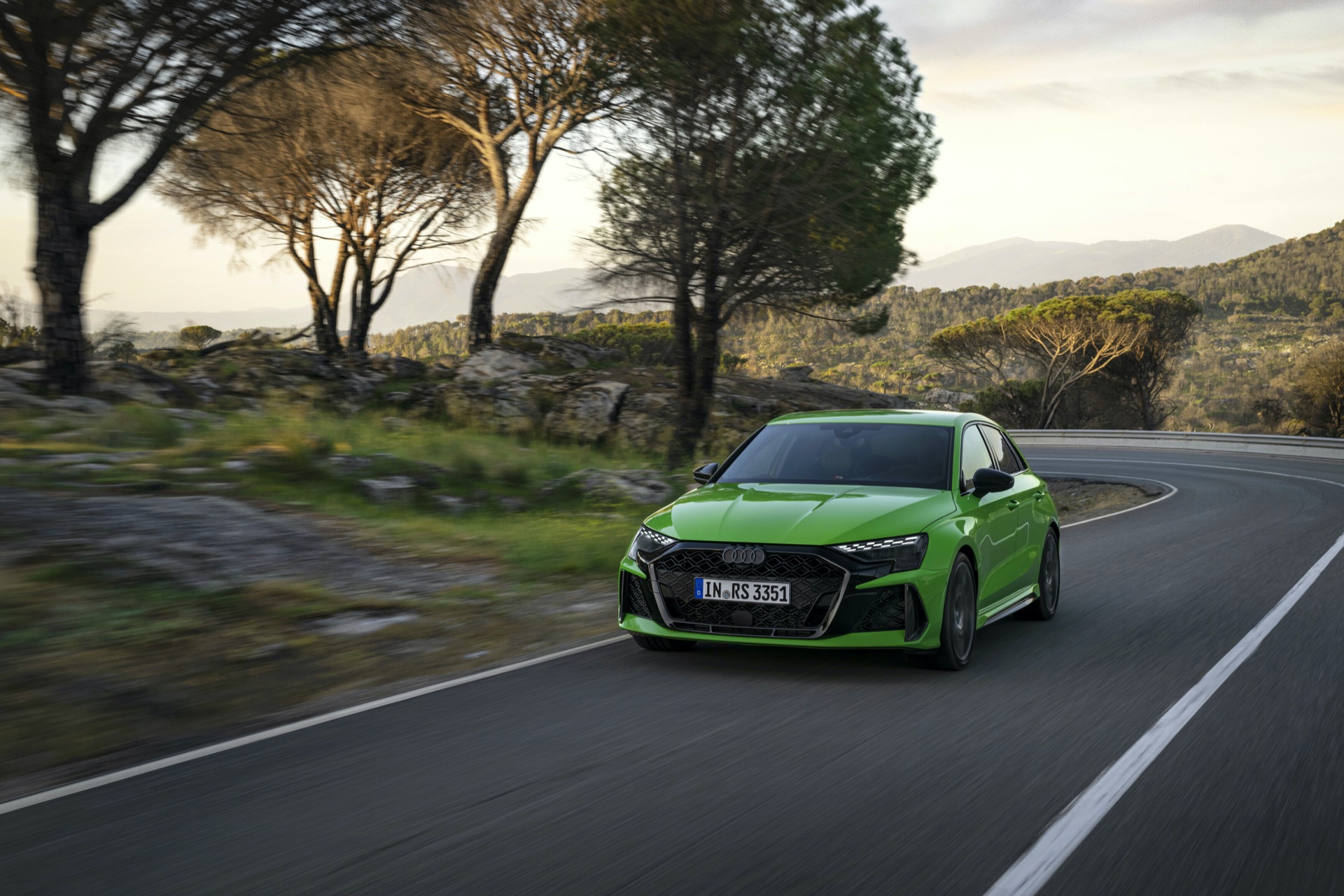
The A3 range update reaches its most sporting version, the RS 3, which keeps the 2.5 TFSI engine producing 400 CV unchanged, but receives chassis optimisation to become once again the King of the Nürburgring
That a car performs well on the Nürburgring circuit says a lot about its performance and dynamic behaviour. If we are talking about a car capable of setting a fastest lap record in its class, as the new Audi RS 3 has just done, then we are talking about something truly remarkable.
And that is what Audi has achieved with the update to the most sporting version of the new A3 family: shattering the previous record over the 20.8 km Eifel circuit in the compact car category, with a lap time of 7:33.123 minutes. Mind you, that is five seconds faster than the previous record, which belonged to the BMW M2. And almost 7 seconds faster than the time recorded by the previous RS 3.
That is no small feat, especially considering the new RS 3 shows no evolution under the bonnet, where the 5-cylinder 2.5 TFSI still roars, producing 294 kW (400 CV) and a peak torque of 500 Nm, which allows the RS 3 to reach a top speed of 290 km/h and accelerate from 0 to 100 km/h in 3.8 seconds. At Audi they have limited themselves to optimising the throttle flap control of the exhaust system at low revs so the exhaust sound is even more commanding, and little else.
Higher cornering speed thanks to chassis optimisation
Where the engineers in Ingolstadt have pulled out all the stops is in tuning the chassis, with one main objective: achieving higher cornering speeds and even greater agility in changes of direction.
To this end, the way the chassis control systems operate has been adjusted, from the torque splitter with torque vectoring on the rear axle to the stability control or the adaptive damping. According to Audi, a refined algorithm allows all these systems to interact more precisely, making the car even more agile, especially in the most sporty driving mode and with stability control switched off.
These adjustments also apply to the “drift” mode, which allows controlled slides, so that it is now easier to initiate oversteer through the steering wheel, rather than leaving all the work to the accelerator. Another key element in achieving the Nürburgring record, from which RS 3 customers will also benefit, is the new high-performance tyres fitted as standard, which provide greater lateral grip. Optionally, the Pirelli P Zero Trofeo R semi-slick tyres remain available in the catalogue.
An even more sporty interior
Otherwise, the Audi RS 3 receives the product update of the A3 range, with the styling and equipment details specific to the most sporty version. Highlights include Matrix LED headlights with a digital signature that reproduces a chequered flag, new wheel designs, the new Daytona grey body colour in matt finish, or the carbon and gloss black decorative packs for the air intakes, the skirts and the mirror housings.
Inside, the most striking features are the new RS bucket seats, although the steering wheel has also been changed to a version flattened at the top and bottom, which can be trimmed in leather or Dinamica microfibre. As in the rest of the A3 range, ambient lighting on the door panels arrives to give a very premium look, while the red or green design packs add a touch of colour to the seatbelts, the upper part of the seat backrests and the climate control air vents.
Available in Sportback and Sedan body styles, the RS 3 has a starting price for the Spanish market of 83,990 euros for the five-door, while the three-box variant carries a surcharge of 1,000 euros.
Audi RS 3 – Image gallery
Technical specifications of this car
 Kia offers an electric range of 10 models, 50 versions and 400 possible combinations
 The seven finalists for the 2027 European Car of the Year (COTY) are exclusively electric
 Peugeot E-208 GTi: a battery-powered toy that revives the spirit of the 1980s sports cars
Deja un comentario