BMW Serie 6 Sedans Sports Cars Photos Tests
BMW Series 6 Gran Coupe, road test (Engine and performance)
 Diego G. Moreira
12 March 2013
5 min.
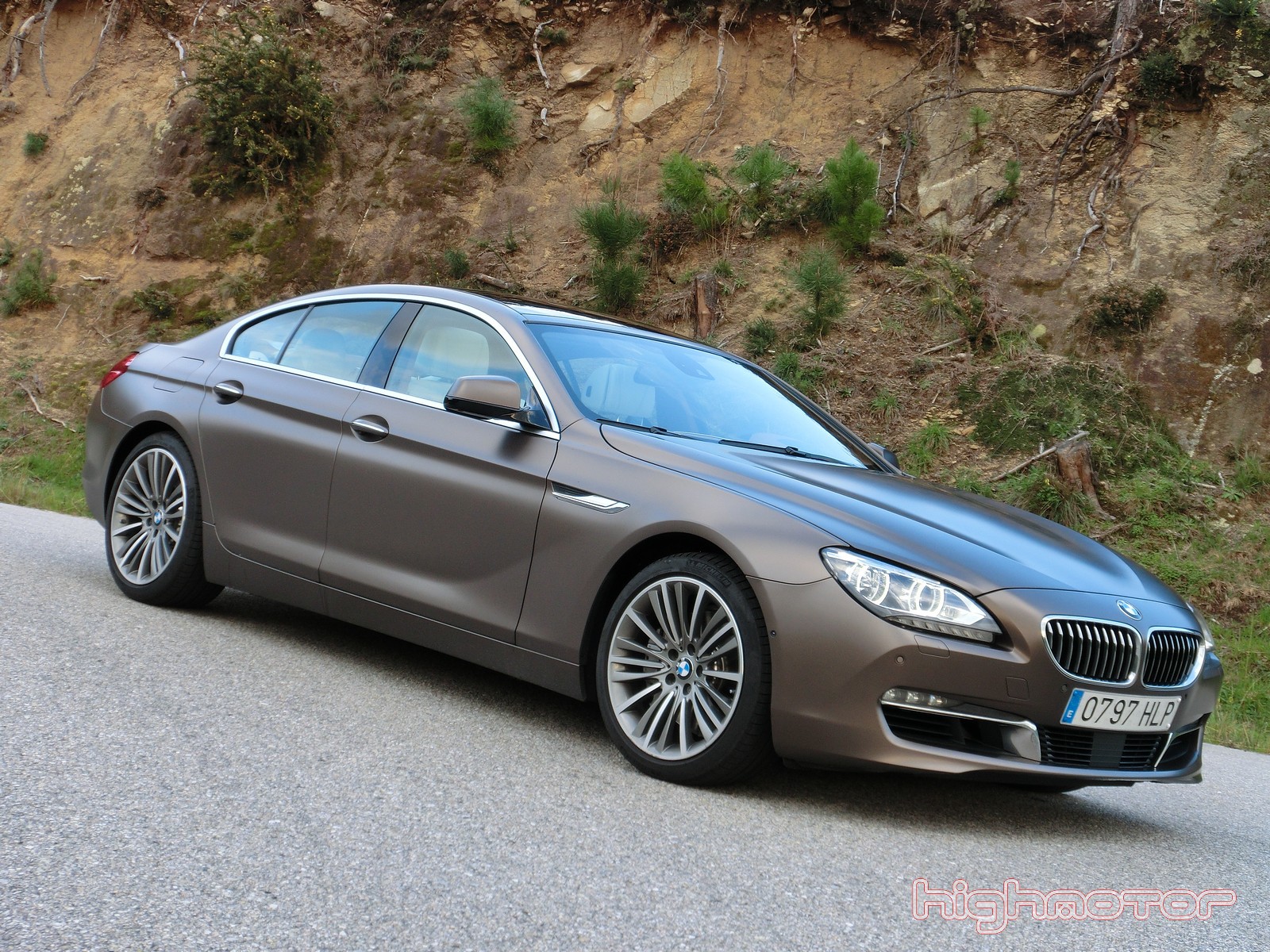
We kick off a new test on Highmotor with a very special car, whether for its design, its 320 CV petrol engine or its meticulously finished interior. We are talking about the new BMW 640i Gran Coupe in BMW Individual trim, the new rival to the well-known Audi A7 and Mercedes CLS (which we have already tested).
During the test the BMW Series 6 Gran Coupe drew plenty of attention, with a design that doesn’t go unnoticed and a roar when you press the accelerator that shows the horsepower hiding under the bonnet. Keep reading this test and we will tell you everything about the engine, performance and design, as well as the equipment, which includes features such as the night vision camera.
Engine and performance
Although the 640i designation might make you think the engine is a four-litre, nothing could be further from the truth: this designation covers a modern, latest-generation powerplant with 3.0 litres of displacement, six in-line cylinders, twin turbos and a final output of 320 CV (at 5,800 rpm). The most significant figure, however, is the torque, with 450 Nm between 1,300 and 4,500 rpm. It also comes with the Start&Stop system.
All these figures translate into a strong pull from low revs, which builds as we approach 3,000 rpm and becomes downright brutal from 5,500 rpm up to nearly 7,000 rpm.
In this last stretch the sound is similar to what a supercar can produce, making it more fun to switch off the radio and enjoy the sound of the engine with the powerful Bang & Olufsen audio system, which never becomes annoying.
Both petrol engines (the 640i and the 408 CV 650i) are paired with an eight-speed ZF automatic gearbox, which performs more than adequately, being quick when we opt for manual sequential shifting through its eight ratios (and it has a Sport mode that raises the revs further).
Normally on the road, if we don’t need much power, the Series 6 Gran Coupe stays below 2,000 rpm. This changes if we select Sport mode on the gearbox or in the car; it then sits around 2,500-3,000 rpm and the response to the accelerator is much quicker.
The car has five driving modes that affect throttle response, steering stiffness and suspension: ECO Pro, Comfort +, Comfort, Sport and Sport +. The first one works real miracles on consumption and gives several driving tips (reduce speed, lighter throttle, climate adjustments…); it also shows how many km you gain between each refuelling thanks to more efficient driving.
Comfort + increases suspension comfort, making it considerably softer. Sport mode firms up the steering and suspension, and also acts on the accelerator pedal, while Sport + switches off the electronic aids (at that point the five metres of the Series 6 Gran Coupe and its rear-wheel drive become very entertaining).
Handling
Despite everything we have described in the engine and performance section, the BMW 640i Gran Coupe cannot be defined as a sports car, it has good performance, but one must consider its 5 metres in length and its weight (1,825 kg).
On the road it is very composed and stable, and if we select Comfort + mode, interior comfort improves over poor surfaces; even so, the low-profile 19-inch wheels do not help much in this respect.
On twisty sections, such as a mountain pass, its agility is surprising for a car of this size, holding its line very well and responding outstandingly, but again I stress that we must always remember what car we are driving and that it is not a small sports car.
The steering remains as always impeccable, a true hallmark of BMW, and its direct, precise feel is appreciated. We also liked the brakes, of considerable dimensions (they barely fit inside the wheels), which stop the Series 6 with authority and confidence.
Fuel consumption
As for fuel consumption, when we collected the car in Madrid and had to drive the typical 600 km to Vigo, I must confess I was nervous. A twin-turbo petrol engine in a car of this type; I thought it would not drop below 12 litres over the whole journey.
But nothing could be further from the truth: I started the car and selected ECO Pro mode, and after roughly 200 km the average consumption display showed an optimistic 8.5 litres per 100 km, a figure that eventually rose to 8.8 litres over our motorway route.
On country roads it is hard to get it below 12 litres, but if we use ECO Pro mode and are careful with the accelerator, we can cruise at around 10.5 litres per 100 km. In town, neither ECO Pro mode nor anything else helps much: if you want to save money, it is better to use public transport. As one would expect, it is a large petrol car, and despite the Start&Stop system, the average was around 14 litres per 100 km (though I suppose buyers of this car will not be overly bothered by city consumption).
I insist on the ECO Pro mode, because it really was very useful for lowering consumption figures; in some road tests, the saving compared with normal driving was two litres per 100 km, and on the motorway the distance-gained indicator for eco driving reached 93 km (on a full tank) over a 600 km route.
In the second part of the test we will focus on the elegant, eye-catching and showy exterior design. We will also look at the interior’s spaciousness, finished in a blend of exclusivity and luxury that envelops its occupants.
Photos | Diego G. Moreira
Locations | El Espinar (Segovia), Baiona (Pontevedra), Urueña (Valladolid), Nigrán (Pontevedra)


 Peugeot E-208 GTi: a battery-powered toy that revives the spirit of the 1980s sports cars
 New Lexus ES: luxury grows and goes electric
 First contact with the Dacia Sandero Hybrid 155: power and efficiency from €19,890
Deja un comentario