Ford Fiesta 1.6i Sport 120 CV, road test (part II)
 Javi Vicente @javivicente
23 February 2010
5 min.
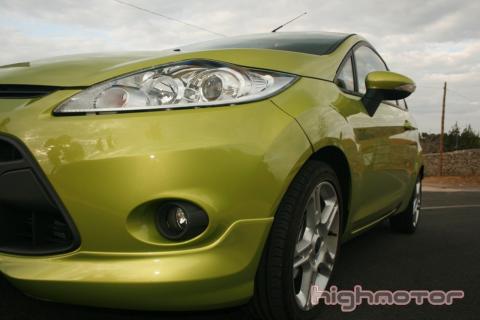
The Ford Fiesta is a striking car (let’s not deny it) and what stands out most is its range of colours. The test car is finished in Squeeze Green, so that it doesn’t go unnoticed, but its Hot Magenta shade with purple tones also surprises, and is also good for going incognito. Both colours are the most expensive, raising the price by 440 euros.
Its exterior look and well-defined lines are striking in their aggressiveness, with a very marked style that people either love or dislike, with no middle ground. Personally, I fall into the first camp for the 3-door version and the second for the 5-door. The sporty design at the rear, mainly the lower section and the spoiler, combines with its elongated front lights and the 5-spoke alloy wheels.
Exterior design
The first impression on seeing it is, to say the least, surprising. Beyond its shapes, the colours. An city car, derived from the compact segment, whose natural habitat is the city, narrow streets and small car parks where a estate would not fit. But let’s look at its design, the kind that turns heads when you round a corner or stop at a traffic light, especially in one of the colours mentioned earlier. It is not a car that reaches 4 metres in length (it stays right at the limit) and its width is 1.72 metres.
Seen from the front its large triangular headlights catch the eye, with room for any lighting unit; the foglights, however, sit in the bumper, beside that large mouth, with its plastic grille, commonly called the calandra, which lets air in to cool the engine. Elongated and running along the lower part, from one side to the other, is a piece that continues the bumper with even more aggressive shapes.
Although the 15-inch alloy wheels may not look a priori particularly sporty given their size, their 5 spokes and tyre profile, together with the overall car, are certainly eye-catching. On the downside, it has no side skirts or cut-outs in the bodywork, following a curve inwards that leaves it looking slightly cut short. The mirror with a turn signal, so fashionable lately, along with its mounting on the door, makes it different from the rest.
We move to the rear. This is what has changed most compared with the previous model, if anything from it has been kept. The plastic diffuser, mimicking several cells for air outflow, together with the large spoiler and the mid-height cut, is what stands out most in this area. The rear light clusters also form a triangle, with the fog lights placed low. The one-piece bumper also includes a piece on each side. It’s a pity that the exhausts are hidden, since a chrome tailpipe would suit it well.
The bodywork we haven’t tested (we haven’t had an accident or knocks to confirm it), but it appears somewhat fragile. It dents easily on the bonnet and above all in the areas where the rear doors should go. It doesn’t feel as rigid as the Mondeo or Kuga, both from the same brand. When the final price to the customer is reduced, costs are reduced too, and this may be the explanation. This is a simple impression, and as we will see in part three, it achieves 5 Euro NCAP stars, something the Chevrolet Spark or the Citroen C3 don’t manage.
Interior design
Inside, as it could not be otherwise, there is chrome finish on both the doors and the centre console, steering wheel included. That is why it has the Titanium trim. When we sat down, it’s not the best seat we’ve tried, but it is up to the standard of a compact car. The steering wheel is comfortable to the touch; you can feel the stitching on the inner areas, which I personally like. The quality is mediocre, and we can’t ask for much more.
The driving position and passenger space are pleasant; it’s never uncomfortable except on very long journeys, which can become tiresome and tiring. I don’t know whether it’s down to the test car, but I noticed that a section of the central tunnel (at the height of the right knee for the driver) got warm, regardless of whether cold or hot air was on. The symmetrical part, by contrast, did not.
The instrument cluster follows the same sporty line as the exterior design, with two well-differentiated dials and a more recessed central zone for the warning lights. The door handles are a hazard: they seem about to break off and leave you holding them. At least that didn’t happen to us.
If we move to the rear seats, we shouldn’t expect a grand lounge. They are rather small and tight for adults, although ideally they should carry children. Although it is approved for 5 adults, I didn’t even want to try it; those I put in the back would stop talking to me, since two people travel somewhat uncomfortably, especially if they are of average or larger build.
The boot can take up to 295 litres. The capacity is surprising, and it seems smaller than it really is until you see everything that has gone in. Even so, if we need more space, the seats can be folded down to reach a total capacity of around 1,000 litres.
As always, I missed a centre armrest (journeys aren’t the same without one), although the glovebox and storage compartments are plentiful, in the doors, on the dashboard and in the lower sections.
Photos | Javi Vicente


 The seven finalists for the 2027 European Car of the Year (COTY) are exclusively electric
 Peugeot E-208 GTi: a battery-powered toy that revives the spirit of the 1980s sports cars
 New Lexus ES: luxury grows and goes electric
Deja un comentario