Hyundai SUV range: crossovers for every taste and need
 Miguel Lorente
16 April 2020
5 min.
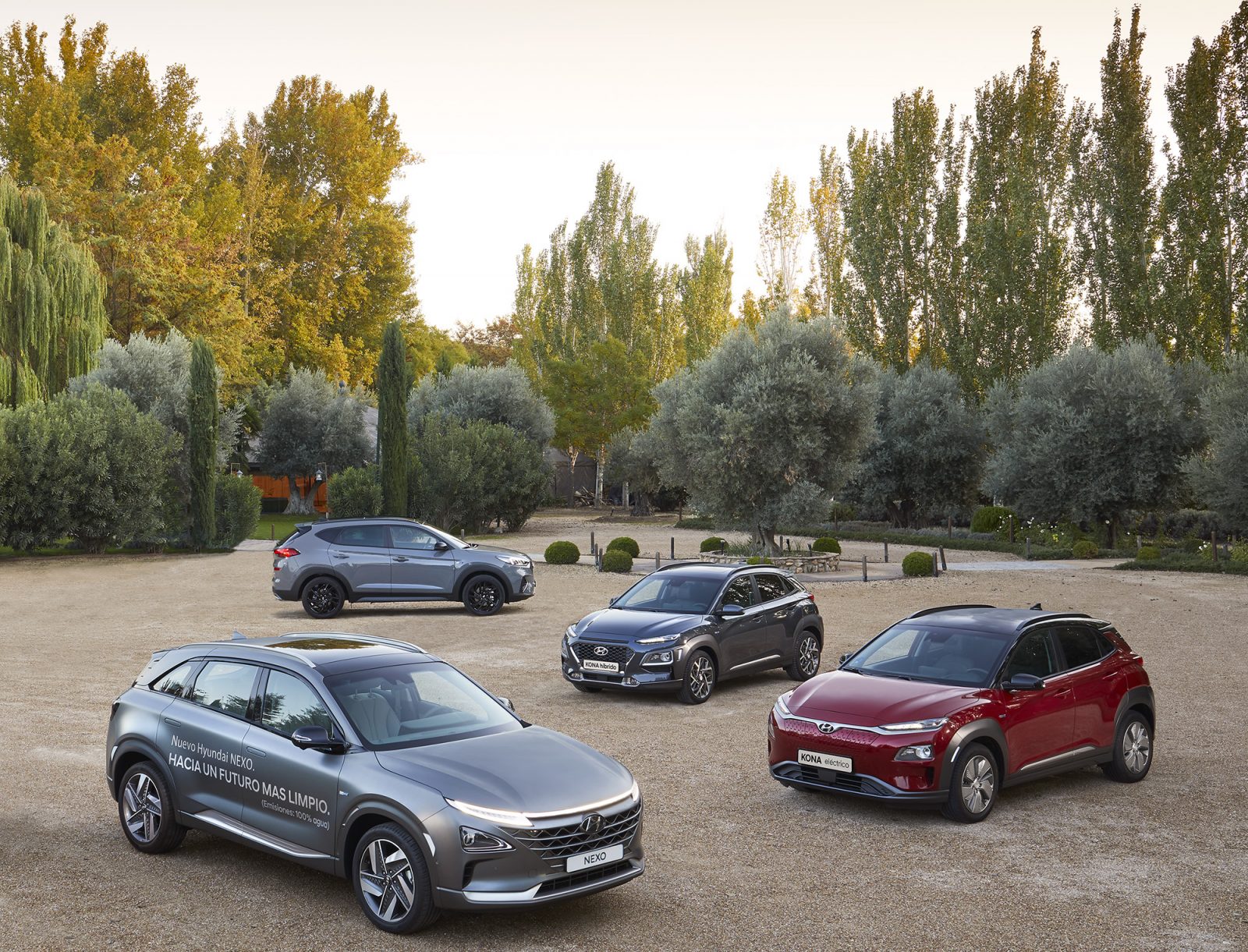
For every taste and need, the Hyundai SUV range offers a wide choice of powertrain configurations, both traditional and from the new electrified era.
Whatever technology you favour, whether you are more traditional or innovative, and whether or not you are concerned about using more efficient engines, the crossovers from the South Korean brand offer powertrain layouts that rely to a greater or lesser extent on electricity as either the main or secondary power source.
In this way, the Hyundai SUV range offers up to four electric technologies: hybrid, 48V mild hybrid, pure electric, and electric drive powered by a hydrogen fuel cell to generate energy, plus the two classic internal combustion options, petrol or diesel.
Taking into account the models closest to traditional off-roaders, the Korean manufacturer’s SUV range focuses on the i20 Active, Kona, Tucson, Santa Fe and Nexo to offer more than 60 variants and up to 16 different engines, 2WD or 4WD drive layouts (4×2 or 4×4), manual, automatic and dual-clutch gearboxes, not to mention the interior space of 5- to 7-seater models. The brand’s aim is to meet the needs of a public that demands the best hybrid or electric SUVs at competitive prices and good value for money.
Diesel or petrol
With regard to the dominant engines in motoring history, the Kona, Tucson and Santa Fe offer both diesel and petrol versions, while the smallest of the crossovers, the i20 Active, only needs a visit to the green-badged pump to fill its fuel tank.
For those who prefer petrol, the three-cylinder and four-cylinder engines range from 999 cubic centimetres up to 2,400, with outputs from 100 for the least powerful, the 1.0 T-GDI, up to 184 for the 2.4 GDI.
Thus, the Hyundai SUVs powered by diesel feature four-cylinder blocks ranging from 1,600 cc to 2,200 cc, with outputs from a modest 100 CV in the 1.6 CRDi up to 200 CV in the 2.2 CRDi, including the diesel engines with mild hybridisation linked to a 48 V system in the 1.6 CRDi and 2.0 CRDi blocks.
Hyundai’s electric and electrified SUVs
Hyundai has not only been one of the manufacturers that has most strongly committed to the new era of electrification, but has also become a standard-bearer for vehicles equipped with a hydrogen fuel cell.
So much so that the Hyundai Nexo is one of the few options sold in our country among these FCEVs. This car is a record-setter, as it has a range of 666 kilometres when it has fully consumed the hydrogen that supplies energy to the electric motor.
We are talking about a crossover whose power unit delivers 120 kW, equivalent to 163 CV and a formidable torque of 395 Nm, allowing it to reach a top speed of 179 km/h, specifications that are more than adequate for a car intended to be a versatile vehicle for everyday use.
Refuelling a car like this could match the refuelling time of a conventional fuel tank, as we explained in our article on matters relating to hydrogen refuelling for FCEVs published on our sister site DrivingEco.
Also electric, but linked to an energy accumulator, the Hyundai Kona Electric, a car that has already passed our evaluation, is sold in two configurations: either a 39.2 kWh battery, which allows a range of up to 289 km, powered by a motor producing 100 kW with consumption of 15 kWh/100 km, or a 64 kWh battery giving a maximum range of 449 km, linked to a 150 kW motor and consumption of 15.4 kWh per hundred kilometres.
A crucial aspect when using an electric car is the charging time required. The manufacturer estimates that 80% charge would take 54 minutes, provided the vehicle is plugged into a 100 kW fast-charging point. Using the 7.2 kW on-board charger, the time would rise to 9 hours and 40 minutes for the higher-capacity, longer-range versions, and 6 hours and 10 minutes for the smaller-battery versions.
As for cars that combine combustion engines and electric systems, hybrid cars, in the Hyundai SUV range, the Kona Hybrid is fitted with a direct-injection petrol engine, four cylinders, 1.6 GDI. This unit delivers a maximum output of 105 CV and 147 Nm of torque. The electric side, meanwhile, has a 1.56 kWh lithium-ion battery that sends power to a 32 kW motor, equivalent to 43.5 CV, with a maximum torque of 170 Nm. Together, the system produces 141 CV and a significant torque of up to 265 Nm.
For those seeking a more adventurous character, the Hyundai Tucson, a 48-volt hybrid, is a mild-hybrid SUV whose electric system reduces fuel consumption and, compared with the versions with combustion engines only, lowers CO2 emissions by around 7 per cent according to the manufacturer. It also adds up to 12 CV and 55 Nm of torque when it feeds its work into the crankshaft of the combustion engine.
This SUV, which looks spectacular in the Hyundai Tucson N Line configuration, is available in hybrid versions paired with the 2.0 CRDi diesel engine of 185 CV and the 1.6 CRDi, both carrying the DGT Eco label.


 Peugeot E-208 GTi: a battery-powered toy that revives the spirit of the 1980s sports cars
 New Lexus ES: luxury grows and goes electric
 First contact with the Dacia Sandero Hybrid 155: power and efficiency from €19,890
Comentarios cerrados