Jaguar XF 2.2D 190 CV, test drive (Engine and performance)
 Diego G. Moreira
28 March 2012
6 min.
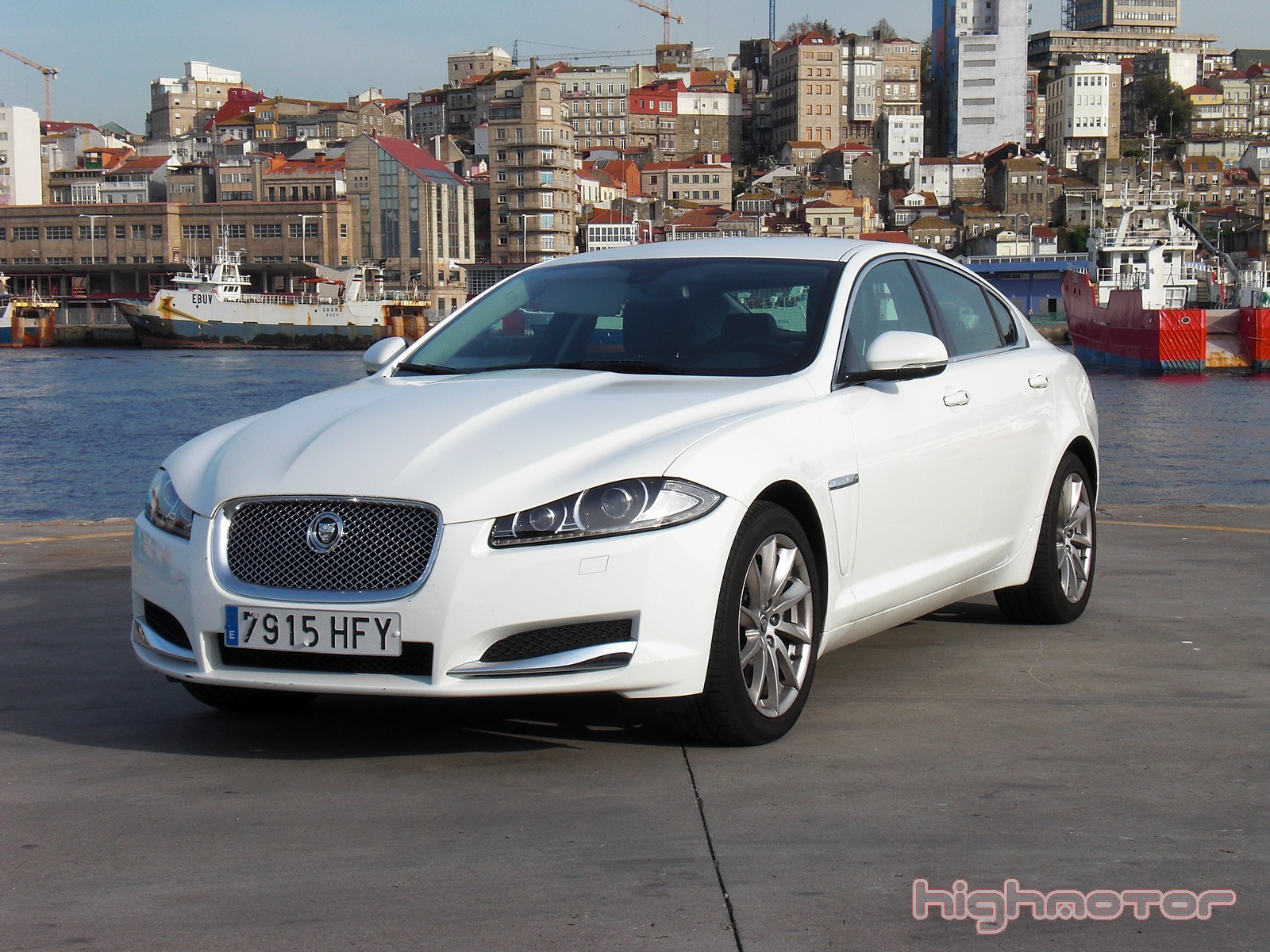
Are you looking for a premium saloon? If so, stay with us for this test of the Jaguar XF with a 190 CV diesel engine, because it is a very interesting vehicle capable of standing up to conventional premium brands with three arguments: quality finish, a different image and a competitive price.
When I talk about a competitive price, more specifically, the Jaguar XF with the 2.2D 190 CV diesel engine starts at 45,900 euros, with equipment that includes bi-xenon headlights, leather upholstery, a touchscreen, dual-zone air conditioning, 17-inch alloy wheels, among other features. This is possible thanks to the incorporation of the four-cylinder 190 CV diesel engine, achieving a more attractive and competitive starting price than the V6 diesel.
If power is what concerns you, after thoroughly testing the Jaguar XF with this four-cylinder engine, we can say without hesitation that the 190 CV it offers are more than sufficient. Without further ado, let’s begin the test of this feline with a personal, sporty and, above all, eye-catching design.
Engine and performance
As I mentioned earlier, until now the only diesel engine available for the XF was the 3.0 V6, an engine of PSA-Ford origin. And now many premium brands are starting to fit their four-cylinder engines to models in segments where only six- or eight-cylinder blocks could be found, in order to achieve a tighter price (and fuel consumption is also reduced).
In the case of Jaguar, the engine that debuts in this XF is of PSA origin (identical to the one fitted to the Peugeot 508 or Citroën C5). While it is true that, although it is the same block, we have noticed significant differences in behaviour and performance (we previously tested it in a Citroën C5). Another notable difference is the traction: in the case of the English feline, the 190 CV go directly to the rear axle.
It seems the engineers at the British firm wanted to give the engine a sporty touch, forgetting about consumption, but with one premise: when you press the accelerator, the car responds with all its strength.
The response is emphatic from 2,500 rpm up to 4,000 rpm. making the XF literally press you into your seat (something we did not notice as clearly in the PSA models). As a result we have an engine with a narrow power band (from 2,500 to 4,000 rpm) but which delivers with decisiveness and force, moving the XF’s more than 1,700 kg without problems.
Associated with this engine (and as standard) comes an eight-speed ZF automatic gearbox. Jaguar and Land Rover were among the first brands to incorporate eight-speed transmissions, which later reached other premium-brand models. The gearbox features paddles for sequential shifting and, besides the Sport mode, which keeps the car above 3,000 rpm so that when we press the accelerator, the response is even more immediate.
Finally, we must not forget the Start&Stop system fitted as standard with this engine. It works quickly and correctly, but there is one small gap where it can be bothersome. Being automatic, the engine switches off as soon as we stop at a traffic light, but it also switches off when we stop to park, for example. When we select reverse it restarts quickly, but even so that speed in switching off is annoying when parking or manoeuvring. That said, the solution is at our fingertips: a single button disconnects the system.
Handling
Within the handling section one detail surprised us: its dimensions and its ability to literally stick to the road. On one hand we have a suspension setup that is soft and aims above all at the comfort of the occupants, something which, combined with good interior soundproofing, makes travelling in the Jaguar XF a true luxury.
But that comfort does not worsen or interfere with outstanding road behaviour, it has a very rigid chassis that grips the road and responds immediately and stably to steering inputs. Despite its dimensions (almost five metres) and its weight (close to 1,800 kg), we took it onto a winding road to test its response and were pleasantly surprised by what we saw.
It tackles each bend and change in gradient with outstanding stability, while never giving the feeling of being at the wheel of a saloon of this size when driving on a mountain road.
In short, the engineers at Jaguar have done an impeccable job, combining on one hand the comfort of the suspension (ideal for those who cover many kilometres a year) with, on the other hand, a sporty response for those of us who want an effective car on the road.
On the other hand, the steering featured variable ratio according to speed and a correct feel, without being excessively soft. The steering column has electric adjustment as standard, both for reach and for rake.
The braking system was also up to the nearly 200 CV of the diesel engine; that said, we have driven vehicles with much more effective brakes. Even so, the above does not detract from a more than adequate performance.
Consumption
At the start of the test I mentioned that the tuning of the Jaguar XF has been set with a single criterion: response. This penalises consumption, but in return we get a much quicker and more effective response than the PSA models fitted with this same diesel engine in its more powerful 204 CV version.
On the motorway the consumption is very tight, with just 5.6 litres per 100 km, a very good figure for a 190 CV saloon. When we move onto country roads the figures are no longer as good, since over our usual route on country roads we achieved an average consumption of 6.3-6.5 litres per 100 km.
In practice, with mixed driving between town and surroundings, being careful with the accelerator, we can hover around 7.5 litres per 100 km. In town is where it rises the most, up to 10.5 litres per 100 km.
In the second part of the test we will talk about the exterior design, the interior space and the quality of the finish (of the highest level) present in this Jaguar XF.
Photos | David Taboada and test team
Technical specifications of this car


 Peugeot E-208 GTi: a battery-powered toy that revives the spirit of the 1980s sports cars
 New Lexus ES: luxury grows and goes electric
 First contact with the Dacia Sandero Hybrid 155: power and efficiency from €19,890
2 comentarios
Deja un comentario
Un gran coche desde luego, fuera de la uniformidad alemana.
La prueba es en Galicia a que sí??? Son inconfundibles sus eucaliptos…. Donde es la última foto?
Si que es Galicia. La última foto es cerca de Toralla, en Vigo. El puerto de Canido para ser más exactos.