EV4 KIA Model 3 Tesla Sedans Electric Cars Compact Comparisons
KIA EV4 vs Tesla Model 3: electric compact showdown under €45,000
 Iván Navarro
1 September 2026
6 min.
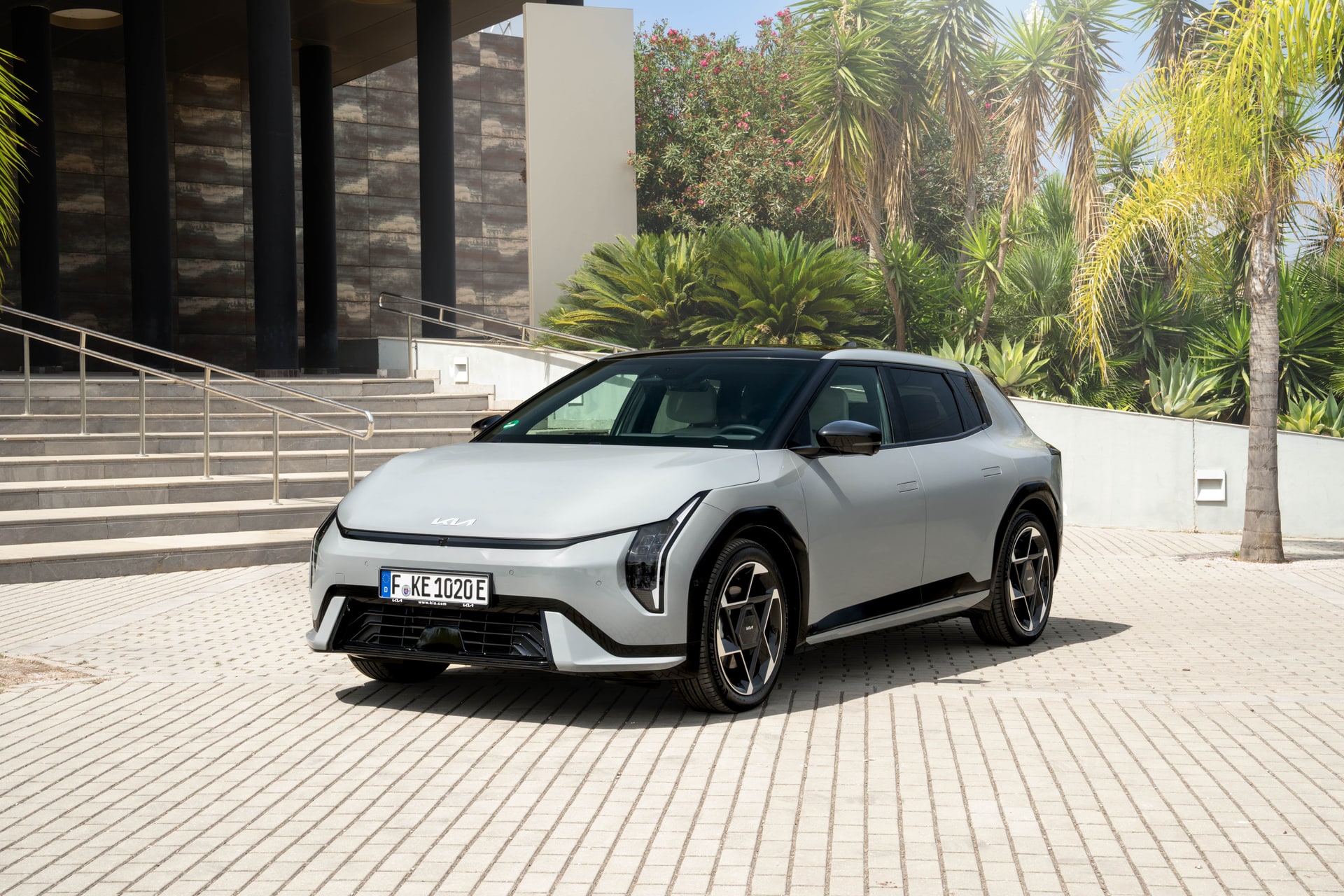
We compare the KIA EV4 and the Tesla Model 3 as benchmarks of the electric compact under €45,000 in Spain: range, charging, technology and value for money.
The electric compact segment under €45,000 has stopped being an experiment and become the arena where the big game is played. This is where the Spanish buyer considering the switch to plug-in power does the real math. And this is where the KIA EV4 and the Tesla Model 3 face off: two compact saloons with contained dimensions, two radically different philosophies, starting prices less than two thousand euros apart.
From the initial list of candidates we ruled out two names that, on paper, could have made it. The BYD is out because the goal of this guide is not to crown a universal winner, but to contrast two clear references in the segment; widening the focus would dilute the analysis. And the Nissan, in our view, carries in its current range a proposition that has fallen a step behind the expectations set today for range, fast charging and digital experience — an illustrious legacy, yes, but insufficient for this particular duel.
A note before continuing: the prices shown throughout the article are the manufacturer’s recommended retail prices (RRP), without dealer discounts, one-off campaigns or aid from the Plan Auto+, whose current amount should be checked on the official website.
Why this comparison matters in 2026
Electric compacts under €45,000 are today the heart of the Spanish market. They are not cars for purist enthusiasts nor the whim of a second urban vehicle. They are the first realistic option for a family with a garage space, a professional who drives long distances and wants to spend less on refuelling, or a mixed-use driver who needs city driving during the week and occasional trips at the weekend.
There, KIA and Tesla arrive with two mature products. One comes from the manufacturer that has best understood the European transition. The other comes from the one that redefined the concept of the electric car. Comparing them is, in practice, comparing two ways of understanding what an electric compact should be today.
KIA EV4: the rational European bet — from €38,715
The KIA EV4 arrives in Spain with a proposition that feels carefully studied. The Standard Range version fits a battery of around 58.3 usable kWh and delivers 204 CV in its entry configuration, with a homologated range of close to 440 kilometres. It is not the most impressive figure in the segment, but it is calibrated for real-world use without drama.
The design divides opinion — that sharp rear, those taut volumes, leave no one indifferent. In my view, it is a brave exercise in a segment where nearly everyone copies one another. The interior, by contrast, plays it safe: dual screens, impeccable ergonomics, physical controls where they should be. KIA has learned from its own digital excesses.
| Power kW | Power CV | Top speed | Range | Consumption | Label | Fuel |
|---|---|---|---|---|---|---|
| 150 kW | 204 CV | ≈170 km/h | ≈440 km | ≈14.7 kWh/100 km | ZERO | Electric |
Tesla Model 3: the heavyweight of the segment — from €36,990
The Tesla Model 3 in its entry version, with a battery of around 60 kWh and rear-wheel drive, delivers 283 CV and is homologated for 572 km. On paper, it is more powerful, more autonomous and slightly cheaper at the starting price than its Korean rival. The numbers speak for themselves.
What the Model 3 offers goes beyond the spec sheet. There is the ecosystem — the Supercharger network remains the reference for any long journey in Spain — and there is a software platform that updates like a phone. That said, the minimalist interior taken to the extreme is not to everyone’s taste: no instrument cluster, everything entrusted to the central screen, and a perceived quality that, to be honest, is not always up to the price.
| Power kW | Power CV | Top speed | Consumption | Label | Fuel | |
|---|---|---|---|---|---|---|
| 208 kW | 283 CV | 201 km/h | 572 km | ≈13.0 kWh/100 km** | ZERO | Electric |
Real-world range and consumption: where the game is decided
In WLTP homologation, the Model 3 clearly wins: some 132 kilometres more than the EV4 with a battery only slightly larger. That superior efficiency — the fruit of years of aerodynamic and drivetrain refinement — is probably the biggest technical argument for Tesla in this comparison.
In real mixed use, the margin narrows but does not disappear. A reasonably charged EV4 offers a practical range of around 350–380 km; the Model 3, under the same conditions, tends to stay above 450 km. For daily journeys of under 100 km, the difference is irrelevant. For 500 km trips with a single stop, it starts to show.
Fast charging and ecosystem: Tesla’s ace in the hole
Here is the great differentiator. The Supercharger network, with competitive pricing and enviable density along main corridors, remains the benchmark. KIA responds with an efficient 400 V architecture and universal compatibility on Spain’s public network — something we already saw with other electric compacts with DC fast charging in the segment — but Tesla’s integrated travel experience still plays in another league.
Technology and onboard experience: two opposing philosophies
The EV4 is a European car in its digital conception: large screens, yes, but physical controls for climate and quick access. Android Auto and Apple CarPlay as standard, wireless charger, head-up display available. The Model 3 is the antithesis — everything on the central screen, no CarPlay or Android Auto, betting on its own ecosystem. Is it worse? It depends on the user. For those who already live in the Tesla world, the integration is superb. For those coming from another manufacturer, there is a learning curve.
Value for money and recommendation by profile
Starting prices are separated by a little over €1,500, in the Model 3’s favour. But comparing only the base RRP is misleading: the EV4 in its Air trim already includes equipment that on the Model 3 is paid for separately. The final tally, with equivalent options, tends to level out — or even tilt in favour of the Korean car.
Summary table and editorial score
| Model | Power | Range | Price from | Range | Charging/Network | Technology | Value for money | Overall |
|---|---|---|---|---|---|---|---|---|
| KIA EV4 | 204 CV | ≈440 km | €38,715 | 7.5 | 7.5 | 8.5 | 8.5 | 8.0 |
| Tesla Model 3 | 283 CV | 572 km | €36,990 | 9.0 | 9.5 | 8.0 | 8.5 | 8.7 |
Frequently asked questions
Which model has more real-world range, the KIA EV4 or the Tesla Model 3?
The Tesla Model 3 is homologated for 572 km versus the ≈440 km of the KIA EV4. In real mixed use, the margin holds: the Model 3 offers between 40 and 70 km more practical range.
Which is cheaper once equipment is matched?
The Model 3 starts at a slightly lower RRP (€36,990 versus €38,715), but the EV4 in its Air trim includes items such as Android Auto, Apple CarPlay or some ADAS that on Tesla usually require higher configurations. The matched comparison tends to end up very close.
Is the KIA EV4 compatible with the Supercharger network?
Yes, both models are compatible with the Supercharger network in Spain thanks to Tesla opening its network to vehicles from other brands via the CCS Combo 2 connector.
Which should I choose based on my usage profile?
For frequent long journeys, advanced driving technology and maximum range, the Model 3 is the most rational choice. For those who prioritise an interior with physical controls, CarPlay/Android Auto integration and European styling with the KIA service network, the EV4 is the more logical companion.
Technical specifications of the cars in this article

 Peugeot E-208 GTi: a battery-powered toy that revives the spirit of the 1980s sports cars
 New Lexus ES: luxury grows and goes electric
 First contact with the Dacia Sandero Hybrid 155: power and efficiency from €19,890
Deja un comentario