Opel Sedans Eventos Photos Salón de Londres
London Motor Show 2008: Opel Insignia, in detail
 Eduardo Mariz
25 July 2008
7 min.
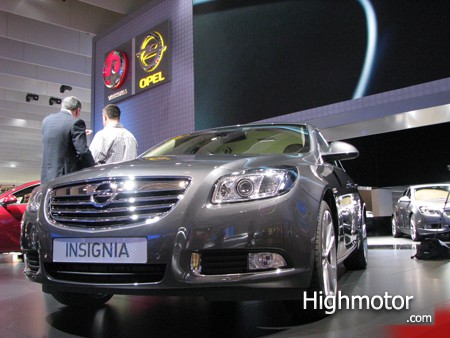
After the press conference, it was time to pull out cameras, notepads and a critical eye and dive in. The Insignia is the model of change. We knew that from the day the first photos started to appear, but it is not just the press saying it: the brand defends it that way and with real conviction.
But they don’t just want it to be a benchmark for themselves; they also want it to be one for the mid-size segment. They say they are proud to have fitted an elegant and sporty design into a saloon that increases and improves interior space compared to its predecessor, and they have done so at an affordable price.
We share their view, although not everything that glitters is gold. The Insignia is offered in two body styles – 5 and 4 doors – although an estate will be unveiled in mid-2009. Both share the same overall length (4,830 mm) and wheelbase (2,737 mm).
The elegant, sinuous and sporty design we were talking about gives it an aerodynamic drag coefficient of 0.27 Cx, one of the best figures in the segment. This is not only proof of the good design of the bodywork, but also a factor to consider when it comes to efficiency.
Combining sculptural art with German precision.
That is how Mark Adams, Vice President of Design at GM Europe, defines it. He adds that its shapes are fluid and are accentuated by eye-catching joining lines. These lines, which in a discreetly angular form create gradual shadows across the whole bodywork, produce different shades of colour over a single paint finish at first glance.
Accented by a new logo of Opel on the grille (there is also a new one for Vauxhall), it should also be said that this design was the work of GM Europe’s Design Centre, opened barely two years ago, which has the latest technologies for this purpose.
The engines are also an important part of the Insignia. All of them meet the Euro 5 emissions standard, something they are proud of and which, in today’s climate, is well regarded by consumers who save on vehicle taxes for pollution in some countries.
These engines are four petrol units with outputs ranging from 115 to 260 CV, and three new 2-litre turbo diesel engines: 110, 130 and 160 CV. More powerful units will arrive later, along with an ecoFLEX version that will reduce CO2 emissions.
All these engines are paired with six-speed gearboxes, a plus since they make it possible to get more out of the engine and save fuel. These gearboxes may be automatic on the most powerful versions.
On the all-wheel-drive versions, petrol engines 2.0 Turbo with 220 CV (closely linked to the Opel GT) and 2.8 V6 Turbo with 260 CV can also be specified; the diesels will arrive later. Incidentally, all-wheel drive is not without novelty either, as the new Adaptive 4X4 is introduced for it. This new traction system increases grip on slippery surfaces through electronic control: the Haldex hydraulic rear differential continuously adjusts and optimises torque distribution between the front and rear axles.
Another novelty in the Insignia is the chassis, called FlexRide. It allows you to choose between a more comfortable mode and a sportier one at the touch of a button, affecting the response of the accelerator pedal, ESP, steering, the all-wheel-drive traction setting where necessary, the AFL cornering light function (see below) and the gear-shift point of the automatic transmission.
One area they spent a lot of time on at the earlier press conference was the Adaptive Lighting System (Adaptive Forward Lighting – AFL). It is fitted to the bi-xenon headlamps and automatically adjusts the light beam distribution to the road profile and current conditions. It has nine light settings: city light, pedestrian area light, secondary road light, motorway light, adverse weather light, static cornering light, dynamic cornering light and daytime running lights.
Incidentally, those daytime running lights are, naturally, Audi-style LED diodes. The trend is in crescendo.
Continuing with active safety, the new Insignia introduces the Opel Eye system. This very innovative system can identify road signs through a front-mounted camera and show the information on the instrument panel for the driver. Alongside it there is also a lane change warning system.
For winter days when dirt sticks firmly to the windscreen, the Insignia has the “Hot Shot” system. It heats the windscreen washer fluid to help clear dirt more effectively.
The interior, for its part, is one of the areas that has received the most attention in the new model. Not only in terms of design appearance, but also in its use and interior space. It features the curved, stylised lines of the exterior. Lines that wrap around, creating a perfect, imperceptible symmetry that also vindicates the good name of Opel from the inside (personally, I have never found it to be a brand that has managed to produce good interiors).
John Pusker, Director of Interiors at General Motors Europe, explains all this very well. These enveloping lines give strength and move between colours, creating shadows that scale different shades – something similar to what happens on the exterior.
Every element is given its own place and a special presence, just the right and necessary amount through sculptural forms and floating parts. The priority was to be basic in design, following one direction and unifying the parts.
Comfort is achieved through ergonomics, buttons with direct access (incidentally, there are no useless buttons even on the basic versions with less equipment) and taking care of the details. For example, the door handles and nearby materials are designed to accommodate the movement and touch of the hand as it passes.
It is also striking that there are some duplicated controls: for example, the multimedia system can be operated from the steering wheel, the lower part of the centre console or the central section. Why? Because everyone has their own habits, habits sometimes acquired with earlier cars, which the customer has no reason to change when buying a new one.
The seats have a deeply studied design: they are large and comfortably accommodate people of almost any height. In some versions, the front part of the seat cushion is even extendable for those with long legs.
My personal opinion, after getting into two different versions with different equipment and luxury levels, is fairly good. The car is genuinely comfortable, although its keen price, one of the pillars on which it hopes to build its success, also costs it the use of many plastics and trim that are not particularly good or pleasant.
Nevertheless, I see it as one of the strongest in the segment at present. Of course, with competitors like the Mondeo/Mazda 6, C5 or Laguna, it needed it. It will reach the market at the end of the year in Germany with a starting price of 22,700 euros.
Note: The last four photos belong to the electric concept E-Flex, also on display at the stand.
Photos | Highmotor


 Peugeot E-208 GTi: a battery-powered toy that revives the spirit of the 1980s sports cars
 New Lexus ES: luxury grows and goes electric
 First contact with the Dacia Sandero Hybrid 155: power and efficiency from €19,890
Deja un comentario