Mercedes-Benz completes winter testing of its eActros 600 electric truck
 Javier Cantagalli
26 February 2025
3 min.
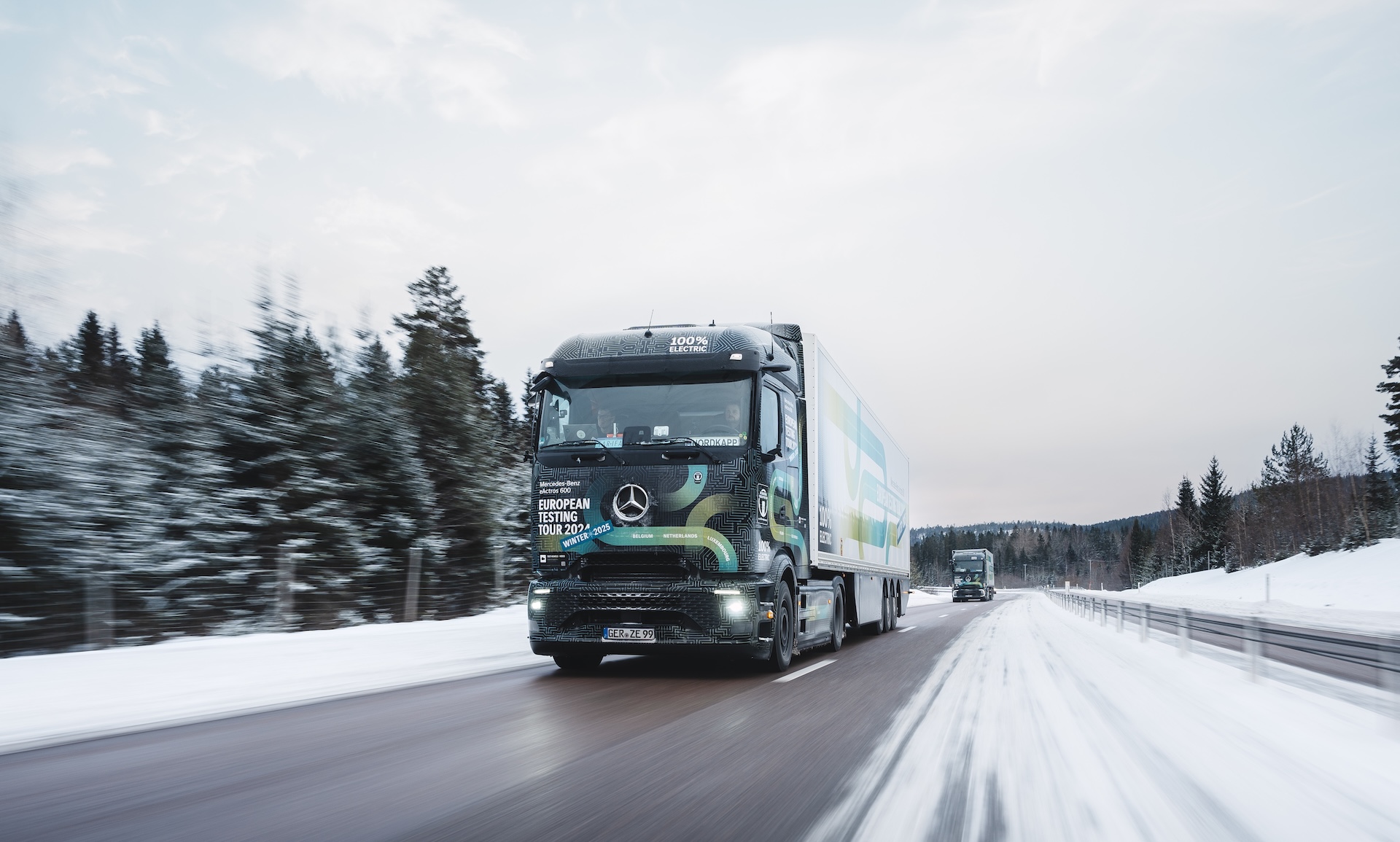
Mercedes-Benz concludes that, although the eActros 600’s energy consumption in winter can increase significantly, its range remains more than sufficient to complete a shift.
The German manufacturer began production of its electric long-haul freight truck, the eActros 600, last November. However, that has not stopped it from carrying out performance tests aimed at gathering valuable information to improve certain technical aspects.
At the beginning of 2025, and over a period of two months, the company decided to send two units of the eActros 600 on a journey through Scandinavia that would take them over 6,500 km. The project was called European Testing Tour 2025. This route, now completed, spanned ten countries in northern Europe with the aim of analysing the effect of extreme weather conditions, with sub-zero temperatures, on the eActros 600’s energy consumption.
Unlike the performance tests carried out in summer 2024, in places as different as Nordkapp in Norway or Tarifa in Spain, this time the two eActros 600 units had to face temperatures as low as 18 degrees below zero, travelling at average daily speeds of between 64 and 77 km/h.
How do low temperatures affect the eActros 600’s energy consumption?
Although the German manufacturer has not wanted to reveal exact consumption figures, it has shown the difference in results obtained on identical sections driven in summer and in winter. For example, Mercedes-Benz explains that at minus 2 degrees and with class B tyres on dry roads, consumption rose by 25 percent compared with identical conditions in summer, when class A tyres were used. The greatest increase was due to rolling and air resistance, at 15 percent, while cabin heating at 21 degrees accounted for an additional 5 percent, and battery temperature management and other auxiliary systems less than one percent each. Finally, the remaining percentage needed to reach that 25 percent was explained by the company as due to reduced energy recovery, affected by winter conditions.
On more demanding routes, with snow and ice, and using class D winter tyres, consumption increased by 50 percent. A surprising figure that is explained by the fact that these tyres, although suitable for winter, substantially increase rolling resistance. By contrast, the impact of heating and auxiliary systems barely changed.
Range is not a problem
Thus, and bearing in mind that in summer, on a mountainous section, consumption reached 106 kWh per 100 km, in winter it could rise to as much as 159 kWh per 100 km. The eActros 600’s range would therefore be, under these complicated weather conditions, between 390 and 470 kilometres. According to Mercedes-Benz, this is more than enough for the maximum of four hours of driving permitted before a stop where the battery can be recharged.
The route covered in these winter tests started in Germany and passed through Denmark, Sweden, Finland (up to the Arctic Circle), Estonia, Latvia, Lithuania, Poland, the Czech Republic and Austria, before returning to Wörth, where Mercedes-Benz’s production plant is located.


 Peugeot E-208 GTi: a battery-powered toy that revives the spirit of the 1980s sports cars
 New Lexus ES: luxury grows and goes electric
 First contact with the Dacia Sandero Hybrid 155: power and efficiency from €19,890
Deja un comentario