Parents of young drivers are in favour of graduated driving licences and black box technology
 Francisco Javier
12 November 2014
4 min.
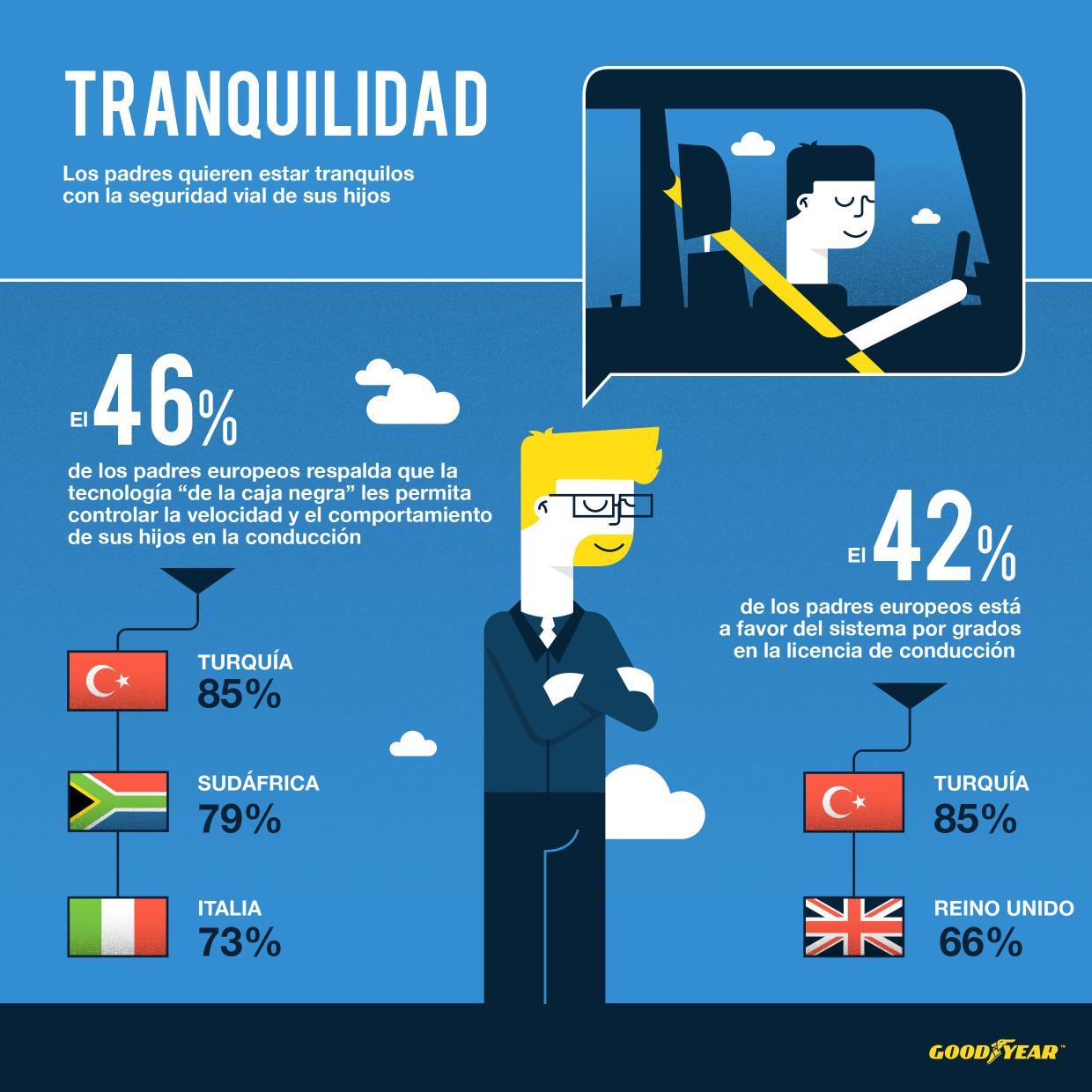
A study carried out by Goodyear in Europe, the Middle East and Africa with more than 6,800 parents from 19 countries whose children are aged between 16 and 25, reveals that parents of novice drivers would agree to the integration of black box technology to monitor their children’s behaviour behind the wheel, and also to the graduated driving licence.
In Spain, 44% of parents advocate black box technology, a percentage similar to that found in the rest of Europe, at 46%. Within the EU, the countries showing the greatest support are Italy (73%), Poland (72%) and Romania (72%). Outside the EU, the highest backing was found in Turkey (85%) and South Africa (79%).
Monitoring in the vehicle itself can significantly reduce risky behaviour, in this case of young drivers, although it can be extrapolated to all other drivers. The study also concludes that novice drivers are more likely to drive more cautiously if they know their parents are keeping an eye on them. 57% of Spanish parents believe that this technology would improve their children’s behaviour behind the wheel.
Many European insurance companies are developing insurance policies based on black box reports. These show how a person drives, and some insurers adjust their premiums according to the level of driving safety. They may even cancel the policy if they consider the driver to be too “unsafe”.
The Goodyear study not only shows that Spanish parents would like to keep an eye on novice drivers, it also demonstrates their intention to actively get involved in their children’s learning, with results even above the European average. 62% expressed the desire to receive regular reports on their child’s progress at driving school from the instructor, compared with 53% in the EU. In addition, 44% of Spanish parents would like to attend lessons as a passenger, compared with 40% of European parents.
Another initiative that has received broad support from parents is the graduated driving licence. It is a measure aimed at improving road safety. It is designed so that, over time, new drivers gain experience and skills in low-risk environments.
The graduated licence restricts, in the early stages, for example, the number of passengers, night driving, motorway driving or driving unsupervised. As time passes and tests are passed, the restrictions are gradually lifted until the full driving licence is finally obtained.
Parents of novice drivers in Spain are in favour of a graduated licence system at 43%, while in the EU 42% of parents of novice drivers are in favour. Opinions are divided in some countries, the United Kingdom (66%), Sweden (15%) and Turkey (85%), and this is explained by the fact that different systems are applied.
Both initiatives may create controversy and will generate differing opinions depending on which group is asked. Parents and children will have different views, since to some extent black box technology infringes privacy, although there will also be novice drivers who view the measure favourably.
In 2012, Goodyear commissioned a survey carried out across Europe with more than 6,400 young drivers to study their attitudes towards road safety. In 2013, the company commissioned another study, this time on the opinions of driving school instructors.
This study on the opinion of parents of novice drivers is based on previous studies relating to young drivers and road safety. The psychologists at Traffic Psychology International helped develop the questionnaire and contributed their expert opinion to the study. The European Parents’ Association also contributed its experience. The new edition of the Goodyear White Paper on Road Safety can be downloaded at www.goodyear.eu.
Source | Goodyear


 Kia offers an electric range of 10 models, 50 versions and 400 possible combinations
 The seven finalists for the 2027 European Car of the Year (COTY) are exclusively electric
 Peugeot E-208 GTi: a battery-powered toy that revives the spirit of the 1980s sports cars
Deja un comentario