Peugeot 308 1.2 Puretech 130 Allure, test drive and review
 Daniel Valdivielso @valdi92
17 August 2015
11 min.
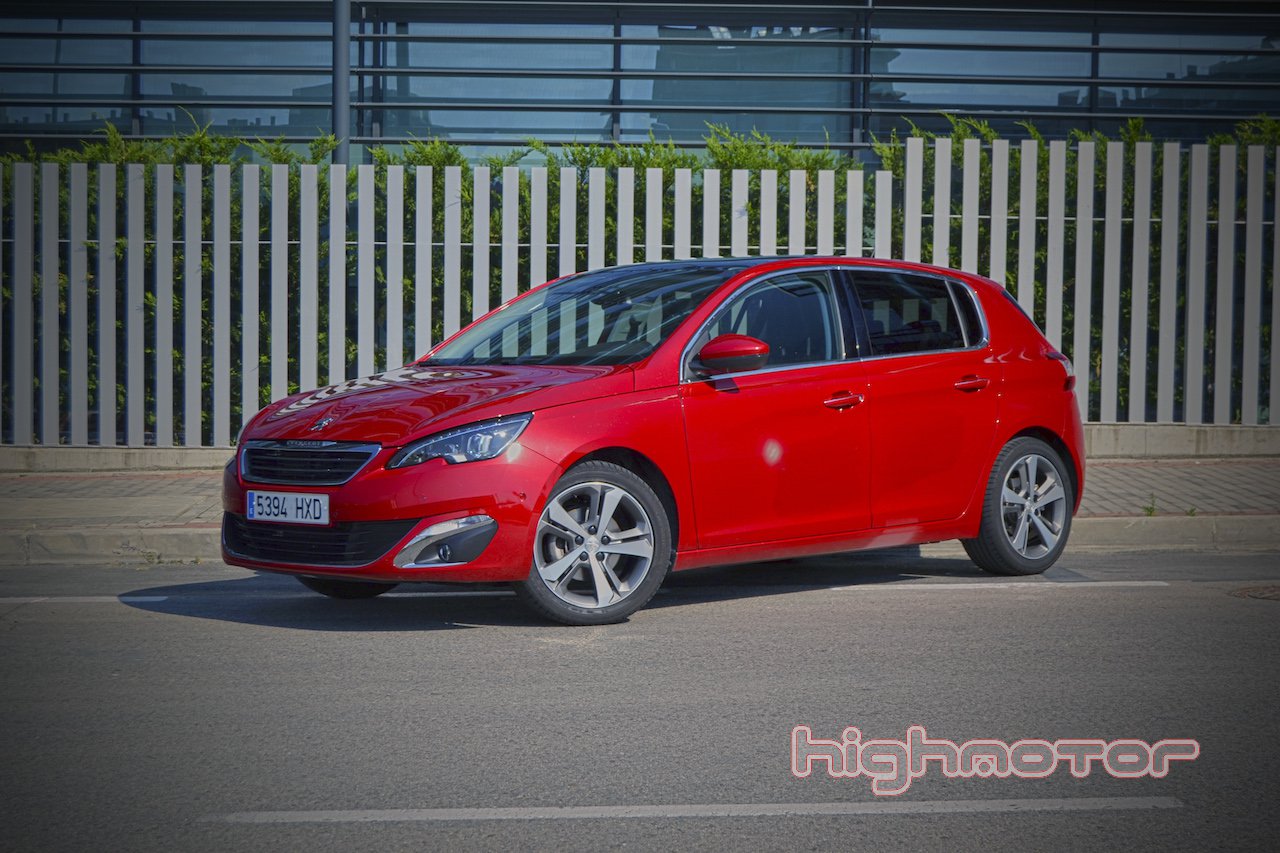
In our regular test section, this week we bring you one of the most popular models on the Spanish market.
It is the Peugeot 308, which in its current generation has made a great leap in quality, both in image and in build quality.
Exterior design
Our test unit features a 1.2 PureTech petrol engine, which we will cover in detail later. For now, it is time to focus on the design of the new 308. Although we already had the chance to try it in its basic 1.2 PureTech 82 CV version, this unit features the highest trim level, called Allure.
It stands out from the more basic versions thanks to elements such as the 17-inch alloy wheels in a two-tone finish, as well as front headlights with Full LED technology that integrate the daytime running light strip, something that sets it apart from the basic versions, which place them at the bottom of the bumper.
The chrome elements can be found on the grille slats, as well as on the lower part of the bumper, in the position of the indicator lights. The fog lights are also located low down, at the ends of the front end, which gives it a pleasant sense of width.
The side of the 308 has also changed substantially compared with its predecessor. It is now much more compact, with no major rises in its lines. The alloy wheels, as we have mentioned, are 17 inches, although 18-inch wheels can be fitted as an option.
At the rear we find straighter, squarer lines. Without doubt, the difference is remarkable. We have moved from lines more typical of a compact MPV to a fully-fledged hatchback. The rear light clusters also feature LED technology for the position lights.
The rear window is relatively small, something that becomes noticeable when looking through the interior mirror. The windscreen wiper is too small and does not clear the glass sufficiently. Overall, the 308 gives off a pleasant sense of quality that puts it a step ahead of previous generations.
Interior design
Now for the interior. As soon as we open the door, we realise that Peugeot has made a real effort to deliver a major leap in quality over previous models. Indeed, simply opening and closing the door gives us clues about its build quality.
The dashboard is built around the i-Cockpit concept, a design language that Peugeot has chosen to use across many models, such as the 208 or the 2008. The most striking and distinctive aspect of the 308’s cabin is the driving position. The steering wheel, which is small, sits lower than normal. By contrast, the instrument cluster, very striking with its large needles moving against one another, sits in a raised position.
Personally, I was not a fan of this idea, at least on paper. However, nothing beats spending a week behind the wheel of the 308 to confirm that the people at Peugeot have done an excellent job. It is only natural that at first it takes some getting used to a position different from what we are accustomed to, but as the hours and kilometres go by, you feel more and more comfortable.
The overall design of the cabin leans towards minimalism and clean lines. A single block forms the entire dashboard, which increases the sense of quality. Almost all the buttons that used to fill the old 308’s centre console have disappeared, as we now control nearly all of the vehicle’s systems through the touchscreen located between the central air vents.
The central tunnel, with a large glossy black plastic trim, is occupied by just four elements: the gear lever, the start button (optional), the Sport button (also optional) and the handle that activates the electric parking brake. There is also a reclining and sliding armrest.
The build materials are, without doubt, another key element of this generation of the 308. The leap in quality is enormous; wherever we look, we find a big difference from its predecessor. The entire dashboard is covered in soft plastic, as is the upper part of all four doors. The seats, with sporty shapes, have a fairly firm cushioning that reinforces the sense of solidity.
The robustness of the 308 is evident in details such as the sound of the doors closing, the fit between parts, or the use of pleasant-to-the-touch materials in places where we will hardly ever put our hand. However, it still shows certain flaws that somewhat mar the final result. For example, when we lift the armrest slightly, a rather ugly metal structure is exposed. Another flaw bordering on the absurd is the use of incandescent bulbs for the footwell lighting, while LED technology is used for the overhead lights.
Rear-seat space is not the model’s strong point. While the front seats offer more than enough room in every dimension, things are less impressive in the rear row. Legroom is too tight, while headroom is only just adequate. The boot, on the other hand, is among the most capacious in its segment, with a capacity of 398 litres. Of course, the rear seat backrests can be reclined to further improve the practicality of this French compact.
Time to get behind the wheel of the small-diameter steering wheel of the Peugeot 308. Our unit had a three-cylinder 1.2 petrol engine which, thanks to turbocharging, delivers no more and no less than 130 CV and 230 NM. Part of the PureTech family, this engine replaces the outdated 1.6 THP of 125 CV.
It is paired with a 6-speed manual gearbox that sends power to the front wheels, with a typically French feel: long travel and somewhat spongy shifts. In practice, though, under normal driving it is not difficult to feel at ease with the transmission.
Performance is notable considering this is a 1.2 petrol engine, though it is adequate and within the average for its segment. It is capable of accelerating from 0 to 100 km/h in 9.6 seconds, reaching a top speed of 207 km/h. In the real world, we find an engine that needs to reach around 1,800 rpm before it starts to perform with vigour, since below that threshold the response is rather weak. It has a Start&Stop system that works well, but it is not even comparable to that of PSA’s diesel versions, the absolute benchmark.
Above 2,000 rpm, and up to 3,000 rpm, the engine is quiet and smooth, responding well to the demands of the driver. This is undoubtedly the most suitable range for everyday use without complications. Once we exceed 3,000 rpm, the engine delivers its fullest character up to 5,500 rpm, at which point it is worth shifting up if we want to keep gaining speed.
In this case, the 308’s engine has “its enemy at home”, as the gearbox ratios are somewhat long for the engine’s power output, especially sixth gear, which, while allowing it to cruise comfortably on fast roads, requires the occasional downshift to move with agility when the road climbs.
The official combined figures for this small three-cylinder are 5.9 litres per 100 km in the urban cycle, 4.0 litres in the extra-urban cycle and 4.7 litres combined. These are undoubtedly very low figures for a 130 CV petrol engine but, unfortunately, once again they are far from real-world use. In normal driving, it is realistic to average around 6-6.5 litres per 100 km. On the motorway, at sustained cruising speeds of 120-130 km/h, consumption ranges between 5.5 and 6 litres; on country roads we can bring that figure down to 5 litres, while in town it is normal to hover around 7 litres per 100 km.
It is, in any case, an engine “in the modern style”, with an “artificial” feel, designed to satisfy the needs and tastes of most buyers, without providing large doses of excitement. If we want a bit more fun, our unit featured, as an option, the so-called “Driver Sport Pack”, which adds a sporty driving mode called Sport, selectable via a large button next to the gear lever.
When we activate this mode, the instrument backlighting turns red, telemetry data appears and a sound synthesiser activates, emitting a pleasant, though again artificial, tone through the car’s audio system.
In terms of chassis, the new 308 has also taken a great step forward. While its configuration is not the most advanced one (McPherson strut at the front and a torsion beam axle at the rear), the good work of Peugeot on the suspension is noticeable, with a setup that is firm enough without being harsh or bouncy.
The 308, especially in this Allure version with slightly firmer damping than other versions, holds the road confidently on any surface. Its handling does not fall apart no matter how broken the tarmac is, and it turns perfectly, obeying the driver’s commands without complaint. Best of all, it manages to excel in all these areas while keeping both acoustic and ride comfort more than good.
The steering, as expected, features electric assistance that varies with speed. The Sport button does not affect the assistance level. It is not the most precise steering in the world, and it does not communicate everything it should to the driver about what is happening beneath the front wheels, but its feel is more than sufficient and in line with what its segment rivals offer.
The braking system consists of discs on all four wheels, with ventilated 283 mm discs on the front axle and solid 249 mm discs on the rear. Its performance is good: it stops the vehicle with confidence and a pedal feel that allows the force to be modulated precisely.
The active safety systems on this vehicle are the normal ones for today’s market. Neither the ABS nor the ESP intervene in an excessively intrusive way, only coming into action when the situation truly requires it. Therefore, if we are smooth with the steering wheel and pedals, our electronic “guardian angels” are unlikely to step in.
Equipment and versions
The 308 is offered in several trim levels. The most basic is called Access, the intermediate one Active, and the most luxurious, Allure, which is the one our unit was fitted with. In addition, we have a more sporty-focused variant called GT Line, while for those seeking genuine sporting thrills, the GT and GTI versions are offered.
Even from the most basic version we find all the active and passive safety elements required today for a European compact. Furthermore, air conditioning, MP3 and LED daytime running lights come as standard across the entire range.
Our trim, called Allure, offers the most luxurious combination in the entire range, with additional elements over the other trims such as Full LED headlights, 17-inch alloy wheels, chrome exterior elements and electric parking brake.
In addition, our unit was fitted, as optional extras, with keyless entry and push-button start, the Driver Sport Pack, the panoramic glass roof, the mixed leather and Alcantara upholstery, automatic emergency braking and the assisted parking system.
Prices
The Peugeot 308 has a starting price for the most basic version (1.2 PureTech 82 CV) of €14,500, but if we want a model equipped with the Allure trim, the minimum price is €19,920, with the same engine as ours (1.2 PureTech) but with 110 CV instead of 130 CV.
With the engine in our test unit, the base price is €20,820. Now, if we want to add all the extras we mentioned earlier, the price rises to €23,380, taxes included and discounts excluded. It is therefore in line with the segment average, a step below the all-powerful Golf, but slightly above the price of an equivalent Seat León.
Photography | Daniel Valdivielso
Technical specifications of this car


 Peugeot E-208 GTi: a battery-powered toy that revives the spirit of the 1980s sports cars
 New Lexus ES: luxury grows and goes electric
 First contact with the Dacia Sandero Hybrid 155: power and efficiency from €19,890
Deja un comentario