Coches GLP/GNC Tests Uncategorized SUV
SsangYong Torres, a functional SUV at a good price
 Rafa Guitart @GuitartRafa
30 September 2023
5 min.
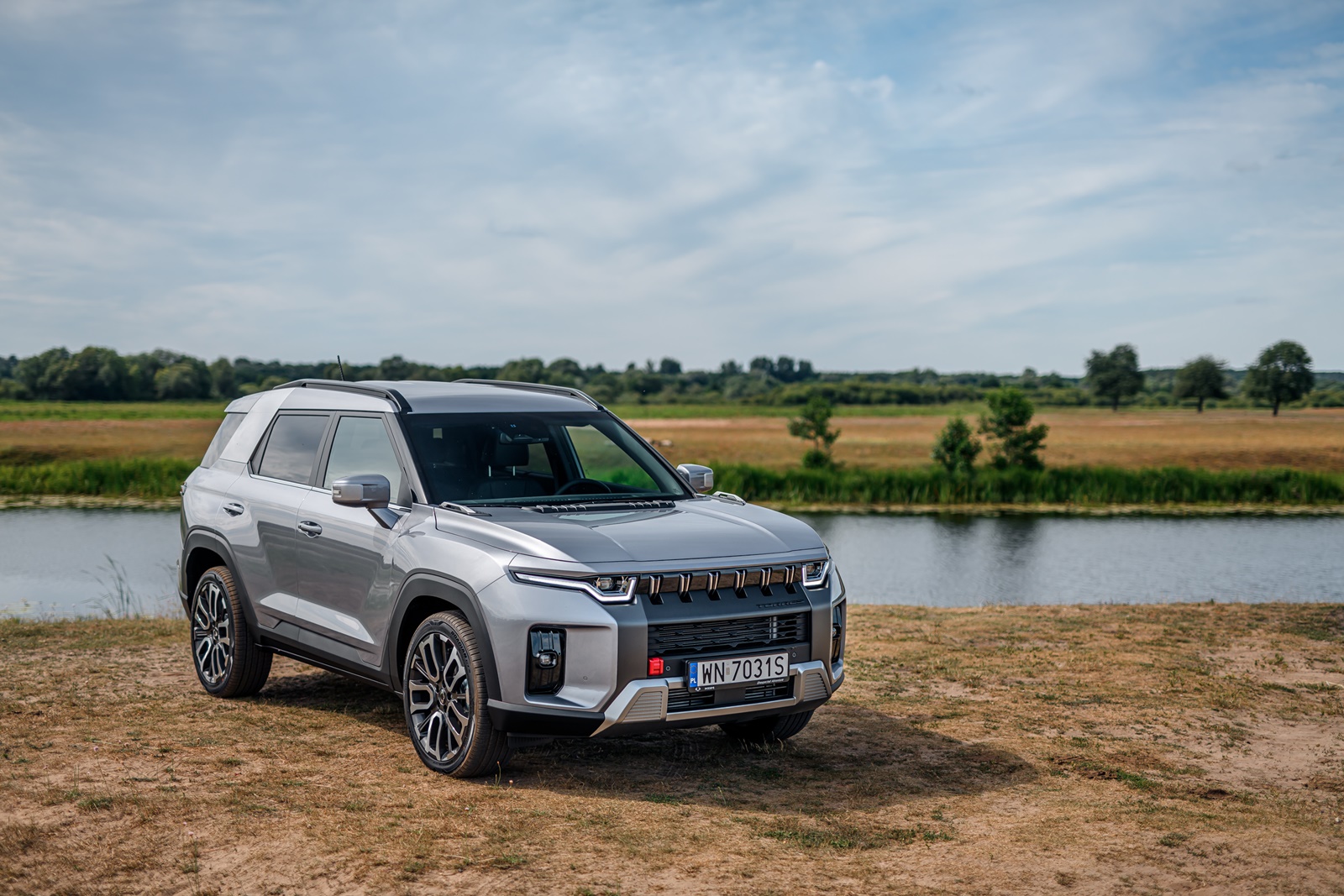
The new SsangYong edition, named Torres (in homage to Chile’s Torres del Paine National Park), previews the new design language of the future SUVs the Korean manufacturer will launch on the market, including a new fully electric edition of the Torres during the first quarter of 2024.
It has dimensions slightly larger than those of its rival models, namely 4.7 m long, 1.89 m wide and 1.71 m high, with a wheelbase of 2,680 mm. For this reason, the brand positions it by size among five-seat segment D rivals, although, on price, it competes with segment C models. It offers a boot capacity of 599 litres, with a 136-litre false floor, and up to 1,662 litres when the second row of seats is folded down.
Its off-road figures are not especially striking: it offers an approach angle of 18.2°, a breakover angle of 17.6° and a departure angle of 21.7°, while its ground clearance is 20 cm. Its tyres are not especially suited to driving across country either, as on the all-wheel-drive variants they measure 245/45 R20, with a profile that is too low for off-road use. Nevertheless, it can be driven with confidence on well-maintained tracks. Furthermore, it has a towing capacity of up to 1.5 tonnes with a braked trailer and 750 kg with an unbraked trailer.
Striking design
With an eye-catching style, the look of this new model recalls products from other manufacturers: a front end reminiscent of the Jeep, with a six-bar front grille and headlights with LED light signatures; a side profile with a pillar similar to the one known from the Toyota FJ Cruiser; and a rear with features resembling those of models from Land Rover, with a hexagonal badge that looks like a spare wheel cover. In any case, its design does not go unnoticed and is especially eye-catching.
It features longitudinal ridges along the sides of the bonnet and aesthetic details that simulate a grille and a towing ring, voluminous wheel arches and very distinctive exterior mirrors. Depending on the trim level, it is offered with different alloy wheel designs, in 17, 18 or 20 inches, and is available in seven body colours.
Its interior is spacious and imposing, with large screens for information, climate control and entertainment: a 12.5-inch instrument cluster, divided into three sections showing driving-related information.
In the centre it has another 9″ screen for the audio system, compatible with Apple CarPlay and Google Android Auto, plus the reversing camera, while below it integrates an 8″ touchscreen that displays the driving modes, stability control, hill descent control, central differential lock (on the 4x4s), the climate control system, and so on.
The front seats are height-adjustable and, in the Life versions, are heated; in the Adventure trim they are electric, heated and ventilated, with eight positions. The second row of seats allows the backrest to recline up to 32.5° and, in the Adventure trim, these are also heated.
Petrol and LPG
Based on the SsangYong Korando, it has a 1.5 GDI Turbo four-cylinder petrol engine with 163 CV of power and 280 Nm at 1,500 rpm. Optionally it is also offered in an LPG version, capable of running on petrol or gas (DGT ECO label), for an additional 2,750 euros. It has a homologated WLTP consumption of 7.9 l/100 km in the manual two-wheel-drive version and 9.1 l/100 km in the all-wheel-drive version with automatic gearbox, which gives it a range of up to 950 km, as it has a 75-litre fuel tank.
It features an automatic stop-start system, which restarts when the foot is lifted from the brake, when the gear lever is moved, when the system detects that the battery has insufficient charge, or when the heating or air conditioning is running.
Versions with the manual gearbox have normal and sport driving modes, while the automatic versions add an extra “Winter” mode for driving on snow or ice. These have a differential lock that disengages automatically when speeds exceed 40 km/h.
Generous equipment
When it comes to safety and driver assistance, no effort has been spared: it offers seven airbags (the Adventure versions also have knee airbags), adaptive cruise control, an advanced emergency braking system, lane keeping and lane departure warning. It also offers automatic light switching, traffic sign recognition, driver fatigue warning, safe-distance and rear traffic alert, tyre pressure monitoring, multi-collision braking, hill descent control and hill start assist, among others.
Prices start at 31,000 euros for the Trend version; 33,500 euros for the manual Life and 36,000 euros for the automatic, while the Adventure 4×4, available only with automatic gearbox, is priced at 40,500 euros. An LPG option is available for all versions at an additional 2,750 euros.
Ease of use
During the first contact we only had the opportunity to drive the top-of-the-range Adventure 4×4, fitted with a six-speed automatic transmission. Its operation is very pleasant, with quick gear engagement and smooth transitions between them. Although we could not drive on winding roads, the steering also struck us as precise, though it must be said that the unit was fitted with 245/45 R20 tyres, which favour precision in the line taken.
Overall, the Torres has an excellent presence, good standard equipment, great passenger and boot capacity, as well as a satisfactory level of performance, although it must be said that the consumption figures, at lively paces, are somewhat high, with on-board computer averages around 10.5 litres.


 Peugeot E-208 GTi: a battery-powered toy that revives the spirit of the 1980s sports cars
 New Lexus ES: luxury grows and goes electric
 First contact with the Dacia Sandero Hybrid 155: power and efficiency from €19,890
Deja un comentario