2CV Citroen Furgonetas Historia
The Citroën 2 CV Van turns 65, a true icon
 Francisco Javier
12 September 2016
4 min.
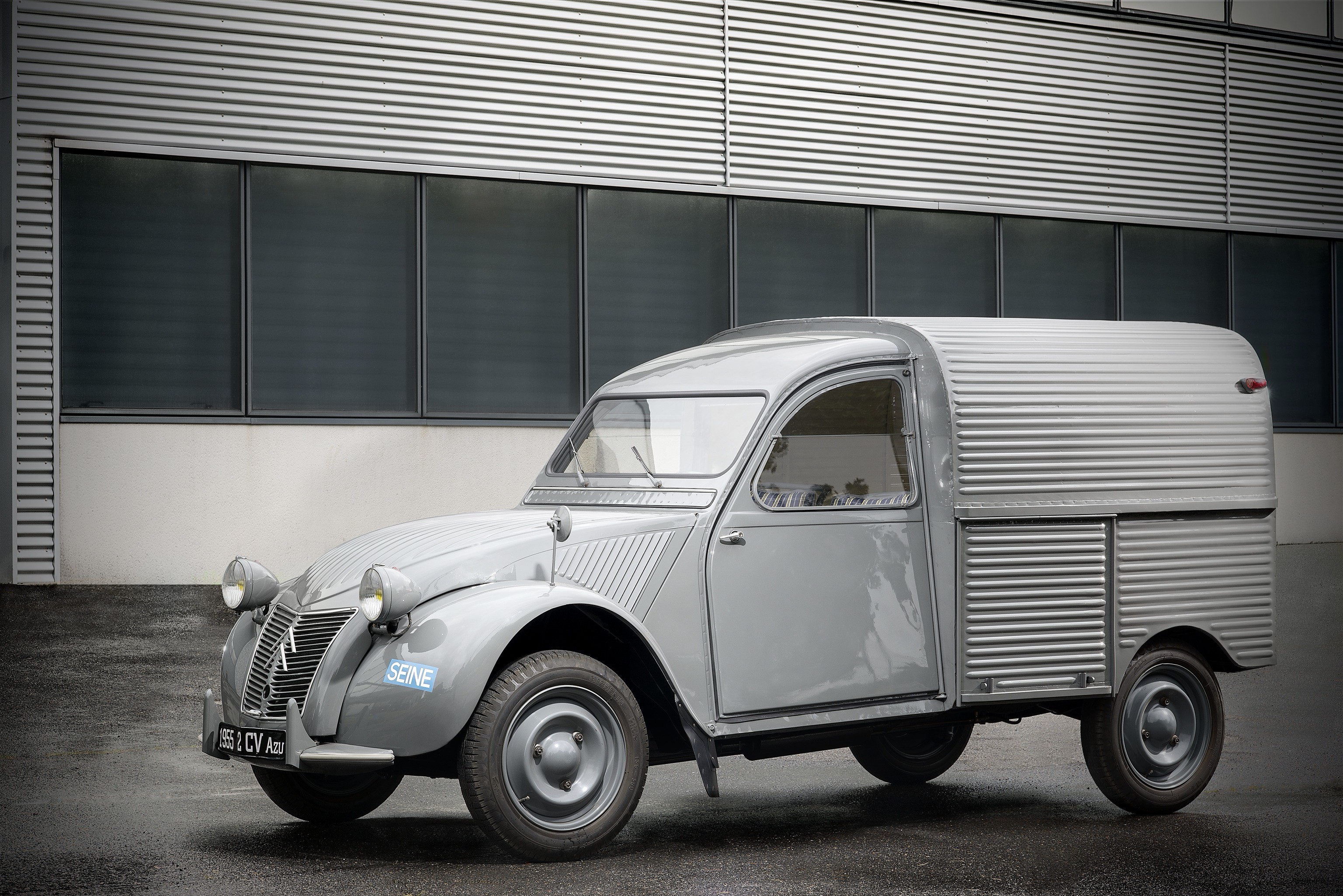
Citroën 2 CV Van
The idea behind the Citroën 2 CV dates back to 1935, but it wasn’t until 1949 that it became a reality and went into series production. It had to meet a demanding set of requirements: it had to be capable of carrying a basket of eggs across a ploughed field without breaking a single one, as well as 50 kg of goods.
It not only had to meet those requirements, it also had to be a car that was easy to drive for someone with no driving experience, have low maintenance costs and consume, at most, 3 l/100 km. Its agricultural vocation was clear, but it also adapted perfectly to the poor condition of the regional roads and rural tracks of the time, while being able to drive around town with complete ease. With these premises, the vehicle was born that would become, over time, a true icon.
Production began in July 1949, far exceeding expectations during its first months on sale. The waiting time to receive a unit came to be as long as three years. It was much cheaper to run and maintain than other models in the same price range, so the public immediately recognised its versatility and qualities. Seeing the great success and acceptance the 2 CV enjoyed, Citroën soon launched a version designed for transporting tools and goods.
Citroën Hispania assembly line in Vigo
The first version of the 2 CV van, the 2 CV AU, went on sale in France in 1951. It featured two of its great hallmarks: the air-cooled twin-cylinder engine, designed by Walter Becchia, and its innovative suspension with helical springs and friction dampers. This new version offered greater load capacity, reaching up to half a tonne (500 kg). All without losing any of the advantages of the saloon version.
It soon arrived in Spain too, as in 1958 its doors opened in the Free Trade Zone of Vigo, the Citroën Hispania factory. The French brand, thanks to the geographical location of Vigo together with the opportunity to reach an emerging market without having to pay tariffs, chose to manufacture its products on Spanish soil. The first model to come off the assembly line was the 2 CV van, although the 2 CV saloon soon followed in its wake.
It soon became a very familiar sight on streets and roads across the whole country. Correos y Telégrafos, the Spanish postal and telegraph service, or the Compañía Telefónica Nacional de España chose the grey-painted 2 CV van as their work tool. In addition, it proved to be the trusted vehicle of many professionals of the era. In this way, Citroën anticipated the needs of the market by opening up an entirely new segment.
Citroën 2 CV Van
The range of the Citroën 2 CV van diversified over the years. From the initial AU model came the AZU, with load capacities of up to 575 kg. The Ak and AKS versions featured new engines and technical modifications that pushed payloads beyond 600 kg. In 1977, production of the 2 CV van came to an end, although it was replaced by a derivative of the Citroën Dyane, the Acadiane, known in Spain as the Dyane 400, which was built in Vigo until 1987. The Citroën Dyane 400 shared technology and engines with its predecessor, thus extending the legend of the iconic 2 CV van a little further.
Another no less emblematic model would be its successor over time. This is the legendary Citroën C-15 van, a vehicle that was a benchmark in its segment and used by many professionals. Also in the agricultural field, the sector for which the Citroën 2 CV was originally designed, where it became an indispensable tool.
Source | Citroën


 The seven finalists for the 2027 European Car of the Year (COTY) are exclusively electric
 Peugeot E-208 GTi: a battery-powered toy that revives the spirit of the 1980s sports cars
 New Lexus ES: luxury grows and goes electric
Deja un comentario