Espace Renault Hybrid Cars Family SUV
The Renault Espace is updated at key points except its engine, with the 200 hp hybrid block continuing at the front.
 David Lopez @espacionblanco
21 March 2025
5 min.
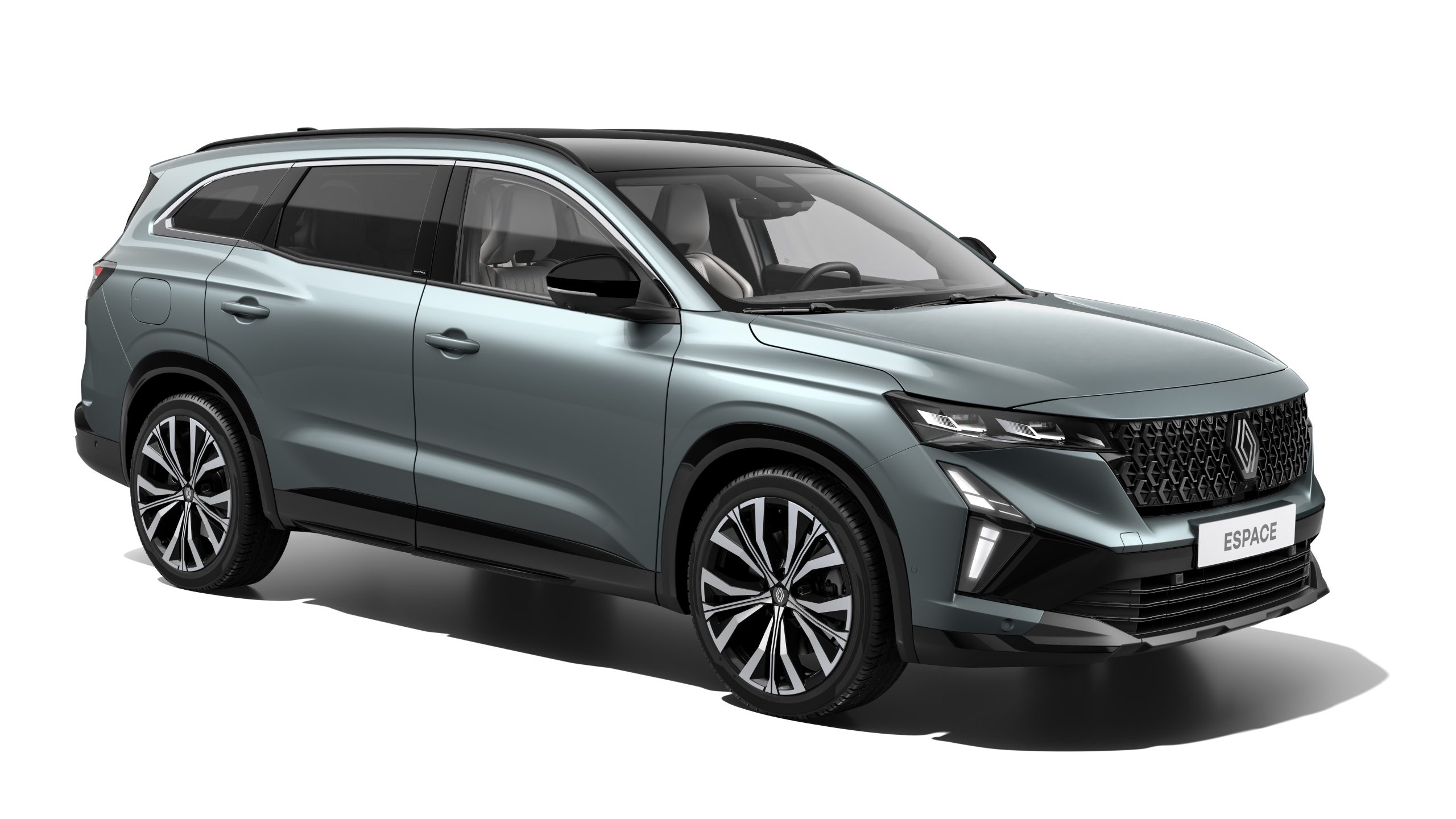
Renault has applied a restyling to the Espace that affects its exterior and interior design as well as the technologies and materials used inside.
The current generation of the Renault Espace is about to turn two years since it went on sale. This generation was built on the CMF-CD platform and brought a revolution in its concept, moving from an MPV to a large SUV aimed at families thanks to its modularity and its capacity for up to seven people.
Two years after reaching the market, Renault introduces an update to several key points of the Espace, resulting in an SUV that reinforces both its design and its equipment towards greater modernity and refinement. Starting with the aesthetics, Renault has not held back, and there are numerous changes. Looking at the front, it features a completely new bumper, with sharper, more pronounced lines and a grille that changes its look. All of this is complemented by the brand’s new light signature, in the form of a half-rhombus of daytime running lights (DRL) placed at the ends of the bumper. In addition, the LED Adaptive Vision headlights, fitted as standard, adopt a stylized trapezoidal shape.
Continuing with the exterior design, and in a more discreet way, the new Renault Espace also receives a new bonnet, adapted to and blending with the new front lines, along with more pronounced longitudinal ribs. On the sides, black strips have been fitted that integrate with the door protections, providing a more effective protection against gravel and stones that may be thrown up towards the sides of the bodywork. Finally, at the rear, which features a tailgate where the Renault logo gains prominence, the light cluster is inspired by the one on the Rafale. Its interior design consists of seven geometric shapes; the lights are red when on and switch to a grey tone with a floating ice-cube effect when off.
Despite this update, the trim levels for the new Renault Espace remain unchanged, so we can still choose between the Techno, Iconic and esprit Alpine trims. Obviously, depending on the trim chosen there will be specific design elements, such as the grey grille mesh for the Techno trim or glossy black for the esprit Alpine, a trim that also receives it on the wheel arches and the lowest part of the bodywork. In terms of colours, the new Espace benefits from the new Baltic Grey shade for its bodywork and, more specifically, the esprit Alpine trim will have exclusively the satin Slate Grey colour.
Inside the new Renault Espace we will still find plenty of space for both occupants and luggage, with a boot capacity of up to 2,224 litres in the five-seat configuration with the seats folded down. In addition, occupants will benefit from greater comfort across all trims thanks to improved sound insulation, more responsive climate control thanks to the new sensor fitted, and more interior light thanks to the optional Solarbay glass roof, which we already saw on other models such as the Rafale or the Scenic E-Tech.
All occupants will benefit from higher quality, both visually and to the touch, with the arrival of new upholstery that will also be available in new colours for both the dashboard and the new wrap-around front seats which, depending on the trim chosen, can be combined with fabric, Alcantara leather and even ash wood. Once on board, the new Renault Espace now greets us with a sound sequence developed in collaboration with Jean-Michel Jarre, not forgetting the new graphic design of the multimedia system, which, let us remember, consists of a dual 24-inch openR screen. It will also debut the Driver Recognition function, with which we can set up user profiles for settings such as radio stations and favourite media, driving position and mirror adjustments, and Google applications via the openR link system.
Where there are no changes is in its engines, as the new Renault Espace will continue to be available only with the 200 hp E-Tech hybrid configuration, consisting of a 1.2-litre turbocharged 3-cylinder petrol engine producing 130 hp and 205 Nm, together with two electric motors: one of 50 kW powered by the 2 kWh lithium-ion battery for driving in electric mode, and a secondary one of 25 hp, responsible for starting the combustion engine and for gear changes. These gear changes are carried out through the intelligent multi-mode automatic clutchless gearbox, capable of selecting between 5 driving modes on its own.
With this configuration, the Renault Espace is capable of accelerating to 100 km/h in 8.8 seconds, with combined CO2 emissions of 108 g/km and combined fuel consumption of 4.8 l/100 km, figures that allow it to reach an excellent range of 1,100 kilometres.
The new Renault Espace will continue to be manufactured at the brand’s Spanish factory in Palencia, and its sales are expected to begin before next summer, so we will not have to wait long to learn its new prices for our country.
Technical specifications of this car

 Peugeot E-208 GTi: a battery-powered toy that revives the spirit of the 1980s sports cars
 New Lexus ES: luxury grows and goes electric
 First contact with the Dacia Sandero Hybrid 155: power and efficiency from €19,890
Deja un comentario