BYD CR-V Honda Nissan RAV4 SEAL Seal U Toyota X-Trail Hybrid Cars Comparisons Tests SUV
Toyota RAV4 vs Honda CR-V: which family hybrid SUV offers better real-world consumption and equipment in 2026
 Iván Navarro
1 October 2026
6 min.
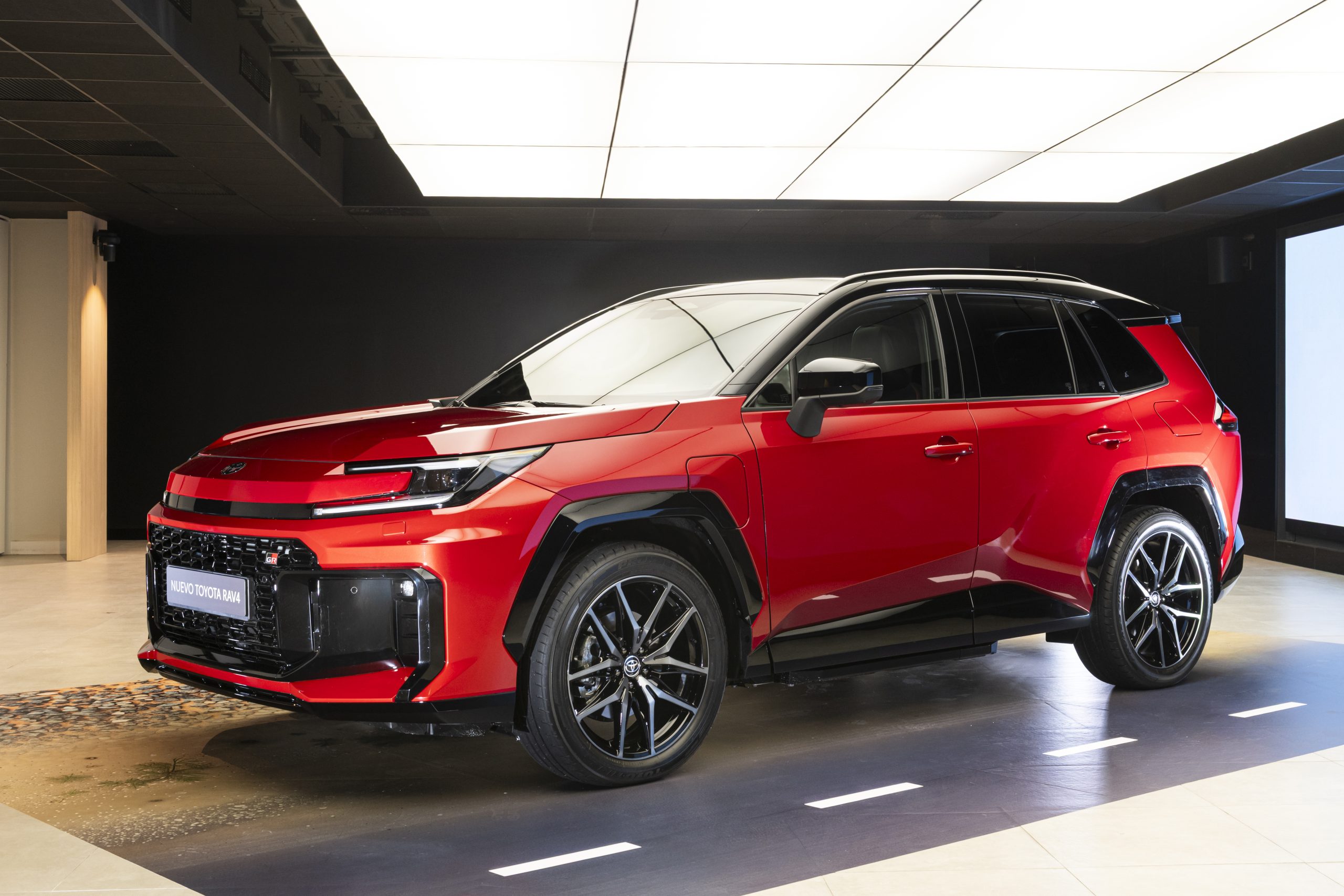
We compare head to head the Toyota RAV4 Plug-in Hybrid 300 Advance and the Honda CR-V Hybrid 2.0 i-MMD Elegance to determine which family hybrid SUV is the better buy in 2026 depending on urban or long-distance use.
The family hybrid SUV has become the favourite refuge of Spanish buyers who don’t want to give up petrol entirely, but don’t want to pay at the pump every week either. In that territory, two names lead the field: Toyota RAV4 and Honda CR-V. Two different philosophies, two hybrid architectures that have nothing in common, and a buyer in 2026 who has to decide whether plugging in at home suits them or whether they’d rather just fill up and forget about it.
This analysis deliberately leaves out two candidates that could have made the cut. The Nissan X-Trail is excluded because, in our editorial judgement, other SUVs in the segment currently offer a better balance between perceived quality and price for the same budget. And the BYD Seal U DM-i, despite its credentials on paper, is ruled out for a similar reason: in our view there are more rounded options in this price bracket when you look at the whole package—finish, official dealer network and residual value—and not just the technical specification sheet. With that clarified, let’s get to the point.
Two opposing hybrid philosophies: Japanese PHEV versus series-parallel hybrid
Here we are not comparing two identical cars with different badges. The RAV4 Advance in this comparison is a plug-in hybrid with a usable battery capacity that lets you get through the entire week without starting the petrol engine if your journeys are urban. The CR-V Elegance, by contrast, is a hybrid from the i-MMD school, where the combustion engine almost always works as a generator and the wheels are driven by the electric motor. These are opposing approaches to the same problem.
Which one makes more sense? It depends on whether you have a charging point. That is the question that decides almost everything.
Toyota RAV4 Plug-in Hybrid 300 Advance — from €50,750 RRP without discount; from €46,500 with official promotion
The plug-in RAV4 delivers 268 hp combined, but the interesting figure is not that one; it is the more than 100 km WLTP electric range with its 22.7 kWh battery which, in real urban use, lets you go for weeks without touching the pump. The homologated consumption of 1.4–1.8 l/100 km is, obviously, a laboratory figure with a full battery—on a long journey with the battery depleted, the reality is closer to 5.2–5.8 l/100 km homologated. That needs saying.
The Advance trim includes synthetic leather upholstery, dual-zone climate control, wireless charging, a 10.5″ multimedia screen, digital instrument cluster, panoramic roof and the complete Toyota Safety Sense package. Serious equipment.
| Power kW | Power hp | Top speed | Electric range | Consumption | Battery | Label | Fuel |
|---|---|---|---|---|---|---|---|
| ≈200 kW | 268 hp (4×2) | ≈180 km/h | 100–137 km | 1.4–1.8 l/100 km | 22.7 kWh | ZERO | PHEV (petrol/electric) |
Honda CR-V Hybrid 2.0 i-MMD 184 Elegance — from €51,545 RRP
The CR-V Elegance bets on simplicity: you get in, start, drive. No cables, no planning. Its 184 hp combined move a car weighing around 1,700 kg with ease, and the i-MMD powertrain—one of the most refined on the market—means that in town the car runs in electric mode most of the time without the driver doing anything. In real urban consumption we are talking about figures very close to the 6 l/100 km homologated; on the motorway at 120 km/h it rises somewhat because the combustion engine switches to direct drive, but it stays within a reasonable range for an SUV of this size.
The
Elegance
comes with a 9-inch screen, a 10.2-inch digital instrument cluster, dual-zone climate control, rear-view camera, complete Honda Sensing and heated front seats. A sober interior, well assembled, with that feeling of a “serious car” that Honda continues to cultivate.
| Power hp | Top speed | Consumption | CO₂ emissions | Label | Fuel | |
|---|---|---|---|---|---|---|
| 184 hp | ≈190 km/h | 6.0 l/100 km | 134–135 g/km | ECO | Hybrid (petrol/electric) |
Real consumption: the plug changes everything (if you use it)
Here is the crux. The PHEV RAV4, with overnight charging and daily journeys below 100 km, can close the month with
average consumption below 2 l/100 km in real terms. Without charging, it drops to 5.2–5.8 l/100 km homologated with a depleted battery, which means practically the same as the CR-V while carrying an extra 150 kg of battery. It is the classic trap of the poorly used PHEV.
The CR-V, by contrast, delivers what it promises without asking anything of you: 5.5–6.5 l/100 km in real mixed use, regardless of how you treat it. For anyone without a charging point, it is the logical route.
Equipment and finish: two interpretations of Japanese luxury
The RAV4’s
Advance comes loaded as standard with screen and connectivity; the CR-V’s Elegance offers an interior that, to my taste, feels a step above in hard materials and ergonomics of the physical controls—Honda still doesn’t sacrifice buttons for screens, and that is appreciated—. In the rear seats, the CR-V wins on legroom; the RAV4, on usable boot space when the battery doesn’t eat into part of the lower compartment.
For anyone seeking a broader view of this category, in
how to choose a family hybrid SUV in 2026 we break down the criteria that matter most beyond the technical specification sheet.
Price and running costs: the €1,000 difference doesn’t tell the full story
On paper, the CR-V Elegance is just €1,000 above the RAV4
Advance. It seems a trifle, but the real calculation changes when you factor in the Plan Auto+: the PHEV RAV4, being plug-in with more than 90 km of electric range, qualifies for aid that the hybrid CR-V does not have. Check the current amount on the official website before signing.
Important: the prices quoted are the manufacturer’s recommended RRP, without dealer discounts, one-off campaigns or purchase aid.
Comparison table and verdict
Verdict? If you have a charging point at home and do mostly city driving,
the PHEV RAV4 is unbeatable on cost per kilometre and also qualifies for the ZERO label. If you don’t, or your life is spent on the open road, the CR-V i-MMD is more honest: it consumes what it says it consumes and doesn’t force you to change your habits.
Frequently asked questions
Which hybrid SUV uses less fuel in 2026, the RAV4 or the CR-V?It depends on use. The PHEV RAV4 is homologated at 1.4–1.8 l/100 km with a charged battery, but without charging it comes to around 5.2–5.8 l/100 km homologated with a depleted battery. The CR-V stays steady at 6.0 l/100 km homologated without any need to plug in. For urban use with charging, the RAV4 wins; for mixed use without a charger, the CR-V.
How much does the Toyota RAV4 Plug-in Hybrid 300 Advance cost in Spain?From €50,750 as an indicative RRP, without applying Plan Auto+ discounts or aid. With the aid currently available, the final price can drop by several thousand euros.
Does the Honda CR-V Hybrid have a ZERO label?No. As a self-charging hybrid with no option to plug in, its label is ECO. For a ZERO label in this segment, you need to go for the PHEV RAV4 or an equivalent plug-in rival.
Which has the bigger boot, the PHEV RAV4 or the CR-V Hybrid?Both are around 500 litres—RAV4 PHEV 446 litres; CR-V Hybrid about 587 litres—in five-seat configuration, but the CR-V offers a more regular load area and a more useful lower compartment, since the plug-in RAV4 sacrifices part of the double floor to house the battery.
Technical specifications of the cars in this article


 Kia offers an electric range of 10 models, 50 versions and 400 possible combinations
 The seven finalists for the 2027 European Car of the Year (COTY) are exclusively electric
 Peugeot E-208 GTi: a battery-powered toy that revives the spirit of the 1980s sports cars
Deja un comentario