A journey through time: we drive all five generations of the SEAT Ibiza
 Antonio Roncero @roncero_antonio
24 February 2024
12 min.
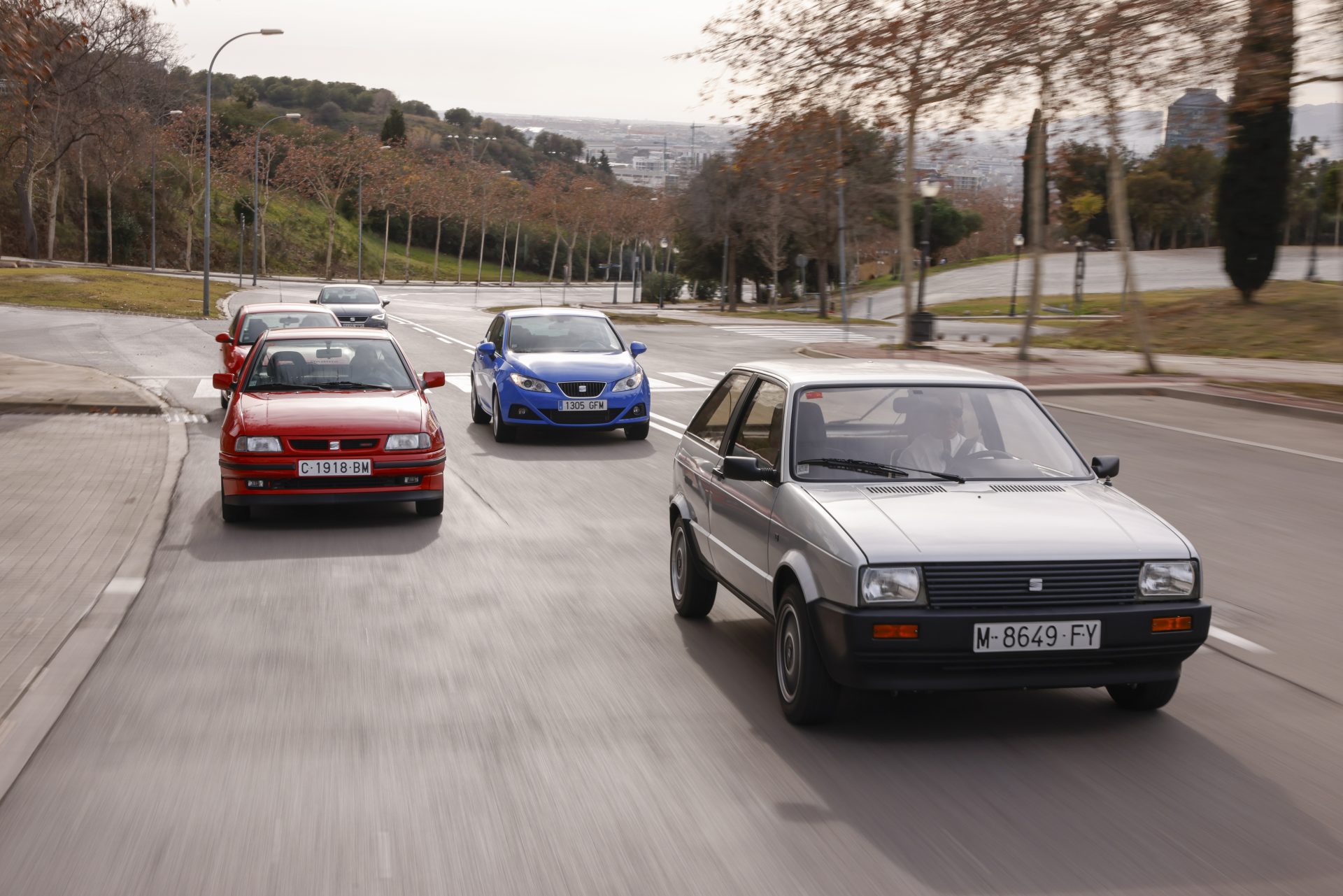
SEAT is celebrating the 40th anniversary of its iconic Ibiza, of which more than six million units have been sold since its launch in 1984. And we have taken part in this “birthday party” by getting behind the wheel of all five generations.
Five generations and more than six million units sold since its launch in 1984 say almost everything. And I say “almost” because the meaning of the SEAT Ibiza for the Spanish brand goes beyond mere figures. The city car that this year celebrates its 40th anniversary has not only been a benchmark in the market in each and every one of its generations, but it also laid the foundations for SEAT’s growth to become a brand capable of looking beyond our borders. And when SEAT invited us to a day in which we could drive all the generations of the Ibiza in a single day, I was particularly excited.
At home we have had many SEATs. But never an Ibiza, which during the years I drove my trusty Seat 127 every day to get to university was the car of my dreams. Then fortune wanted me to dedicate myself to this blessed profession of testing cars… and precisely the first-generation Seat Ibiza was one of the first. Specifically, I remember it as if it were yesterday, a “New Generation”, the first of the two restyles the first Ibiza had. Getting back behind the wheel not just of the first Ibiza, but of each and every one of the five generations of this model, has undoubtedly been one of the best experiences I have had in recent years.
Join me in this brief review of the history of a model that forms part of the history of SEAT and of Spanish automotive, and which still has a lot ahead of it…
SEAT Ibiza MK1 (1984 – 1993): the king of the 80s
The first model created and developed by SEAT from scratch at the Martorell Technical Centre was a real bombshell. It was presented to the press on the island of Ibiza, and SEAT enlisted the collaboration of partners such as Giorgetto Giugiaro for the body design, Karmann for the interior and no less than Porsche for adapting the engines derived from Fiat. You should have seen the gleam in the eyes of the owners of one of these early Ibizas when they opened the bonnet to show off the famous “System Porsche” badge on the cylinder head cover of the 1.2 and 1.5-litre petrol engines with 63 and 85 CV respectively. Then came the SXi versions, with 100 CV and the 5-door variant.
This generation had two restyles: one in 1989 focused on the interior, in which the always confusing satellite controls that the Seat Málaga also had were replaced by conventional levers and buttons for the lights, indicators, etc.; and another in 1991 which sharpened the front end with longer oval headlights instead of square ones and a grille without slats, although many at the time felt it was a step backwards compared with the robust and unmistakable look of the original design.
This first Ibiza stood out from its rivals of the era thanks to an enormous wheelbase of 2.45 metres relative to its external size, and with it, excellent interior space. During the event we were able to drive one of the two Ibiza GLXs that SEAT Históricos keeps in its collection. Specifically, a unit that was purchased from a SEAT dealership with barely 64 km on the clock, and which had never been registered. It was quite an experience to sit at the controls of a model in practically new condition, built 40 years ago: the smell, the feel of the gear lever, the unassisted steering, the elasticity of the 1.5 engine, capable of pulling very long gears… and, of course, the peculiar dynamic behaviour, conditioned by a rear suspension with a transverse leaf spring which made the Ibiza change its reactions a great deal depending on whether you were travelling alone or with a load. That said, the “leg lifts” for the photo sessions during the Ibiza tests of the time were epic…
SEAT Ibiza MK2 (1993 – 2002): a generational leap
Compared with the square, solid lines of the Ibiza I, the second generation, also designed by Giugiaro, represented a tremendous generational leap. This is the second car developed entirely at the Martorell Technical Centre with SEAT already within the Volkswagen Group -the first was the Seat Toledo-, and it quickly established itself as one of the sportiest city cars in its category, thanks to the incorporation of the 2-litre, 115 CV engine that the saloon also used -no other car of this size used a block with such displacement- and later the arrival of the GTI versions and the first Ibiza CUPRA.
Over its nine years of life, the Ibiza II enjoyed an unusually wide range of engines, some of which clearly marked the success of this generation. The first of these, the aforementioned 115 CV 2.0, which allowed the Ibiza to wear the GTi badge for the first time, which it later shared with the 130 CV 1.8 16V. Also the 150 CV 2.0 16V of the first Cupra. Not to mention the 1.9 TDi which reached 110 CV, and which quickly became one of the most sought-after versions for its incredible balance of performance -capable of exceeding 190 km/h- and consumption. This Ibiza also had a 1.8 Turbo with a 5-valve-per-cylinder head and almost 160 CV. With this engine, the Ibiza was the first in its class to offer ESP.
Externally, the Ibiza II still remained well below 4 metres, with its length of 3.81 metres -almost 20 cm more than the Ibiza I- while keeping the 2.45-metre wheelbase. But the new platform, now with rear suspension using trailing arms -like that of the VW Golf of the time-, which unlike the leaf-spring rear axle of the Ibiza I kept the camber angle and track width constant and was not so sensitive to load variations, gave the Ibiza surprising ease of driving and agility. As technical novelties, this generation also introduced ABS, traction control, and the EDS electronic limited-slip differential on the Cupra…
During the event I was able to drive the 1.8 16V with 130 CV, of course in impeccable condition, in red and with the characteristic three-double-spoke alloy wheels. An engine that had a hard time asserting its multi-valve head against the larger displacement of the 115 CV 2.0, although its feel was sportier. The sound it made as the revs climbed stayed with me at the time… and it still does today, especially after this “remember”.
SEAT Ibiza MK3 (2001 – 2009): the TDIs take over
Many third-generation Ibizas are still on the road. It can be considered more of an evolution of the Ibiza II, especially when compared with the revolution that the move from the first to the second series represented. In fact, the platform was basically the same, with important novelties such as the arrival of electro-hydraulic power-assisted steering. It grew in size again to 3.96 metres, now with the wheelbase stretched to 2.46 metres; but above all it grew in width. And interesting novelties appear in the engine range.
Many engines from the extensive mechanical range of the Ibiza II were dropped to welcome the small three-cylinder blocks of 1.2 litres in petrol, and 1.4 litres in the case of the TDIs. The long-lived 1.9 TDI splits here into 100 and 130 CV variants with pump-injector technology from the Group. The iconic TDI badge, with its last two letters in red, identified an Ibiza that, for the first time, broke the 200 km/h barrier in its class with a diesel engine.
And alongside the escalation of power and performance came, in the final years of this generation, the first Ecomotive models, boasting low consumption, especially in the case of the 1.4 TDi with particulate filters, which already used “tricks” such as lowered suspension to reduce aerodynamic drag and fitted low rolling-resistance tyres. It became the most ecological car in its class in 2007, with CO2 emissions of 99 g/km. For their part, the petrol engines continued their escalation of power up to 180 CV for the 1.8 Turbo of the Cupra, an absolute record for the brand… and always with the “shadow” of the TDIs, which generated the eternal debate and countless GTI vs TDI comparisons. Indeed, the 1.9 TDI reached 160 CV, and with this engine the Ibiza reached a top speed of 220 km/h.
Worth highlighting here is that the design was the work of Walter da Silva, who managed to give the Ibiza a silhouette that recovered the energy of the first series, the sportiness of the second, and added a masterful touch of modernity, always with a very youthful air. In 2004 the Ibiza celebrated its twentieth birthday, and it was also in this third generation that the first FR versions arrived, which today remain a hallmark not only of the model, but of the brand.
Seat coined the slogan “SEAT auto emocion” for this generation and its new brand image. The concept of “agile chassis” introduced in this generation lived up to the slogan when driving it, although it is true that the interior design was not exactly very “emotional”.
SEAT Ibiza MK4 (2008 – 2017): a new leap in design and technology
In 2008 the fourth generation of the Ibiza reached the market, offering 3- and 5-door body versions plus the ST estate, and ended its commercial life solely as a 5-door, which is how the Ibiza V is still sold today.
Luc Donckerwolke’s “arrow-type” design represented a real leap over the previous generation, as did the commitment to extensive standard equipment across all versions. The new Group platform for B-segment cars once again stood out for its excellent dynamic qualities and generous interior space. Two updates were made to the original design: one in 2012 with lines that foreshadowed the Seat León still to come, and another in mid-2015 focused more on an interior that still lacked sophistication, which was also used to fit for the first time a 6.5-inch multimedia screen in the centre of the dashboard, allowing the Ibiza to boast connectivity.
As for the mechanical side, this generation received the DSG dual-clutch gearbox. Towards the end of its commercial life, the Ibiza III had a completely new range of engines, notably the 3-cylinder turbo EcoTSI with 95 and 110 CV, the 1.4-litre 4-cylinder EcoTSI with 150 CV and active cylinder deactivation, and the 3-cylinder 1.4 TDI with 75, 90 and 105 CV. With this 1.4 TDI engine the Ibiza offered a homologated consumption of just 3.4 l/100 km.
SEAT IBIZA MK5 (2017 – present)
And we arrive at the current Ibiza, the fifth generation, presented in 2017 and still fully current. The body design is by Alejandro Mesonero-Romanos, who had already designed the Ibiza 30 Aniversario version of the previous generation. And besides the evolution of its exterior lines, here a genuine revolution takes place in the one area where the Ibiza had previously “fallen short”: the interior.
Of course, this is also an Ibiza with a completely new platform, the MQB-A0, designed to offer the most advanced technology. An Ibiza that, unlike the previous three generations, no longer features the much-loved CUPRA versions, which became an independent brand a year after the new model reached the market. With the new platform the Ibiza V becomes the safest model in the brand’s history. The most advanced assistants arrive, such as Travel Assist with Level 2 semi-autonomous driving; and Seat Connect opens a new world of possibilities for users to interact with their vehicles, providing access to a large number of functions.
With the restyle undergone in 2021, this fifth generation of the Ibiza remains one of the most complete cars in its class, both for those looking for their first car and for those who need a vehicle for all uses to handle daily urban journeys or long-distance road trips. The new special edition Seat Ibiza 40 Aniversario tops off an appetising cake that is a real temptation for the young… and for those of us who are no longer young.
Technical specifications of this car


 Peugeot E-208 GTi: a battery-powered toy that revives the spirit of the 1980s sports cars
 New Lexus ES: luxury grows and goes electric
 First contact with the Dacia Sandero Hybrid 155: power and efficiency from €19,890
Deja un comentario