Astra Opel Hybrid Cars ECO Family Tests
For these reasons, the Opel Astra Sports Tourer PHEV seems to me the best Astra in the entire range
 Antonio Roncero @roncero_antonio
28 March 2025
10 min.
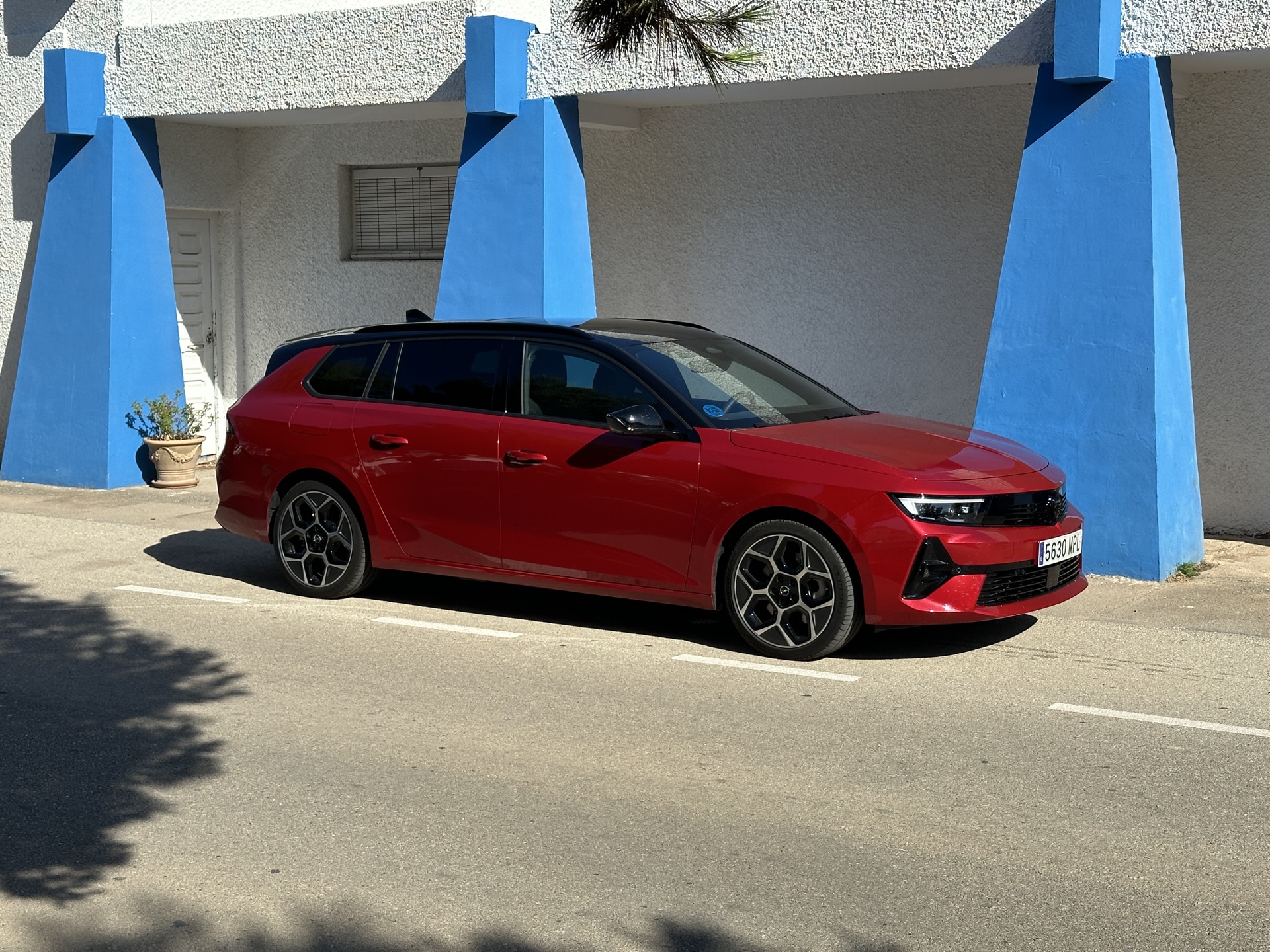
A few days living with the plug-in hybrid version of the Opel Astra Sports Tourer, using it every day and taking advantage of it for a trip, has helped me once again appreciate how versatile a car with this type of body is… and the advantages of plug-in hybrid technology. Two features that the Opel Astra combines very well, making it one of the most attractive proposals in its category and, at least in my opinion, the best Opel Astra in the entire range. Let me tell you why.
A very practical estate body
There are not many excuses for not choosing the Sports Tourer estate body. To begin with, it has a very sporty design, with the rear pillar and rear window sloping and a slightly falling roofline. And with the two-tone bodywork with the black roof, it looks spectacular. The price won’t be a drawback either: it’s only 1,200 euros more than the 5-door Astra; but believe me, it’s well worth it… even if you think you don’t need so much space. In the end, the day will come when you have to make a long trip with passengers in the rear seats and need space for everyone’s luggage. Or simply when you have to transport some long or bulky object. And on that day you’ll remember if you didn’t opt for the Sports Tourer, with more load capacity and much more practical than the 5-door Astra.
It is almost 30 centimetres longer, which you will only notice when parking, although its 4.64 metres still make it a relatively compact size. But the wheelbase also increases compared with the 5-door Astra. This translates into rear seats with more legroom -around four centimetres- and, above all, a boot with 165 litres more capacity. And I’d like to point out here that the Astra Sports Tourer PHEV loses only 80 litres of boot capacity compared with the diesel and petrol versions, maintaining a very good figure of 516 litres. In other plug-in hybrids the loss of boot capacity can be a reason to look the other way, but that is not the case with the Astra Sports Tourer.
I would also like to point out here that the boot has very regular shapes, a loading lip close to the floor, and it can include elements for organising luggage such as hooks, retaining nets or a divider net to separate the cargo from the cabin. There are also handles to very easily fold down the front seat backs (the bench stays fixed). Under the floor sits the high-voltage battery of the hybrid system, and there is room to carry the charging cable.
In my case, as I often get around “with the bike on my back” and I’m not keen on carrying it on the roof unless there’s no other option, the Astra Sports Tourer format suits me perfectly: the bike fits with hardly any effort, simply by folding down the seats and removing one wheel. The versatility this body style offers is truly remarkable… and I’ll say it again, even at the risk of being tiresome before I’ve started: without any penalty when driving.
Like an electric car day to day, and a hybrid when the battery runs out
I won’t reveal anything new here: the Astra Sports Tourer PHEV can operate like an electric car day to day if you start the day with a charged battery… and like a conventional hybrid once the battery is depleted. That means you don’t depend on a plug to get around with very low average consumption, although you really make the most of it if you can charge it every day.
Now I’ll give you more details, but first let’s talk about the range and prices, which are very interesting. There are two power versions, with 180 hp or 225 hp. In both cases the petrol engine is a 1.6 Turbo 4-cylinder, delivering 150 hp or 180 hp respectively. It features a 110 hp electric motor coupled to the 8-speed automatic gearbox, and a 12.4 kWh gross battery (9.9 kWh usable) that allows an electric-only range of 65 km on the WLTP cycle. The battery can be charged from a domestic socket comfortably overnight (it takes less than 4 hours at 3.7 kW), or in less than 2 hours with the optional 7.4 kW charger, which costs 200 euros.
The 180 hp version is associated with the GS trim, and the 225 hp one with the GSe. The difference in performance and consumption is minimal, so you shouldn’t decide based on power. The 180 hp one is already great… but I wouldn’t buy it myself, and I’ll explain why. The price difference between the GS and the GSe is 1,700 euros, and not only do you get the more powerful engine, but the GSe adds sportier exterior styling, aluminium pedals, an inductive phone charger, the Intelli-Drive 1.0 pack (including rear cross-traffic alert, lane keeping assist, lane change assist and blind spot warning), the Dynamic pack with a sporty suspension setup which I find very well judged, and 225/40 tyres on 18-inch wheels, instead of 225/45 on 17-inch wheels. But if you don’t go for it, as I said, the GS with 180 hp is also great.
As for the positioning of the PHEV within the Astra range itself, the purchase incentives of the MOVES Plan must be taken into account, when they are in force. Because with these incentives, the 180 hp GS PHEV costs “only” around 2,000 euros more than the 130 hp automatic 1.5 Diesel, which has a C label. The difference with the 136 hp 1.2 Hybri petrol, which already has an ECO label, is somewhat greater, more than 3,000 euros. But the PHEV is worth it for its performance, consumption, pleasant driving and, don’t forget, the advantages of the DGT CERO environmental label.
And since we’re on the subject of prices, it’s also worth knowing that, in general, the Astra Sports Tourer is one of the most affordable cars in its category, where there are many compact estates, and some others with hybrid powertrains, such as the Seat León SportsTourer or the Peugeot 308 SW PHEV, which shares its mechanics with the Opel.
Behind the wheel of the Astra Sports Tourer PHEV
Several factors make the Astra Sports Tourer a very pleasant car to drive. The first is that it has a very well-resolved driving position, with materials that convey a sense of quality, very comfortable seats -I think they are the first with AGR certification for back care that have really won me over- and a good driving posture, keeping physical controls for the main and most frequently used functions, which is no bad thing, since the screen of the multimedia system, although oriented towards the driver, is somewhat far away and sometimes to operate it you have to separate your back from the seat backrest.
What I liked least about the driving position is the large number of surfaces finished in what they call “piano black”, applied to the centre console, the frame of the screen system or even the steering wheel control panels, and which is very hard to keep clean. I’m also not thrilled with how the digital instrument cluster presents information; I would like one of the display modes to show classic dials. If you have equipped the Tech pack you won’t need to consult it much: for about 1,700 euros it adds a head-up display and Pixel LED matrix headlights that work wonderfully, which I recommend if you’ll be travelling at night, plus navigation, a heated windscreen, black roof bars and, on the GS trim, rear cross-traffic alert, blind spot detection and an inductive phone charger.
The Astra’s PHEV system lets you choose between the driving modes usually found in this type of vehicle: electric, hybrid, an e-Save mode to preserve the battery charge, and a Sport mode. If there is charge, it always starts in electric mode, in which we have sufficient performance to get around not only the city, standing out for the smoothness of operation and pleasant driving. In this case we can adjust the level of regenerative braking using the gear selector on the centre console, choosing the “B” mode. I would have liked to be able to do this from the steering wheel paddles too, but they only serve to change gear manually when driving in Sport mode. Using only electric energy, driving somewhat in town and a lot on outer roads, I have easily managed to exceed 40 km of electric range in day-to-day use. Charging at home overnight -around 6-7 hours, using a domestic power socket- and on a standard tariff, this allows a really low cost per kilometre, of less than 3 euros per 100 km.
When the battery has no charge, the Astra Sports Tourer PHEV switches to HEV mode, like a conventional hybrid: it always keeps some charge in the battery to start off in electric mode or to move with the combustion engine off during manoeuvres or at low speed, and it draws on the combustion engine, with the system managing the alternation between both motors, with no option to choose electric-only mode. Although it is a fast car, it’s also true that it doesn’t seem to have 220 hp even when you select Sport mode, in which a greater push when accelerating is clearly noticeable. In sporty or demanding driving, it’s also noticeable -and this happens with many PHEVs- that performance is not the same when the battery is completely depleted. As for consumption with the battery discharged, it’s easy to stay just below 7 l/100 km when travelling on the motorway. It’s a good figure, although the total range isn’t as good because the fuel tank holds only 42 litres, which gives about 550 km between refuelling stops.
The GSe version, with the sport suspension and lower-profile tyres, has a little more agility than the rest of the range, which doesn’t clash at all in a car with an estate body, because it hardly compromises comfort, maintaining a good ability to absorb bumps. The balance between sportiness and comfort is very good, without doubt the best in the range.
Opel Astra Sports Tourer PHEV – Gallery


 Kia offers an electric range of 10 models, 50 versions and 400 possible combinations
 The seven finalists for the 2027 European Car of the Year (COTY) are exclusively electric
 Peugeot E-208 GTi: a battery-powered toy that revives the spirit of the 1980s sports cars
Deja un comentario