Geely Starray Hybrid Cars Buying Guides Review SUV
Geely Starray review: why the Chinese gasoline compact SUV bets on premium equipment in 2026
 Iván Navarro
3 September 2026
6 min.
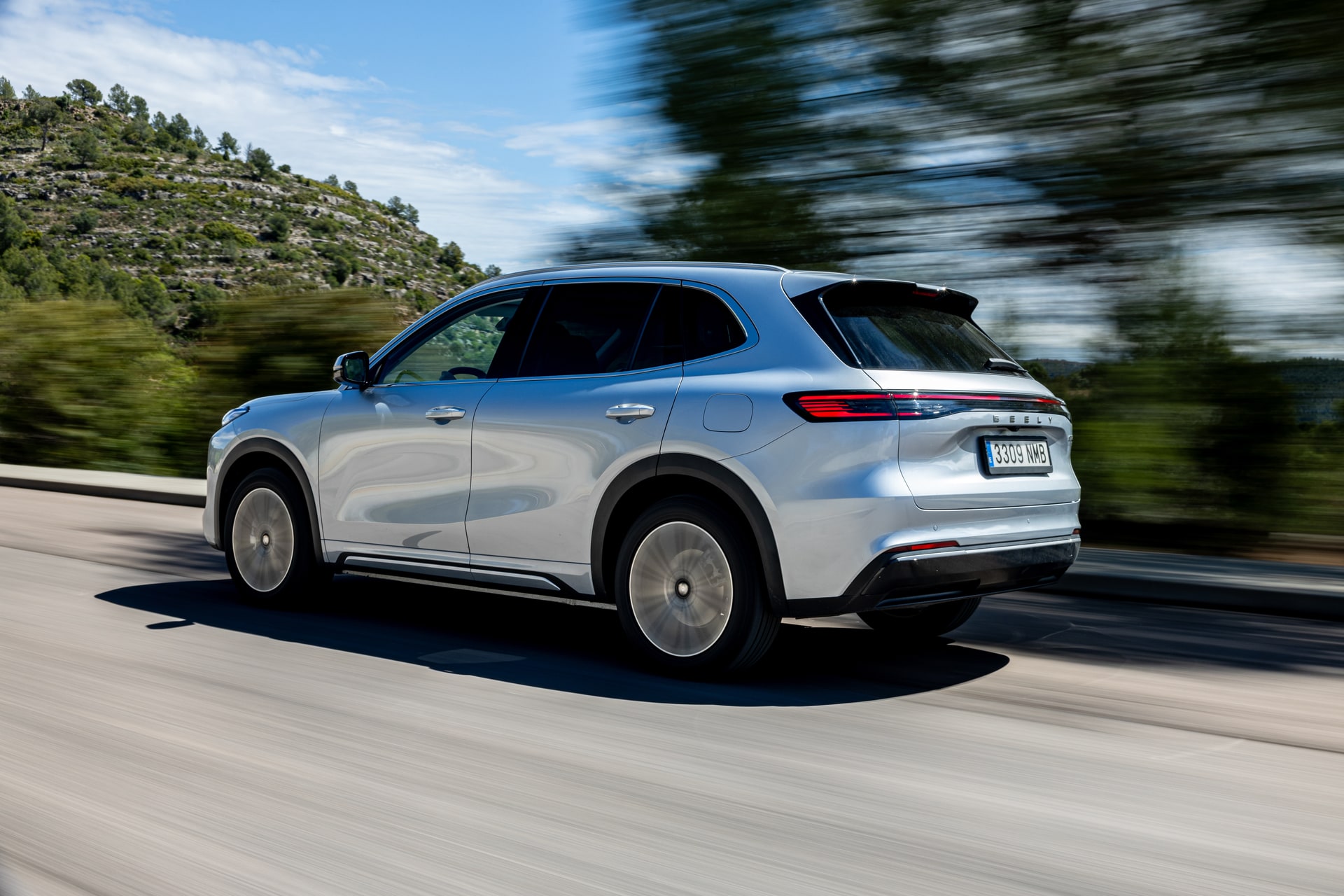
We test the Geely Starray PHEV 262 Pro: 260 CV, 2.5 l/100 km and equipment that goes head-to-head with European compact SUVs from around 33,500 euros.
Geely’s arrival in Spain hinges largely on its credibility with a single model. The Geely Starray enters the C-segment with an approach that is not typical among recently arrived Chinese brands: rather than competing on the lowest price, it climbs to the plug-in hybrid rung with 262 CV and commits to premium equipment from the first euro. The question, in our view, is not whether it is competitive — it is — but whether it can justify the €33,490 price against rivals that have been learning to sell in Europe for longer.
From the initial list of candidates we have ruled out the BYD of the equivalent segment: the manufacturer has staked its ground over the last two years mainly on aggressive pricing, but we believe that in 2026 the bar is measured by overall balance — design, interior feel, software, dealer network — and by that editorial reading other rivals have ended up offering a more rounded package. The comparison, therefore, focuses on the plug-in hybrid C-segment SUVs that do compete head-to-head with the Starray.
Geely Starray from €33,490: what the premium Chinese compact SUV offers
The Starray is sold in Spain in a single main configuration of relevance: the PHEV 1.5 EM-i 262 Pro, with 193 kW (262 CV) combined and a homologated efficiency of 2.4 l/100 km. In practical terms: CERO label, urban use practically in electric mode if plugged in daily, and backup from the 1.5 turbo when the battery runs out. On paper it is a very on-trend approach for what the Spanish family compact SUV buyer demands today.
Aesthetically it plays the card of the sober SUV, with clean proportions and a restrained grille that will age better than more over-embellished designs. Inside, soft-touch materials on the upper dashboard, worked upholstery and a central screen that dominates the layout without cannibalising it. It is not a German premium interior, let’s be clear — but it feels a step ahead of the average Chinese car from 24 months ago.
| Power kW | Power CV | Top speed | Range | Consumption | Label | Fuel |
|---|---|---|---|---|---|---|
| 193 kW | 262 CV | 170 km/h | data not available | 2.4 l/100 km | CERO | PHEV petrol |
Plug-in hybrid engine with 262 CV and homologated consumption of 2.4 l/100 km
The mechanical layout combines a 1.5 turbo with EM-i architecture and an electric motor that takes the lead in town. In practice, the system prioritises electric propulsion up to notable speeds, and only calls on the combustion engine when the right foot presses hard or the battery runs low. The 262 CV are felt mainly on roundabout exits and motorway slip roads, where the instant torque of the electric motor lifts the Starray out of the trap of the heavy SUV with a small engine.
Is it a car for driving? That is not its league. It rides comfortably, insulates well, and the steering feel is correct without more. For 90% of users in this segment, it is more than enough.
Premium standard equipment: screen, ADAS and finishes
Here lies much of the commercial argument. The 262 Pro trim comes with a full ADAS package — active lane keeping, adaptive cruise control, emergency braking, blind-spot detection —, panoramic roof, front heated and ventilated seats on higher configurations, premium-signature sound and a large-format central screen with integrated navigation. Little remains to tick on the options list, and that is a pitch that is still uncommon in the European C-segment below €35,000.
On prices: we remind the reader that the figures quoted are the manufacturer’s recommended RRP, without dealer discounts, occasional campaigns or aid from programmes such as the Plan Auto+, whose current amounts are worth checking on the official website.
Comparison with Chinese rivals on the same ground
The Starray’s most interesting scenario is not against the Cupra Formentor or the Peugeot 3008, but against the Chinese competitors that have already carved out a niche in Spain. And there the duel tightens.
Omoda 9 SHS from €52,900
The Omoda 9 SHS plays on a higher rung of size and price, but it is worth keeping on the radar as an aspirational ceiling. More car, more presence and an interior that pushes towards semi-premium — in exchange for almost €19,410 more than the Starray.
| Power kW | Power CV | Top speed | Range | Consumption | Label | Fuel |
|---|---|---|---|---|---|---|
| 395 | 537 | 180 km/h | 145 km (electric) / >1,100 km (total | 1.7 l/100 km (WLTP) | CERO | PHEV petrol |
Jaecoo 7 PHEV from €38,295
Direct rival to the Starray in philosophy and price. More pronounced design, off-road-look orientation that not all buyers want. It is the rival you have to beat in the showroom.
| Power kW | Power CV | Top speed | Range | Consumption | Label | Fuel |
|---|---|---|---|---|---|---|
| 250 | 340 | 180 km/h | 90 km (electric) / >1,000 km (total) | 0.7 l/100 km (WLTP) | CERO | PHEV petrol |
MG HS PHEV from €36,990
MG has the advantage of the most extensive dealer network among Chinese manufacturers in Spain and a strong warranty. The HS PHEV is more conservative in its pitch but very solid as a product.
| Power kW | Power CV | Top speed | Range | Consumption | Label | Fuel |
|---|---|---|---|---|---|---|
| 250 | 339 CV | 190 km/h | 103 km (electric WLTP) / >1,000 km (total) | 0.54-1.8 l/100km (WLTP) | CERO | PHEV petrol |
Cupra Formentor e-Hybrid from ≈€43,000: the European benchmark
The useful comparison against Europe is set by the Formentor e-Hybrid. It offers an emotionally different product — sportier, stronger brand, bigger after-sales network —, but asks for €9,000-10,000 more to access a plug-in of equivalent power. That gap is exactly the ground the Starray wants to occupy.
| Power kW | Power CV | Top speed | Range | Consumption | Label | Fuel |
|---|---|---|---|---|---|---|
| 150 kW | 204 CV | 210 km/h | ~125 km (electric WLTP) | 0.4 l/100 km (WLTP) | CERO | PHEV petrol |
Summary table and editorial score
| Model | Price from | Power | Label | Score |
|---|---|---|---|---|
| Geely Starray PHEV 262 Pro | €33,490 | 262 CV | CERO | 8.7 |
| Omoda 9 SHS | €52,900 | 537 CV | CERO | 8.4 |
| Jaecoo 7 PHEV | €38,295 | 340 CV | CERO | 8.2 |
| MG HS PHEV | €36,990 | 339 CV | CERO | 8.3 |
| Cupra Formentor e-Hybrid | ≈€43,000 | 204 CV | CERO | 8.5 |
Verdict: who the Geely Starray makes sense for
The Starray is one of the most balanced arrivals of the year in the plug-in hybrid C-segment. It combines 262 CV, a homologated 2.4 l/100 km and equipment that European brands would require stepping up a trim level to get. It is not a car for the enthusiast seeking feel and emotion, but it is one for the rational family SUV buyer who wants a CERO label, full equipment and an entry price around €33,490. If Geely strengthens its after-sales network in Spain — the big unknown —, the Starray has the arguments to become a reference. For those comparing alternatives beyond the Chinese brand, we have also dedicated a specific guide to how to choose a plug-in hybrid SUV with the best value for money in 2026.
Frequently asked questions
How much does the Geely Starray cost in Spain?
The manufacturer’s recommended RRP starts at around €33,490 for the PHEV 1.5 EM-i 262 Pro version, not including dealer discounts, sales campaigns or Plan Auto+ aid.
What range and consumption does the Geely Starray homologate?
The Starray PHEV homologates a combined consumption of approximately 2.4 l/100 km and CO₂ emissions close to 54 g/km, with a CERO environmental label thanks to its plug-in hybrid status.
How much power does the Geely Starray have?
The version available in Spain delivers 193 kW (262 CV) by combining the 1.5 turbo engine with the electric motor of the EM-i system, with a top speed of around 170 km/h.
Is the Geely Starray a better option than a European compact SUV?
It depends on your priorities. In equipment per euro and CERO label, the Starray has an advantage over comparable European rivals, which usually require €8,000-10,000 more to reach a comparable PHEV configuration. In brand image, consolidated after-sales network and residual value, European manufacturers still hold the advantage.
Technical specifications of this car

 Peugeot E-208 GTi: a battery-powered toy that revives the spirit of the 1980s sports cars
 New Lexus ES: luxury grows and goes electric
 First contact with the Dacia Sandero Hybrid 155: power and efficiency from €19,890
Deja un comentario