Hennessey Venom F5: the company shows us its first machine built to a customer's taste
 Jaime Avilés
20 July 2021
2 min.
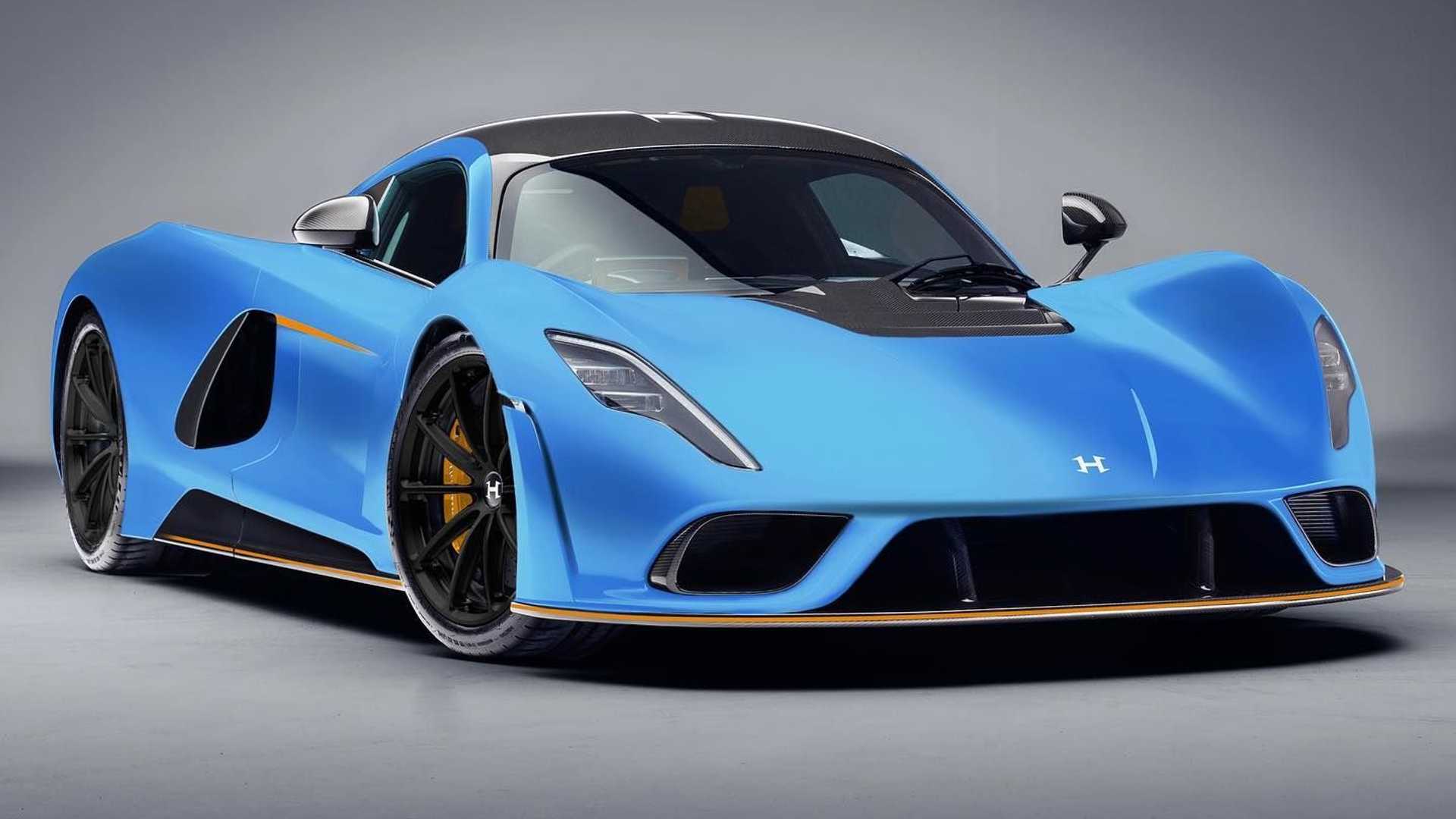
The Venom F5, with over 1,800 CV, is one of the biggest beasts on the road today, and Hennessey has presented its first personalised example, made to order
The Hennessey Venom F5 is one of the largest hypercars of all time and, like all good things, it is worth the wait. The Texas-based company has already announced that production of these beasts will begin in the coming months, coinciding with the 30th anniversary of the company, founded by John Hennessey in 1991 out of his passion for cars.
Now, to whet our appetite, Hennessey has shown us the first images of its first model personalised to the customer’s taste, which, to be honest, looks spectacular.
Price and exclusivity on the same level
The personalised model is for businessman Howard Panes, one of the lucky few who will get one of the 24 units that will be produced in total of this ultra-exclusive supercar, priced at 2.1 million dollars.
The exterior is wrapped in a bright colour called Blue Arione that covers practically the whole bodywork, except for parts such as the front lip, the side skirts, the diffuser and the brake calipers, which are orange, a combination that will remind racing fans of the iconic livery of Gulf Oil.
Lots of carbon fibre
The interior features two bucket seats made of carbon fibre – a material used in virtually all the trim of its cabin – upholstered in bright orange leather to match the exterior details we have already mentioned.
The Formula 1-style steering wheel in carbon fibre and orange leather is a clear sign that this is a car costing several million dollars, one that will be needed to tame this beast of stratospheric figures.
Power by the bucketload
Its heart is a 6.6-litre V8 with a twin-turbocharged system producing an incredible 1,817 CV and 1,617 Nm of torque, which will allow it to go from 0 to 100 km/h in under 3 seconds and from 0 to 200 km/h in under 5 seconds.
These incredible figures are not down to the 1,817 CV alone, but also to its lightweight carbon fibre monocoque chassis, which weighs only 1,338 kg, giving a power-to-weight ratio of 1.35 CV per kilo. The goal of this beast is to surpass 500 km/h, a speed more fitting for a fighter jet than a car.


 Peugeot E-208 GTi: a battery-powered toy that revives the spirit of the 1980s sports cars
 New Lexus ES: luxury grows and goes electric
 First contact with the Dacia Sandero Hybrid 155: power and efficiency from €19,890
Deja un comentario