Hyundai Santa Fe Volvo XC90 Hybrid Cars Comparisons Tests SUV
Hyundai Santa Fe PHEV vs Volvo XC90 Recharge: seven seats, two philosophies of efficiency
 Iván Navarro
22 May 2026
5 min.
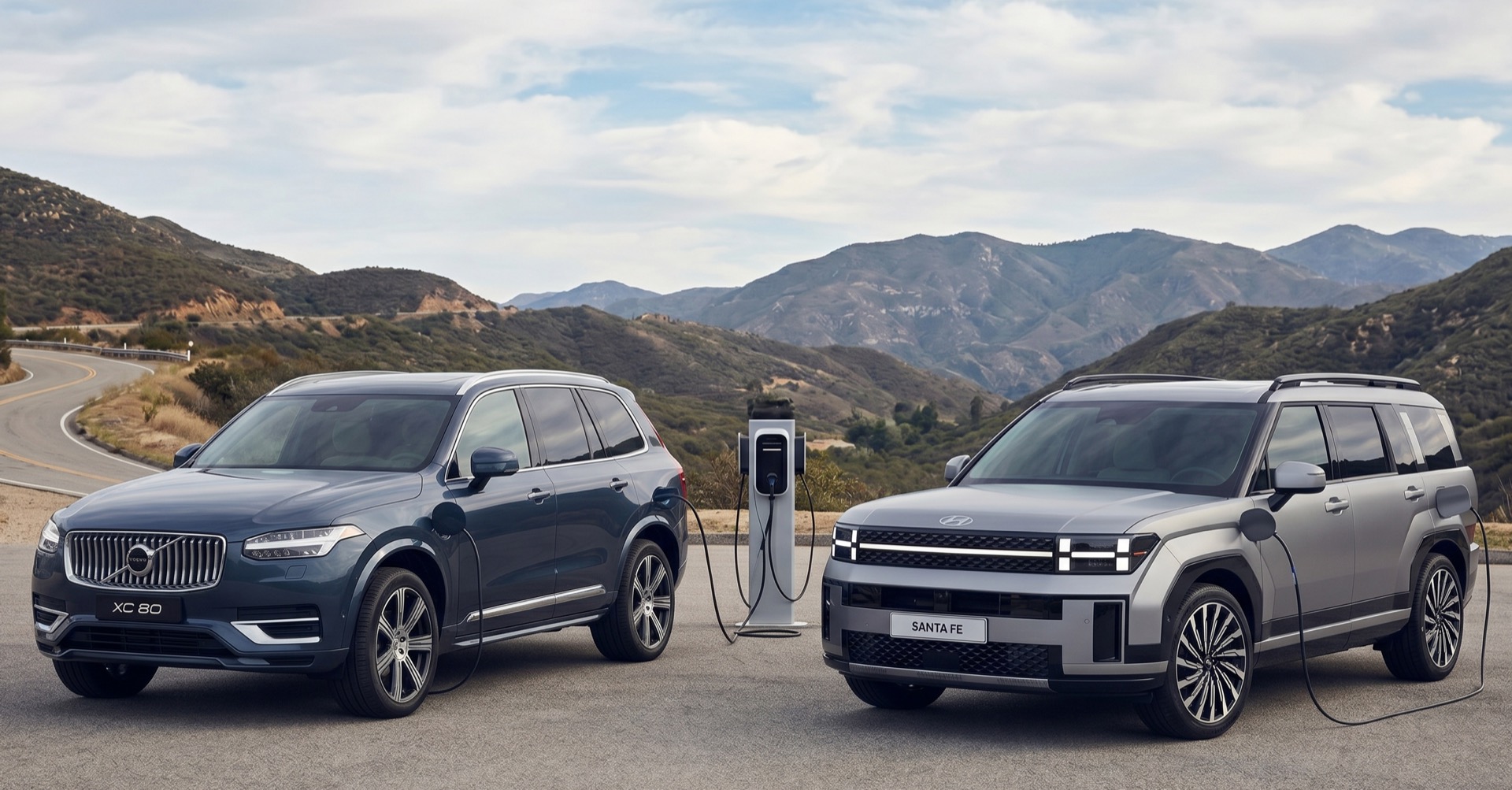
We compare the Hyundai Santa Fe PHEV and the Volvo XC90 Recharge T8, two seven-seat plug-in hybrid SUVs that defend opposing visions of premium family efficiency in Spain.
The seven-seat family SUV segment with plug-in hybrid technology has become one of the most demanding in the Spanish market. Two contenders currently attract the attention of those looking for space, a CERO label and useful electric range for everyday driving: the Hyundai Santa Fe PHEV and the Volvo XC90 Recharge T8. One embodies accessible efficiency, the other Scandinavian refinement. Both share the idea that a large family does not have to give up plugging in.
Two ways of understanding the plug-in family SUV
Seven-seat SUVs with plug-in hybrid powertrains are no longer niche models. Asian, European and emerging brands, from Hyundai to up-and-coming names such as Changan Deepal or Geely, are redefining what it means to move seven people on less than a litre of petrol per 100 homologated kilometres. Within that landscape, Volvo maintains its premium discourse with a mature recipe: the XC90 Recharge T8.
Hyundai Santa Fe PHEV: Asian efficiency down to the detail (from €60,200)
The consumption and electric range of the Santa Fe PHEV neatly sum up the Korean proposition. With a supercharged 1.6 T-GDi system and an electric motor, Hyundai offers around 253 CV combined, a 13.8 kWh battery and a WLTP electric range close to 54 km, enough for daily urban and peri-urban journeys. Its new design language, with its H-shaped front and a cabin where third-row space is among the most usable in the segment, reinforces its character as an SUV designed for real families.
| Power kW | Power CV | Top speed | Electric range | Consumption | Label | Fuel |
|---|---|---|---|---|---|---|
| 186 kW | 253 CV | 187 km/h | ~54 km WLTP | 1.6 L/100km | CERO | PHEV |
Volvo XC90 Recharge T8: the Scandinavian premium with a plug (from €91,150)
The XC90 Recharge T8 is, even today, one of the benchmarks among seven-seat plug-in hybrid family SUVs. Volvo combines a 2.0 turbo and supercharged engine with a high-output electric motor, reaching 455 CV combined and a WLTP electric range of around 70 km thanks to its 18.8 kWh battery. Acceleration, acoustic refinement, fine materials and serene driving place it in a different emotional league. The price of the Volvo XC90 Recharge T8 starts well above the Santa Fe, but so does its technology and safety content.
| Power kW | Power CV | Top speed | Electric range | Consumption | Label | Fuel |
|---|---|---|---|---|---|---|
| 335 kW | 455 CV | 180 km/h | ~70 km WLTP | 1.1 L/100km | CERO | PHEV |
Real alternatives on the Spanish market
MG HS PHEV (from ~€37,000)
MG Motor has shaken up the segment with an aggressively priced HS PHEV. It does not offer seven seats, but it enters any rational buyer’s conversation who values an electric range above 100 km WLTP. The British manufacturer’s proposition shows that efficiency is no longer the preserve of premium brands.
| Power kW | Power CV | Top speed | Electric range | Consumption | Label | Fuel |
|---|---|---|---|---|---|---|
| 249 kW | 339 CV | 200 km/h | 103 km WLTP | 0.54 L/100km | CERO | PHEV |
EBRO s700 PHEV (from ~€37,700)
The revived EBRO bets on a PHEV crossover with notable figures. EBRO does not compete in seven seats, but its s700 PHEV offers clear benchmarks for what is expected today from accessible plug-in efficiency.
| Power kW | Power CV | Top speed | Electric range | Consumption | Label | Fuel |
|---|---|---|---|---|---|---|
| 255 kW | 347 CV | 180 km/h | 90 km WLTP | 0.8 L/100km | CERO | PHEV |
The context: new players and mainstream references
Brands such as Changan Deepal and Geely are landing in Europe with plug-in hybrid proposals that will look the Santa Fe straight in the eye. Changan Deepal, in particular, is preparing models with high electric ranges and multi-energy architectures. Geely, a shareholder in Volvo, shares platforms and know-how, which explains much of the XC90’s maturity. On the mainstream side, Citroën keeps its comfort-focused discourse with the C5 Aircraft and family proposals such as the electric e-Berlingo; Citroën does not yet play in the seven-seat PHEV SUV segment, but its philosophy of accessible family mobility is an essential reference. Neither Citroën nor the newcomers yet rival the Santa Fe head-on, but they frame the competitive context.
Summary table and score
| Model | Seats | Electric range | Power | Price from | Score /10 |
|---|---|---|---|---|---|
| Hyundai Santa Fe PHEV | 7 | ~54 km | 253 CV | from €60,200 | 8.7 |
| Volvo XC90 Recharge T8 | 7 | ~70 km | 455 CV | from €91,150 | 9.0 |
| MG HS PHEV | 5 | 103 km | 339 CV | ~€37,000 | 8.2 |
| EBRO s700 PHEV | 5 | 90 km | 347 CV | ~€37,700 | 7.9 |
Conclusion: which is the best seven-seat plug-in hybrid SUV in 2025?
If the question is which is the best seven-seat plug-in hybrid SUV in 2026, the answer depends on your budget and value priorities. The Hyundai Santa Fe PHEV is the champion of rationality: real seven seats, generous equipment, CERO label and a noticeably lower price. The Volvo XC90 Recharge T8 remains aspirational, refined and technically brilliant, although its deep renewal is still awaited. Between the two, two philosophies; one certainty: Spanish families finally have seven-seat PHEV options worth considering.
Note: the prices indicated correspond to the manufacturer’s recommended retail price, without taking into account current offers, dealer discounts, one-off campaigns or purchase grants.
Frequently asked questions
How much real electric range does the Hyundai Santa Fe PHEV offer?
In realistic mixed use, the Santa Fe PHEV achieves around 40-45 km of effective electric driving compared with the ~54 km homologated WLTP, enough for daily urban journeys without resorting to the petrol engine.
Does the Volvo XC90 Recharge T8 keep seven seats with the battery installed?
Yes. Volvo designed the SPA platform to house the battery in the central tunnel, preserving three rows of seats without sacrificing significant cargo space.
Which DGT label do both models carry?
Both the Santa Fe PHEV and the XC90 Recharge T8 display the CERO emissions label, as they comfortably exceed 40 km of homologated electric range.
Is it worth paying the price difference between the Santa Fe PHEV and the XC90 Recharge?
It depends on use. If performance, premium materials and greater electric range are valued, the XC90 justifies it. For rational family use with priority on space and cost, the Santa Fe PHEV offers a value/content ratio that is hard to beat.
Technical specifications of the cars in this article


 Kia offers an electric range of 10 models, 50 versions and 400 possible combinations
 The seven finalists for the 2027 European Car of the Year (COTY) are exclusively electric
 Peugeot E-208 GTi: a battery-powered toy that revives the spirit of the 1980s sports cars
Deja un comentario