911 Porsche Coches clásicos Sports Cars
If you have 395,000 euros to spare, you can now have a lightweight, open-top Porsche 912 thanks to the KAMM 912c Targa.
 David Lopez @espacionblanco
17 January 2025
4 min.
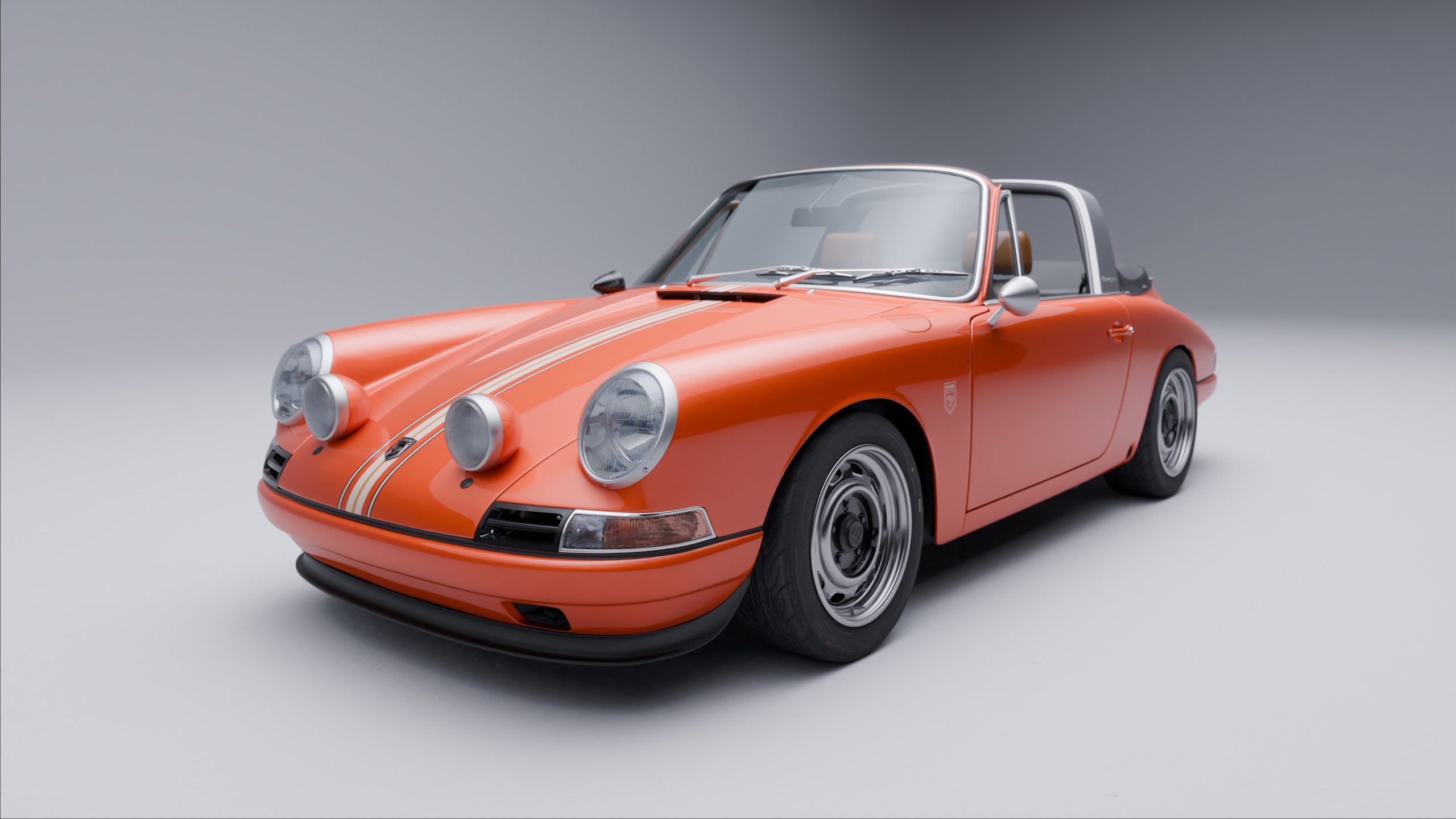
If KAMManufaktur surprised the world last year with the 912c, now, just one year later, it expands its range with the 912c Targa, full of unique details.
Owning a Porsche 911 in any of its generations was not within everyone’s reach, much less in its early generations, where affording such a luxury was within the reach of very few people. Even so, Porsche did its best to bring the 911 closer to a larger number of customers and, among its many variants, between 1965 and 1969 there existed a 911 we could consider affordable: the 912.
During those years around 30,000 units of the 912 were built in coupé bodywork and some 2,500 units with Targa bodywork, which, as you can imagine, are highly sought after today despite being a modest 911. To an untrained eye, the 911 barely differed from a top-spec version; in fact, the difference lay in the engine it carried, a flat engine that changed to a four-cylinder of 1,600 cc producing 95 CV, replacing the six-cylinder 2,000 cc flat engine.
Today the 912 is once again in the spotlight thanks to the Hungarian manufacturer KAMManufaktur and the design and engineering exercise they have carried out with its 912c, which is simply taking a donor model, lightening it to the maximum and giving the engine more power, seasoned with the personal touch of this tuner. The result is a truly spectacular recipe: a restomod that certainly draws attention for the detail with which it has been executed, while respecting the historical legacy of this model.
At the beginning of last year KAMManufaktur presented the 912c, that is, with coupé bodywork, and now they are doing the same with the Targa version, named, as it could not be otherwise, 912c Targa. The recipe begins with the same goal: achieving maximum lightness while keeping the original bodywork as much as possible. From there it features elements such as the front bonnet, front wings, doors, front bumper, rear boot lid, rear bumper and several interior, structural and engine parts in carbon fibre.
It has other details where special attention was paid to reducing weight: if you look at the photos, the 16-inch wheels appear to be steel, but they are actually aluminium with a classic design, and there is also the option to fit carbon-fibre wheels in the style of the 917. There are other details such as the carbon-fibre mirrors created by KAMManufaktur, based on those carried by the Talbot 3000, or the front splitter and floor covering, designed to improve aerodynamics.
The already distinctive touch of the Hungarian manufacturer on the KAMM 912c Targa comes with elements such as the Cibie auxiliary headlights or the roof rack, also in carbon fibre, on which you can even carry a surfboard created by KAMManufaktur itself. Inside, you can have everything from heated seats to carbon-fibre competition seats, multiple FIA-spec belts and harnesses, a classic-style Fusina Racing steering wheel, and even comforts such as air conditioning or a high-quality sound system with Morel speakers.
Mechanically it continues with the improvements to the 1,600 cc four-cylinder flat engine already seen in the coupé version, so the KAMM 912c Targa also goes up to 2,000 cc and delivers 185 CV, along with a torque of 205 Nm, sent to the rear axle through a dog-leg five-speed gearbox upgraded by KAMManufaktur, plus a limited-slip differential signed by ZF and a competition hydraulic clutch of Porsche. It has also been fitted with a high-performance exhaust, a TracTive semi-active coilover suspension front and rear, and Brembo brakes with ventilated discs.
All this design and engineering exercise does not come cheap, nor is it suitable for every budget: to have a 912c Targa in your garage you will have to spend no less than 395,000 euros, although a restomod on the level of those built by KAMManufaktur certainly deserves it.
Technical specifications of this car


 Kia offers an electric range of 10 models, 50 versions and 400 possible combinations
 The seven finalists for the 2027 European Car of the Year (COTY) are exclusively electric
 Peugeot E-208 GTi: a battery-powered toy that revives the spirit of the 1980s sports cars
Deja un comentario