9 OMODA Hybrid Cars Review SUV
In-depth analysis of the Omoda 9: is the premium Chinese SUV that challenges European benchmarks?
 Iván Navarro
22 June 2026
5 min.
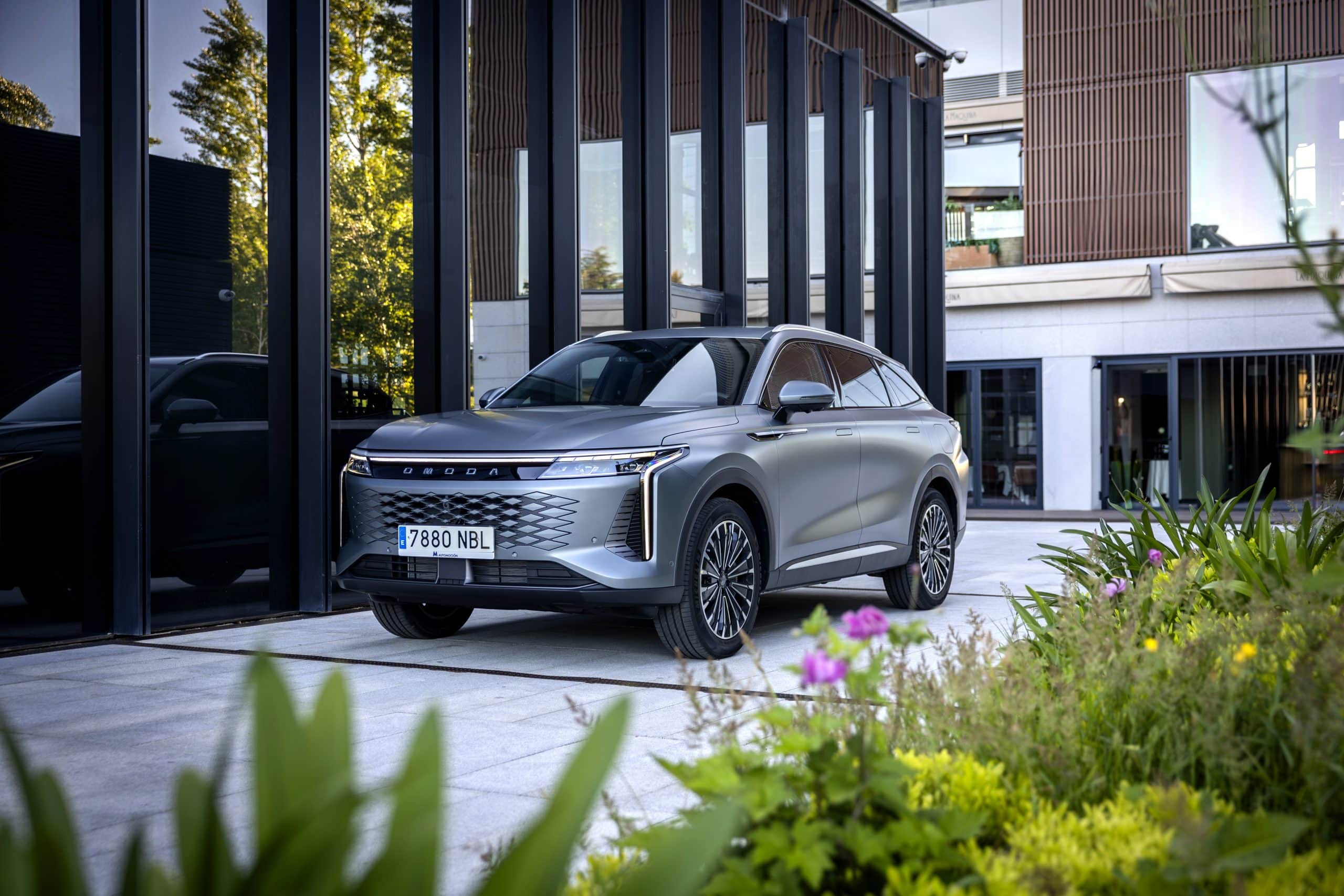
We tested the Omoda 9 PHEV, the premium Chinese SUV with 540 hp and 150 km of electric range, on sale in Spain from €52,900, which goes head-to-head with the BMW, Audi, Volvo and Mercedes-Benz.
In just a few years, the arrival of Omoda in Spain has gone from Asian curiosity to a full-blown offensive. With the Omoda 9 the brand makes the leap into the D-Premium segment with a plug-in hybrid that, on paper, is quite intimidating: 540 hp, 150 km of electric range and a price that sits below any equivalent German rival. The question is inevitable: is this the premium Chinese SUV that finally forces Munich and Ingolstadt to look in the mirror?
Omoda 9: the leap into the premium segment for the Chinese brand
Omoda started out as an aspirational sub-brand within the Chery group, and the 9 is its flagship. While the 5 and the 7 compete in accessible compacts, the 9 enters the ring of five-metre SUVs with the SHS –Super Hybrid System– technology, a dual-electric-motor PHEV architecture aimed squarely at the European benchmarks of the segment.
Positioning against the BMW, Audi, Volvo and Mercedes
The Omoda 9 starts at approximately €52,900 in Spain in its 1.5 TGDi 537 Premium AWD PHEV version, a figure that sits between €10,000 and €20,000 below a BMW X3 xDrive30e, Audi Q5 TFSI e, Volvo XC60 Recharge or equivalent Mercedes-Benz GLC 300 e. The commercial argument is compelling: complete premium equipment as standard and power figures that the German models would require stepping up to M, S line or AMG Line versions to match.
Design and presence: an SUV that doesn’t go unnoticed
Exterior lines and dimensions
At 4.77 metres long, the 9 adopts a formal language close to that of European SUVs: long bonnet, pronounced shoulders, steeply raked rear glass and a front grille split into small illuminated geometric pieces. It isn’t as disruptive as a Lexus nor as minimalist as a Volvo, but rather a fairly successful synthesis of current trends.
Cabin and perceived materials
Inside, Omoda opts for a 24.6-inch curved double screen, seats with massage function, a 14-speaker Sony sound system and a panoramic roof as standard. Perceived quality is high—well-finished synthetic leathers, soft-touch plastics in the contact areas—although some details on the centre console show that the brand does not yet have the fine-finish refinement of the German benchmarks.
Mechanics: the Omoda 9 PHEV under the microscope
Combined power and AWD traction
The Omoda 9 PHEV combines a 1.5 TGDi turbo petrol engine with two electric motors—one per axle—to deliver a combined output of around 540 hp (≈400 kW) and all-wheel drive. The transmission is a dedicated three-speed DHT gearbox designed specifically for hybrid systems, which prioritises electric propulsion and reserves the combustion engine for generating power and providing reinforcement at high speeds.
Battery, electric range and consumption
The battery of approximately 34.5 kWh is generous for a PHEV: the homologated electric range of the Omoda 9 is around 150 km WLTP, a figure that far exceeds the segment average (between 80 and 110 km for its rivals). The homologated combined consumption stands at around 1.5 l/100 km with CO₂ emissions of about 40 g/km, enough to earn the CERO label from the DGT.
| Power kW | Power hp | Top speed | Electric range | Consumption | Label | Fuel |
|---|---|---|---|---|---|---|
| ≈400 kW | ≈540 hp | ≈180 km/h | ≈150 km | ≈1.5 l/100 km | CERO | PHEV |
Omoda 9 test: dynamic behaviour
In the city and on open road
In electric mode the 9 moves with the smoothness expected of a car that reserves the combustion engine for emergencies. The steering is light, perhaps too light, and the suspension filters urban potholes well. On the motorway, the 540 hp figure allows dazzling overtakes, although the tuning prioritises comfort over precision: here a BMW X3 or a Audi Q5 retain the dynamic advantage.
Driving modes and refinement
The system offers several modes—EV, hybrid, sport, off-road—with a transition between combustion and electric that is one of the car’s strong points: imperceptible in 90% of cases.
Standard equipment and technology
The Premium trim includes as standard a head-up display, level 2 semi-autonomous driving, four-zone climate control, electric memory seats, cooled wireless charging and a hands-free electric tailgate. It is one of the car’s strongest arguments: what it offers as standard would easily add €8,000–12,000 in options on a German equivalent.
Strengths and reasonable doubts
In favour: unbeatable equipment-to-price ratio, record electric range for the segment, sports-car combined power, a generous warranty and the CERO label.
Doubts: dealer network still expanding, residual value at 3–4 years to be confirmed, fine dynamic tuning that does not reach the level of the German benchmarks, and a brand whose premium perception will have to be built over years.
Conclusion: a real threat to the Germans?
The Omoda 9 is not an experiment: it is a serious, well-executed product with aggressive positioning. It does not dethrone an BMW X3 or a Mercedes GLC in dynamic purity or prestige, but it offers a value-for-money equation that no European rival can match today. For the rational buyer with a CERO label on the horizon, it is a must-see.
Frequently asked questions
What is the real electric range of the Omoda 9 PHEV?
The WLTP homologation is around 150 km, an exceptional figure for the segment. In real-world use, expect between 110 and 130 km depending on driving style and temperature.
How much does the Omoda 9 cost in Spain?
The indicative RRP starts at approximately €52,900 for the 1.5 TGDi 537 Premium AWD PHEV version, excluding discounts and grants.
Does it have a DGT CERO label?
Yes. Its 150 km of electric range and emissions of around 40 g/km of CO₂ earn it the CERO label, with all its tax and traffic advantages.
Is it better than a BMW X3 or a Audi Q5?
It depends on the criteria. In equipment, power and price, the Omoda 9 is superior. In dynamic refinement, brand prestige and medium-term residual value, the Germans still have the edge.
Technical specifications of this car

 Peugeot E-208 GTi: a battery-powered toy that revives the spirit of the 1980s sports cars
 New Lexus ES: luxury grows and goes electric
 First contact with the Dacia Sandero Hybrid 155: power and efficiency from €19,890
Deja un comentario