Hyundai KIA Santa Fe Sorento Hybrid Cars Comparisons Tests SUV
KIA Sorento vs Hyundai Santa Fe: a duel between two 7-seat Korean hybrid SUVs under 55,000 euros
 Iván Navarro
11 November 2026
5 min.
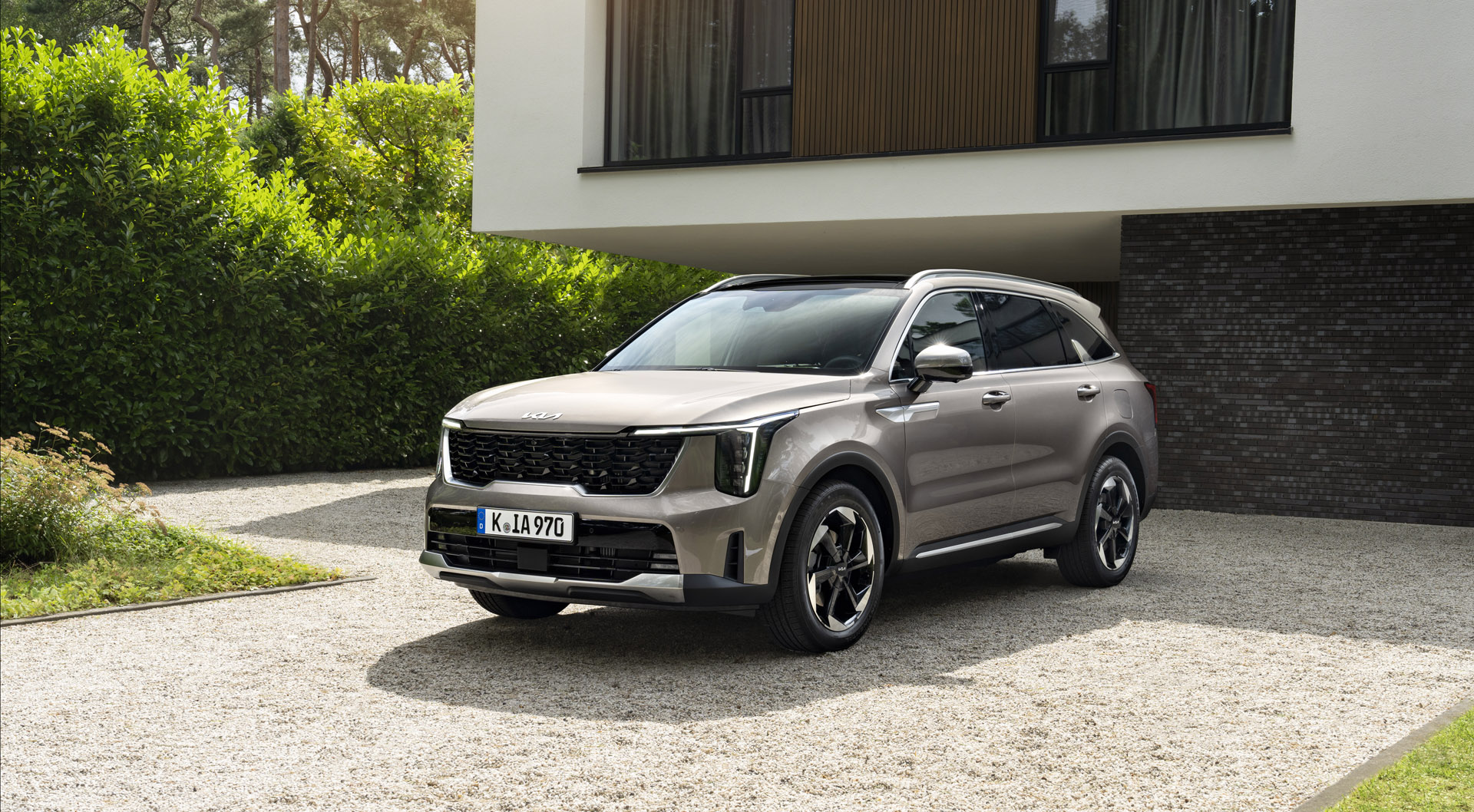
We compare the Kia Sorento PHEV and the Hyundai Santa Fe HEV, the two most relevant 7-seat Korean SUVs with an ECO label on the Spanish market. Deep electrification versus simplicity and price: that is how the ground is divided.
Few rivalries sum up the state of the Korean family SUV as well as this one. Two sister brands, two different electrification philosophies, and one shared goal: fitting seven seats, towing capacity and an environmental label into a single vehicle without giving up anything. The Kia Sorento PHEV and the Hyundai Santa Fe HEV share a group platform but not an approach, and that is exactly what makes them interesting to pit against each other.
Kia Sorento PHEV: deep electrification from 61,445 €
The Sorento has taken the leap that many large SUVs still don’t dare to take: a plug-in hybrid with all-wheel drive as standard. The Hybrid PHEV 1.6 T-GDi 252 Drive 4×4 5-door 7-seat Auto. version combines a petrol engine with an electric system delivering 185 kW (252 CV) combined, backed by a 13.8 kWh battery that allows up to 55 km in zero-emission mode. For a typical urban commute — school, work, the trip home — that can mean not touching the fuel tank all week.
| Model | Power | Top speed | Electric range | Consumption | CO₂ emissions | Fuel | Price from |
|---|---|---|---|---|---|---|---|
| Kia Sorento Hybrid PHEV 252 Drive 4×4 | 185 kW / 252 CV | 183 km/h | 55 km | 1.6 l/100 km | 37 g/km | PHEV (petrol/electric) | 61,445 € |
Hyundai Santa Fe HEV: simplicity and a disruptive design from 56,020 €
The Santa Fe plays a different game. No plug, no charging to manage: conventional hybridisation, unlimited range on the fuel tank, and a silhouette that breaks with everything the brand has done before. Straight lines, a squared-off rear, an almost classic off-roader air that sets it apart from the typical “capsule” SUV. The HEV 1.6 TGDi 239 Maxx 5-door S/S Auto. version features a 176 kW (239 CV) powertrain, reaches 196 km/h and averages around 6.4 l/100 km officially.
| Model | Power | Top speed | Consumption | CO₂ emissions | Fuel | Price from |
|---|---|---|---|---|---|---|
| Hyundai Santa Fe HEV 239 Maxx | 176 kW / 239 CV | 196 km/h | 6.4 l/100 km | 144 g/km | Hybrid (petrol/electric) | 56,020 € |
Prices are the manufacturer’s recommended retail prices, indicative only, excluding dealer discounts or one-off campaigns — worth bearing in mind before comparing final figures.
Design: technological capsule versus sculpted block
The Sorento keeps the evolutionary language of Kia: a stylised “tiger nose” grille, softened proportions, a design that ages well but doesn’t surprise. The Santa Fe, by contrast, opts for an almost blocky body, with pronounced wheel arches and a rear that recalls the American off-roaders of the nineties reinterpreted. It is undoubtedly the SUV that generates the most conversation in the supermarket car park.
Spaciousness and real family use
Both offer genuine seven-seat configurations for occasional use in the third row, with a boot that suffers when those rear seats are folded flat — common in the segment. The Sorento adds the nuance of the battery under the floor, which in some PHEV configurations slightly reduces the boot space compared with its sibling. The Santa Fe, not carrying such bulky cell packs, keeps a flatter floor in the cargo area.
Mechanics and driving behaviour
Here is the difference that truly separates these two cars. The Sorento, with standard all-wheel drive and instant electric torque, handles slippery surfaces or compacted gravel tracks better — without being a pure off-roader, it feels more capable off the asphalt. The Santa Fe HEV prioritises smooth transitions between the combustion and electric motors, with more predictable motorway driving, though without the all-wheel-drive reserve in all its versions.
Consumption and environmental label
The Sorento carries a ZERO label in electric mode and an ECO label in hybrid mode, with an official consumption of just 1.6 l/100 km which, honestly, only holds if you charge it diligently. Anyone who doesn’t plug the car in every night will see that figure climb well above it. The Santa Fe, with an ECO label, offers a more realistic and consistent consumption of 6.4 l/100 km, with no surprises or fine print linked to charge management.
Comparative summary table
| Model | Power | Electric range | Consumption | Price from | Score |
|---|---|---|---|---|---|
| Kia Sorento PHEV 252 Drive 4×4 | 252 CV | 55 km | 1.6 l/100 km | 61,445 € | 8.3/10 |
| Hyundai Santa Fe HEV 239 Maxx | 239 CV | — | 6.4 l/100 km | 56,020 € | 8.0/10 |
Which one to choose based on your profile?
If your daily commute fits within 55 km and you have somewhere to plug in, the Sorento PHEV more than pays back its premium of roughly 5,425 € in fuel savings — and on top of that, it adds all-wheel drive for snow or the track to the country house. If you prefer not to depend on a charger, want the lowest entry price in the segment and are drawn to a design that breaks the mould, the Santa Fe HEV delivers without complications. Those looking for something more compact within the family SUV world can also check our comparison of comfortable family SUVs for long journeys, where this dilemma between plug-in and conventional hybridisation repeats itself in other segments.
Anyone wishing to explore public purchase incentives should check the current conditions of the Plan Auto+ on the official website, as the amounts change frequently and it’s wise not to rely on any figure that isn’t up to date.
Frequently asked questions
What is the real difference between the Kia Sorento PHEV and the Hyundai Santa Fe HEV?
The Sorento is a plug-in hybrid with 55 km of electric range and standard all-wheel drive; the Santa Fe is a conventional hybrid without a plug, simpler to use and cheaper to get into.
Which is cheaper to run day to day?
It depends on use. The Sorento can cost less if you charge it daily on short trips; the Santa Fe offers a more stable and predictable consumption without depending on a charging point.
Do both have the DGT environmental label?
Yes: the Sorento PHEV carries a ZERO/ECO label depending on the mode of use, while the Santa Fe HEV runs with an ECO label.
Which of the two is better for long journeys with seven occupants?
The Santa Fe is somewhat more versatile in boot space with the third row folded flat, while the Sorento compensates with better traction if the journey includes sections of track or snow.
Technical specifications of the cars in this article


 Kia offers an electric range of 10 models, 50 versions and 400 possible combinations
 The seven finalists for the 2027 European Car of the Year (COTY) are exclusively electric
 Peugeot E-208 GTi: a battery-powered toy that revives the spirit of the 1980s sports cars
Deja un comentario