Mercedes Electric Cars Supercars
Mercedes-AMG reveals new details about the success on the track of its GT XX prototype
 Javier Cantagalli
31 August 2025
3 min.
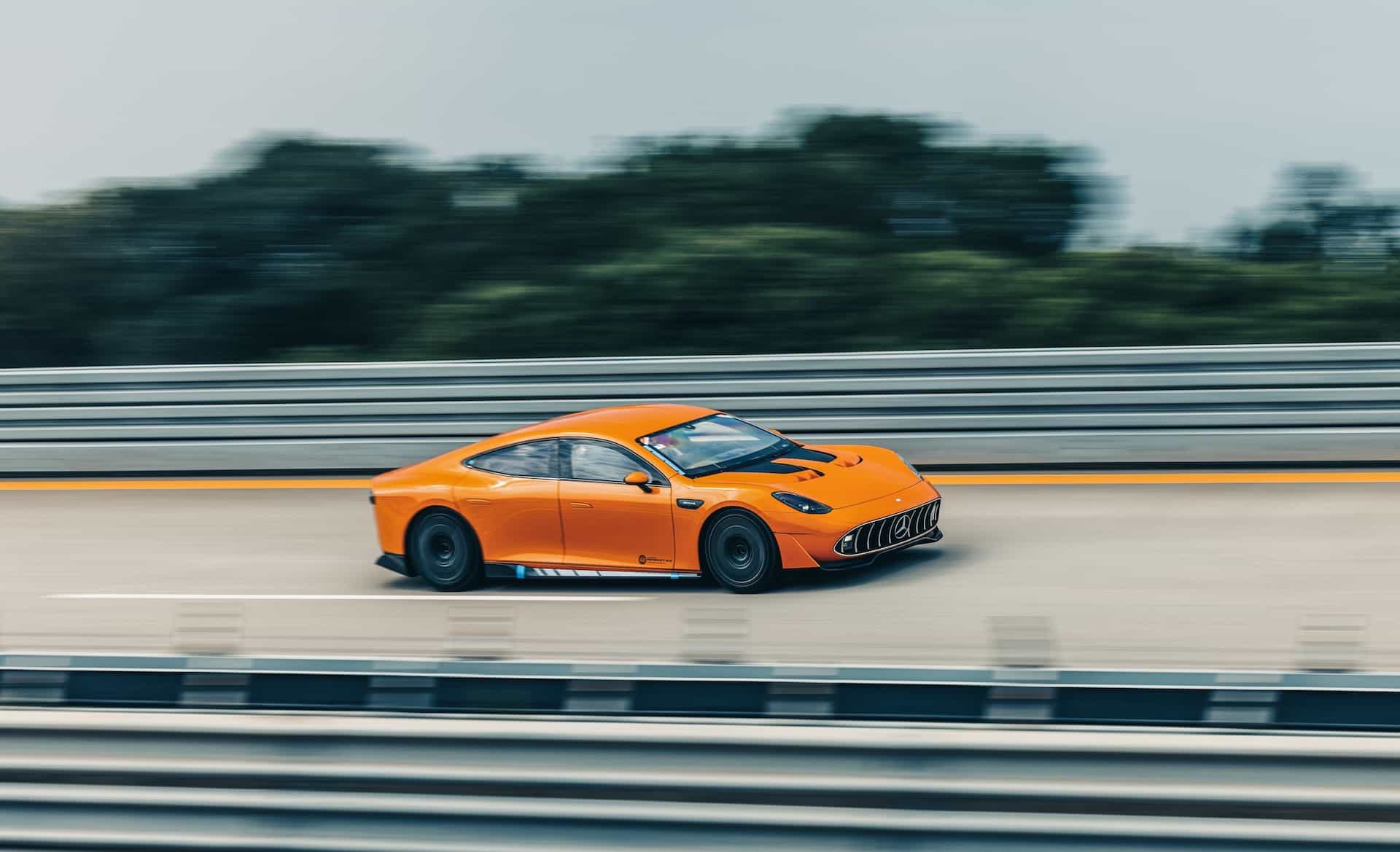
The spectacular performance of the GT XX prototype from Mercedes-AMG will not only serve the German manufacturer to appear in record books, since many of the innovations used will soon make their way into its electric series-production models.
A week ago, we referred in another article to the spectacular success achieved by Mercedes-AMG at the Italian high-speed circuit of Nardò with the AMG GT XX prototype. The German manufacturer managed to cover over 40,075 kilometres in less than eight days with this electric supercar, setting a new benchmark in an endurance test with an electric vehicle. And this was only one of the many records that were broken.
Mercedes-AMG has now shared new details about the vehicle’s innovative cooling system, its operating strategy and the ultra-rapid charging stops at a prototype charging point from Alpitronic, which made this feat possible.
On the Nardò test track, two AMG GT XX prototypes broke 25 records. The first vehicle managed to cover 40,075 kilometres, a distance equivalent to the circumference of the Earth at the equator, while the second finished just 25 kilometres behind the first. With an optimal cruising speed of 300 km/h, both vehicles faced extreme demands. According to the German manufacturer, this success was only possible thanks to an advanced propulsion system, an innovative integrated cooling system, maximum-level aerodynamics and an optimised operating strategy.
Optimising the number of charging stops is more important than being the fastest on the track
Each prototype incorporated three axial flux motors from Yasa, a subsidiary of Mercedes-Benz, and a battery pack with direct cooling, technologies that will enter production in the AMG.EA high-performance architecture next year. Previous simulations determined that the optimal speed for reaching the set targets was 300 km/h, since although both vehicles are capable of higher speeds, even at 360 km/h, consumption would rise disproportionately and the distance covered between each charge would be reduced.
During the test, software developed by the Formula 1 engine division of Mercedes-AMG made it possible to compare the precalculated strategy with real conditions in real time, such as temperature, wind or tyre wear. The data, transmitted to the team’s Control Centre at Mercedes-AMG, allowed continuous adjustments to the duration of the stints and charging times.
As with any other electric vehicle, the charging stops were of notable importance to the final success achieved. Mercedes-AMG collaborated with Alpitronic to optimise the interaction between the vehicle and the charging station, using a prototype charging point capable of delivering 850 kW through a standard CCS cable, adapted with enhanced cooling. This enabled rapid and repeated charges, essential for minimising the time of each stop. The infrastructure at Nardò, which included medium-voltage connections and transformers, was installed in under three months with support from the Mercedes-Benz Charging Unit.
Cutting-edge technology
The cooling system of the AMG GT XX, with a battery pack featuring direct cooling and a “Central Coolant Hub” (CCH), ensured consistent performance in extreme conditions. This component, with high-capacity pumps and advanced valves, kept motors, inverters and electronics at optimal temperatures. Furthermore, a passive cooling plate on the underbody of the vehicle and the aerodynamics of these prototypes, with a drag coefficient of 0.19, helped substantially reduce energy consumption, which is of vital importance when driving at 300 km/h.
Following this success, Alpitronic highlighted that these tests demonstrate the feasibility of ultra-rapid charging, which in the near future will bring the experience of recharging series-production electric vehicles closer to that of refuelling with petrol, and will provide a significant boost to the transition to electric mobility.


 Peugeot E-208 GTi: a battery-powered toy that revives the spirit of the 1980s sports cars
 New Lexus ES: luxury grows and goes electric
 First contact with the Dacia Sandero Hybrid 155: power and efficiency from €19,890
Deja un comentario