F80 Ferrari Sports Cars Industry Technology
Michelin Pilot Sport Cup 2 R K1: the tyre developed in record time for the Ferrari F80
 Óscar Sanz
14 July 2025
3 min.
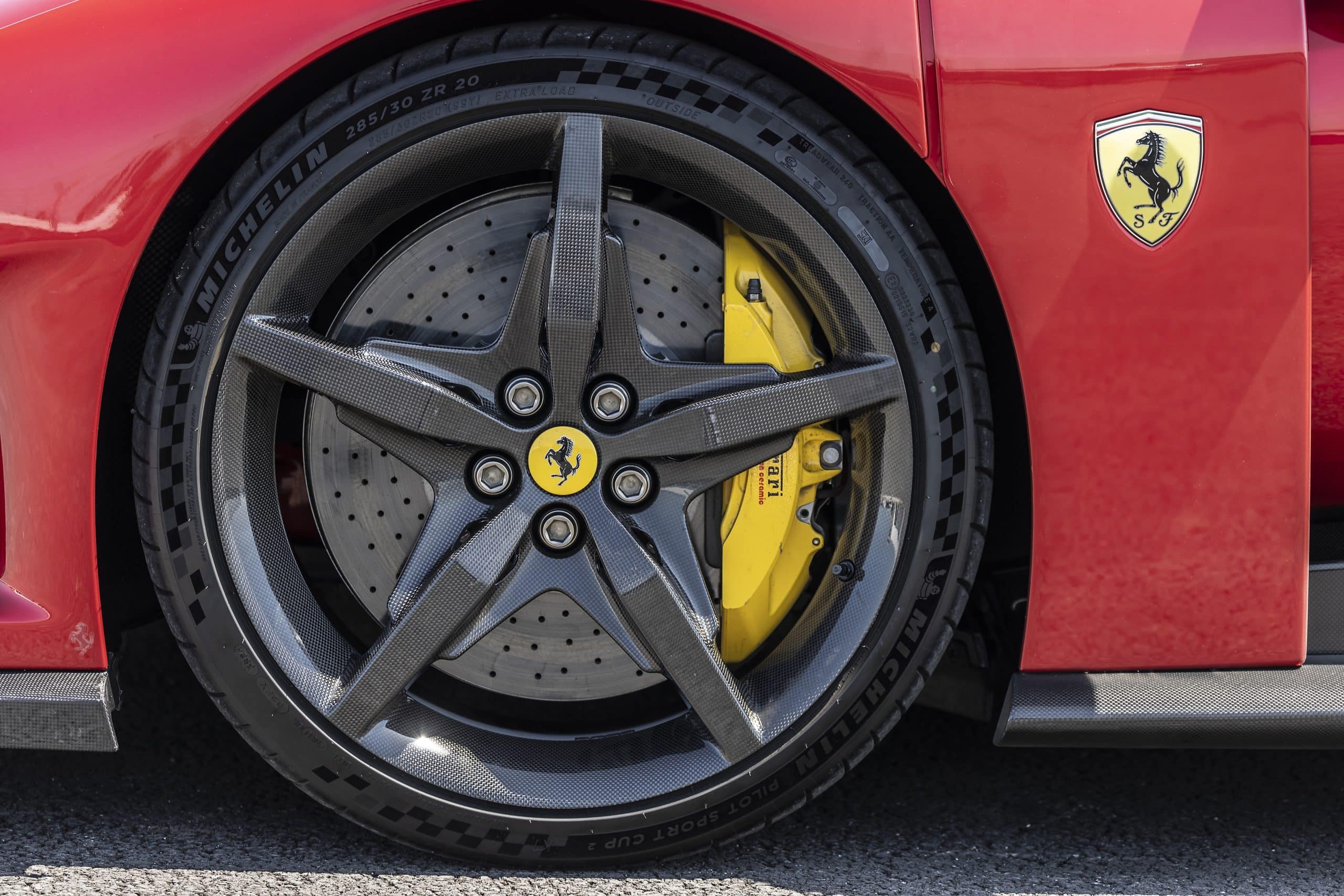
Michelin has developed a specific tyre in record time for the Ferrari F80, drawing on competition technologies, new simulation and manufacturing processes, and a clear commitment to efficiency
In just 15 months, Michelin has achieved what many in the industry considered practically unattainable: designing, developing and homologating a tyre capable of meeting the extreme demands of the new Ferrari F80, one of the most advanced and powerful sports cars ever built by the Maranello marque.
The result is the MICHELIN Pilot Sport Cup 2 R K1, a tyre that combines technologies inherited directly from competition with a completely revolutionary development and production process. It is not merely an evolution of an existing product, but a platform developed specifically for a vehicle that poses new challenges in terms of power, torque, aerodynamic downforce and top speed.
The Pilot Sport Cup 2 R K1 incorporates a series of technical innovations never before applied to a road tyre. Among them stands out a new rubber compound derived directly from competition, designed to deliver maximum grip in extreme driving conditions. Added to this is a reinforced two-ply radial carcass, optimised to withstand high-intensity vertical and lateral loads.
In addition, a new reinforcement technology in the tread has been introduced, which minimises the effects of centrifugal force at high speeds, helping to maintain stability and optimal contact with the road surface. This whole technological package translates into a tyre designed specifically to deliver extreme precision on dry surfaces, both on the track and on open roads.
Specific dimensions and full adaptation to the F80
The tyre has been developed in 285/30 R20 at the front axle and 345/30 R21 at the rear, a configuration that responds to the dynamic needs of the F80 and that has been precisely tuned from the earliest phases of the project.
A key element of this development has been the intensive use of advanced simulation, common in competition but still rare in the field of production tyres. From the pre-development phase—when the Ferrari F80 had not yet been physically built—Michelin worked hand in hand with Ferrari, using the brand’s dynamic simulator in Maranello. This made it possible to define the design and key characteristics of the tyre before a single prototype was manufactured.
Thanks to this strategy, the number of physical tests was reduced by between 20% and 30%, with a positive impact on development time and also on the carbon footprint of the project.
High-precision manufacturing: the C3M process
To ensure that each tyre meets the exact specifications defined during the simulation phase, Michelin has used its exclusive production process C3M. This technology, unique in the world, allows materials to be placed with micrometre precision and ensures very high reproducibility and uniformity between units.
The C3M process also contributes to the product’s sustainability, by reducing waste and improving the efficiency of material use. Furthermore, tyre production takes place at the Les Gravanches plant in Clermont-Ferrand, which has operated with net-zero carbon emissions since 2019 and has one of the lowest water consumption figures in the Michelin Group.
Technical specifications of this car


 Peugeot E-208 GTi: a battery-powered toy that revives the spirit of the 1980s sports cars
 New Lexus ES: luxury grows and goes electric
 First contact with the Dacia Sandero Hybrid 155: power and efficiency from €19,890
Deja un comentario