Panamera Porsche Sedans Sports Cars Mecánica
Porsche launches a fully customizable suspension in the new Panamera: Porsche Active Ride
 Óscar Sanz
13 December 2023
4 min.
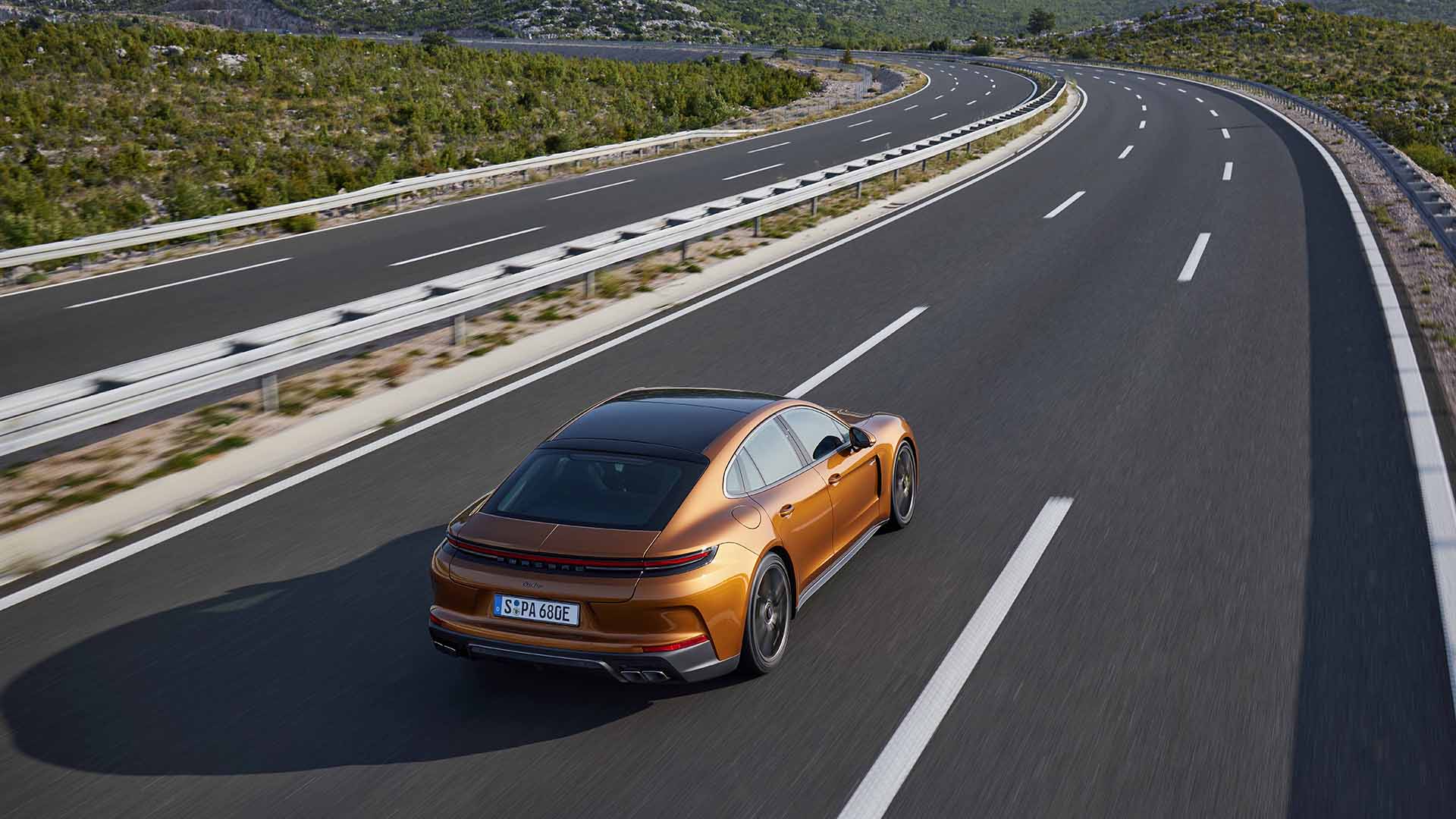
Porsche manages to combine sportiness and luxury with the new Porsche Active Ride suspension, which replaces conventional anti-roll bars with hydraulic pumps, allowing up to 13 different configuration modes
The perfect fusion is found when sportiness and luxury come together in a single car, and that is what they have achieved with this third generation of the incredible Porsche Panamera, which brings a design update and a suspension that lets us decide whether we want a luxury saloon or a sports car with the introduction of the revolutionary Porsche Active Ride suspension, a masterpiece that unites dynamism and comfort in a sports car like the Panamera.
From Porsche they have pushed the limits of chassis development to achieve optimal traction and acceleration through corners without sacrificing comfort on the road. The solution to this challenge comes with the optional Porsche Active Ride suspension, the product of six years of dedication and refinement by Porsche’s engineers.
Porsche Active Ride: saloon or sports car?
The magic of Porsche Active Ride lies in its ability to adapt to any driving situation, and it does away with conventional anti-roll bars, allowing the Panamera to absorb bumps independently thanks to the hydraulic pump that is electrically driven. Its bump compensation and filtering function ensures a smooth and pleasant ride, while its ability to keep the body almost motionless creates incredible grip on the road. Ingo Albers, Director of Driving Systems at Porsche, highlights: “The vehicle offers excellent control of body movements and yet is perfectly suited to the track”.
The system operates differently depending on the selected mode, whether Normal, Sport or Sport Plus, automatically eliminating pitch and roll in all programmes, keeping the body level and optimising wheel load distribution for exceptional grip in corners.
The suspension is not limited to its conventional function; it goes further by offering the ability to lean strategically in different directions. In corners, the Panamera can lean inward, similar to a motorcycle, thus increasing the sporty feel. In addition, it can dip forward under acceleration or back under braking, prioritising the comfort of the driver and occupants. An additional function raises the body to make getting in and out easier in tight spaces.
The control frequency is surprisingly fast: 13 adjustments per second, allowing instant adaptation to changing road conditions. Ingo Albers raises the possibility of dispensing with springs with the right design, although the Panamera incorporates single-chamber air springs to ensure an optimal balance between efficiency and performance.
Engine options for the new Panamera
Porsche Active Ride, although it requires a powerful energy source, is already available on the new Panamera Turbo E-Hybrid, powered by a 400-volt high-voltage battery. For the combustion variants, an adapted version is anticipated, while a version designed specifically for fully electric vehicles is under development.
In the case of the standard Panamera, it features a 2,894 cc V6 engine producing 353 CV of power and 500 Nm of torque. It accelerates from 0 to 100 km/h in 5.1 seconds and reaches a top speed of 272 km/h. The Panamera 4, with all-wheel drive and the same engine, reduces the acceleration time to 4.8 seconds and reaches a top speed of 270 km/h.
In a higher category is the Porsche Panamera Turbo E-Hybrid, a plug-in hybrid version featuring significant improvements in both the internal combustion engine and the electric system. Equipped with a new 3,996 cc V8 engine and a PDK gearbox that integrates a 140 kW electric motor in the same housing, this model achieves an impressive torque of over 900 Nm.
This Porsche delivers outstanding performance, with 680 CV and 930 Nm of torque, allowing it to accelerate from 0 to 100 km/h in just 3.2 seconds and reach an impressive top speed of 315 km/h.
Technical specifications of this car


 The seven finalists for the 2027 European Car of the Year (COTY) are exclusively electric
 Peugeot E-208 GTi: a battery-powered toy that revives the spirit of the 1980s sports cars
 New Lexus ES: luxury grows and goes electric
Deja un comentario