Special Test: From Geneva to Bratislava with the Mazda 6 Wagon 2.5 Skyactiv-G 192 CV
 Diego G. Moreira
28 March 2017
8 min.
Long-term road trip test with the new Mazda6 Wagon, equipped with the 2.5 Skyactiv-G 192 CV petrol engine and automatic gearbox. Route between Geneva and Bratislava
Once again, Highmotor was present at the Geneva Motor Show 2017, covering all the novelties at the Swiss event. Part of our team travelled by plane, like the vast majority of journalists from around the world who attend the Swiss event, while the rest of us preferred to continue with our long-term special tests across Europe and drive to Geneva. Precisely the motor capital of Switzerland has been the starting point of a route through Switzerland, Austria and Slovakia.
The star of this special test has been the Mazda 6 Wagon, although the most surprising thing is the engine chosen to cover so many kilometres, since we tested the petrol version equipped with the 2.5 Skyactiv-G engine with 192 CV and automatic gearbox. Over the coming days we will be going through the route day by day in a series of articles, with our driving impressions, curiosities about the different places we passed through, and we will see whether or not the choice of this Japanese car with almost 200 CV running on petrol was the right one.
The route we took starts in Geneva -passing through Lucerne and Zurich-, continues through Austria -Innsbruck, Salzburg- and reaches its destination in Vienna and Bratislava (the Slovak capital less than an hour from Vienna). Seven days of driving, to which must be added the days from Spain to Switzerland and back, covering a total of 11 days and 6,909 km.
Days 1 and 2: From Vigo to Pau and from Pau to Geneva [1,700 km]
Although the actual route began in Geneva, we had almost two days of travel to get there -and along the way- getting acquainted with the Mazda 6 Wagon and starting to discover our companion on the road. The journey through Spain was more monotonous (not because there is nothing to see) but because it was all motorway as far as the French city of Pau at the foot of the Pyrenees, making a 900 km stage.
On a Saturday morning, early (around 8 o’clock) we started the route from Vigo along the A-52 towards León, a route that is familiar and well known in Castile. In Benavente we took the A-66 towards León and once there we took advantage to stop for lunch, a very recommendable place to eat something light and cheap, tapas around the cathedral in the “barrio húmedo” of León. With our batteries recharged we left León via the A-231 motorway, which shares its route with the Camino de Santiago. It is a motorway with little traffic connecting León with Burgos, and somewhat monotonous.
The crossing of the Roncesvalles road was at night and with patches of snow on the road
In the final part of the route, after passing through Pamplona, we entered France via Roncesvalles, a place which, besides being on the Camino de Santiago, is an enclave at the foot of the Pyrenees very worth visiting, both the village itself and the surrounding area. The municipality has barely 33 inhabitants but it is a place of historical importance as an access point to the Iberian Peninsula since time immemorial, with interesting buildings to visit such as its churches and the museum. Along a road full of bends and with a light layer of snow on both sides, we climbed and descended the mountain until we reached the French border and then Pau (our resting point after the first day of driving).
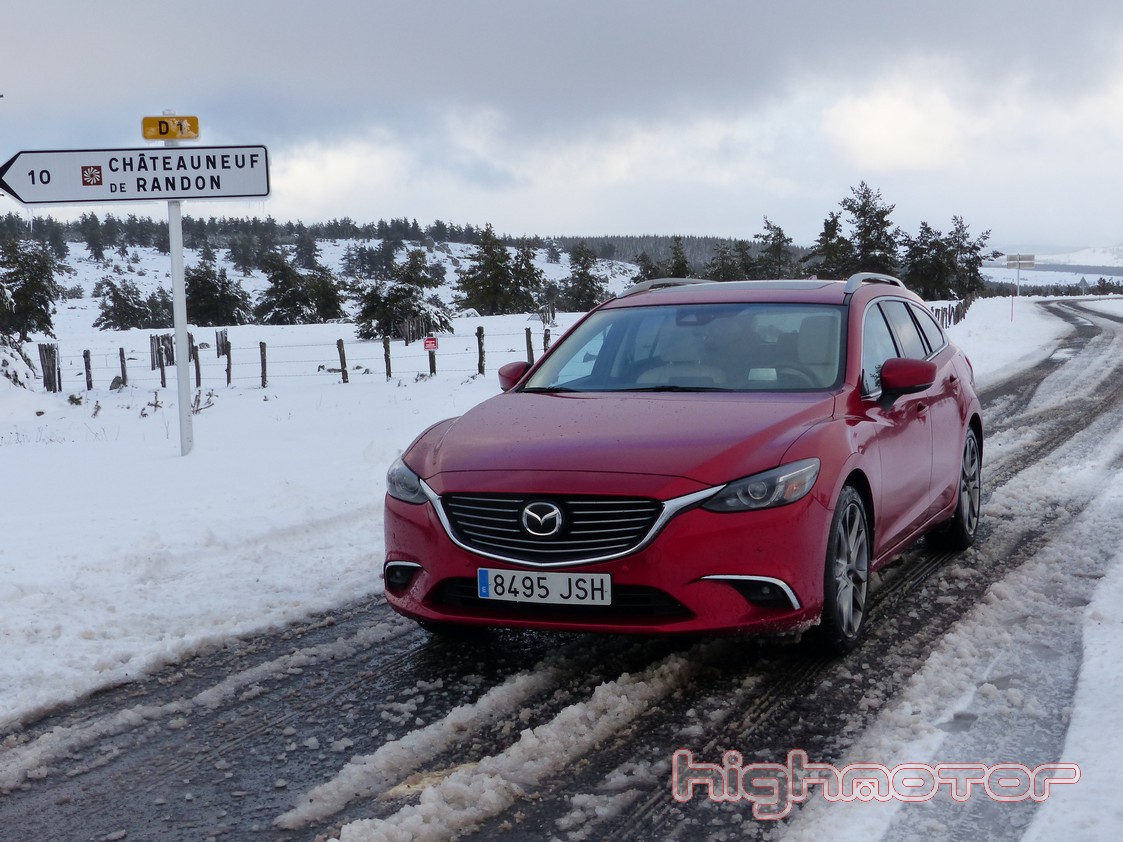
On the second day of the route, now along French roads, as we always do, avoiding toll motorways, which leads us to a curiosity about the dense French road network: although we have been crossing France by road for several years with similar destinations, we have rarely repeated the same road, since each satnav plans the route “in its own way“, discovering a new road or area each time, as in this case the D1 in the middle of France, which, being completely snowed over and closed to traffic, forced us to redesign the route the satnav had proposed.
Auch
Near Pau is Auch, a small French town noted for its cathedral (of considerable dimensions for such a small town) and its historic centre. Another town that caught our attention is Mende which is classified as a UNESCO World Heritage Site, not for its buildings but for its pastoral landscapes together with the towns of Millau, Lodève, Alès and Ganges.
Almost the whole route ran along roads between fields and rural areas, extremely quiet and inviting one to enjoy the driving and the scenery. Only the landscape changed on the mountain road in the Monts d’Ardèche Regional Natural Park and the last kilometres skirting the Rhône river, where the geography contrasted sharply with the rural landscape of fields and the roads became more winding and fun.
Driving Impressions
Section of the D1 in France where the snow also accompanied us
When we plan a long-term test, almost involuntarily we normally think of a diesel vehicle, for cost savings, for logic, for habit… But this time we wanted to be illogical, break with habits and preconceived ideas and opt for a test of a petrol car. Our idea became madness when the vehicle proposed was a Mazda 6 estate with a 2.5-litre naturally aspirated engine under the bonnet, with 192 CV, and to top it all, automatic (undoubtedly ideal for covering almost 7,000 km). In estimating the costs of the journey, we had barely any consumption references (beyond the homologated figure of 6.3 litres per 100 km on average), and we estimated on the high side, thinking it would easily hover around 8 litres per 100 km on average. Fortunately, we were wrong.
Our first contact with the Mazda 6 Wagon pleasantly surprised us. It is the facelifted model (with changes outside and especially inside), and now has a more refined interior, with improved finishes, a new central screen (perhaps somewhat small compared with its rivals) and even changes to the instrumentation itself. Our test unit was fitted with light-coloured microperforated leather seats, with electric adjustment and heating.
The first thing that surprises us as soon as we set off is the low noise of the engine, and in the first kilometres the smoothness is the most notable thing, a smoothness that reaches an outstanding level and that few four-cylinder engines can match (here the fact of not having a turbo works in its favour). To this must be added improved interior soundproofing compared with the previous model, which is noticeable on motorways, for example.
With the tank full the car shows a range of approximately 700 km. We find this figure insufficient given the travelling character and the size of the Mazda 6 Wagon; the 62-litre tank feels small, at least for this petrol version. That said, during the motorway section the average consumption hovered around 7.4 litres per 100 km, a very good figure that begins to reveal the economical character of this powertrain.
Part of the route ran along the Roncesvalles road, a stretch full of bends in the middle of the Pyrenees, where we put the stability and agility of the Mazda 6 Wagon to the test, surprising us through the corners, more stable and agile than other family vehicles have accustomed us to, thanks to its lightness (it weighs only 1,445 kg) and to the tuning of the chassis together with the G-Vectoring Control system.
The map full of bends on the descent from the Ibañeta pass (1,057 m) (Roncesvalles road)
GVC is a simple system, transparent to the driver but noticeable in corners, and even more so when driving a family car almost 5 metres long. It electronically controls the vehicle’s inertial forces (G-forces) by regulating engine torque when cornering. Regardless of how we accelerate, it manages torque to keep the car stable, avoiding the need to correct the steering and making driving through bends more comfortable. In practice, this whole system helps us take corners more smoothly and fluidly, without noticeable body roll and with a greater sense of control over the car.
At the end of these two days of driving, the average consumption came to around 7.2 litres per 100 km, a good figure, bearing in mind that the motorway stretch had to be combined with a mountain pass (the Roncesvalles road) and the typical French roads between villages with roundabouts every 10-20 km.
The next day of driving will be between Geneva and Interlaken, a route through valleys and mountain landscapes, not forgetting cities such as Bern or Murten.


 Peugeot E-208 GTi: a battery-powered toy that revives the spirit of the 1980s sports cars
 New Lexus ES: luxury grows and goes electric
 First contact with the Dacia Sandero Hybrid 155: power and efficiency from €19,890
Deja un comentario