BYD SEAL Sedans Electric Cars Tests
Test drive of the BYD Seal 313 CV RWD: we analyse its real-world consumption on the road
 Diego G. Moreira
12 May 2025
6 min.
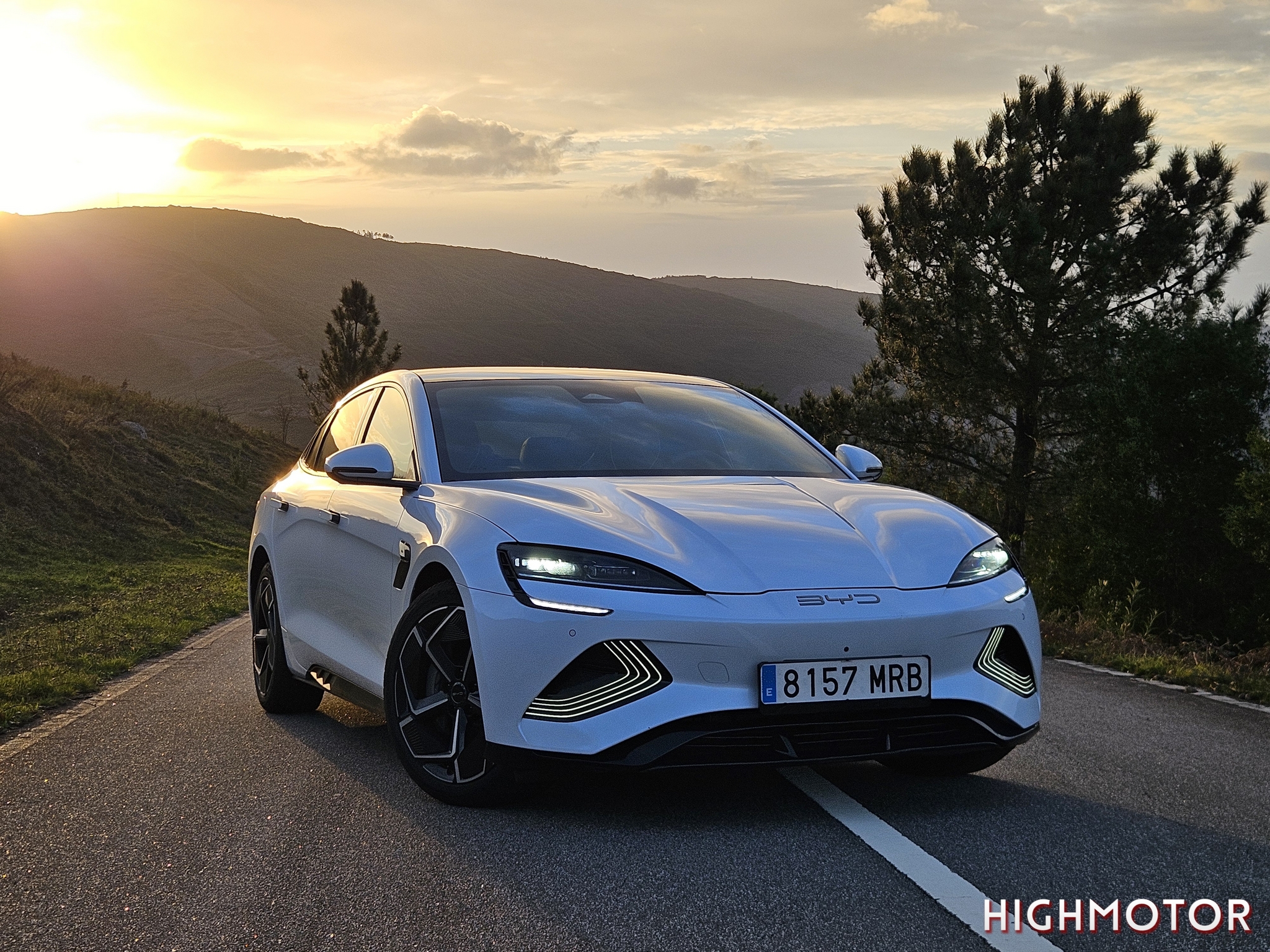
We take an in-depth look at the real electricity consumption figures of the BYD Seal 313 CV RWD, on a motorway journey between Madrid and Galicia, as well as its road consumption figures, charging times and range.
Little by little we need to dispel the idea that a electric car is no good for travelling or covering long distances, because today there are models on the market that can set off on a trip without any problem.
With that in mind, we wanted to put the BYD Seal in its 313 CV rear-wheel-drive version to the test, theoretically with a range of up to 570 km. To do so, we planned a week of tests that begins with a motorway journey between Madrid and Vigo (and the return trip), covering 600 km in each direction.
1. Sporty and personal design
Before getting into consumption and driving behaviour, it is necessary to talk about its design. The Seal is a car that attracts attention, both from detractors of electric cars and from those who know the subject well.
Its front (with LED lighting in all its lighting functions) is sharp, with a striking light signature on the lower part of the bumper, and its rear has an LED profile that runs the full width of the car, with a sporty lower finish.
2. Comfortable, quality and technological interior
The sporty exterior design carries over into the interior, with seats more typical of a sports car than of an electric car, with integrated headrests and sporty-cut leather upholstery. They offer ventilation and heating. They are not the most comfortable I have tried in an electric car, but they do their job even on long trips.
Another detail that stands out is the huge 15.6-inch screen, which can be rotated electrically at the touch of a button (a striking feature, though not very practical in daily use). But if we are to talk about the interior, there are two clear standout qualities: interior space and the quality of the finish.
I want to pause on the quality in particular, because it is above what other European models offer, and it can hold its own without complexes against alternatives considered premium. All of this is complemented by outstanding interior soundproofing.
3. Handling and engine: comfortable, quick but not sporty
The variant with the greatest range and rear-wheel drive offers 313 CV. Its performance tells us it is a fast car, accelerating from 0 to 100 km/h in just 5.9 seconds, with 360 Nm of torque; in “Sport” mode the immediacy and strength of the whole package become apparent.
But the BYD Seal is aimed at comfort, and that shows, it does not have a sporty tuning; the suspension is rather comfortable, designed to absorb the irregularities of the road surface. That said, in its favour, it is worth saying that it surprises with its composure when tackling a mountain pass or a winding road, with noble reactions.
In short, it has a very comfortable ride, outstandingly insulated acoustically, and a high level of comfort that reminds us of the typical premium German saloon.
4. Real-world consumption of the BYD Seal: up to 500 km
With the BYD Seal you can travel without problems: its 82.5 kW battery (we do not have the net capacity figure) is more than enough to leave urban environments behind.
To check consumption, we carried out a journey between Madrid, Vigo and back to Madrid (approx. 1,200 km) under different weather conditions, obtaining variable results.
The Madrid to Vigo leg was made at a mild outside temperature (between 10 and 15 degrees) without using the heating or air conditioning, achieving an average consumption of 20 kWh per 100 km, with occasional moments of consumption around 22-24 kWh per 100 km (on prolonged climbs) and others where on descents the figures were around 17-19 kWh per 100 km. Under these conditions the range was around 380 km.
The Vigo to Madrid journey was made in adverse weather conditions (low outside temperature, below 6 degrees), and it was necessary to use the climate control at times, at 22 degrees and minimum power. In this case, consumption rose to 22-24 kWh per 100 km, leaving the motorway range at approximately 330 km.
On country roads it is a very efficient car, since if we drive gently we can keep an average consumption of 13-14 kWh per 100 km, easily bringing the real-world range close to 500 km (or even slightly exceeding it).
If we are not so gentle on country roads, the average consumption easily rises to around 16 kWh per 100 km, a good figure for its size and wheels.
5. Battery and charging
Now that we know a little more about consumption, let us analyse charging and power. Officially the maximum advertised charging power is 150 kW, although it usually sits above 100 kW.
On the motorway, we took 38 minutes to go from 40% to 95% of the battery, charging above 85% at an approximate power of 47 kW. In fact, when starting to charge at 40% battery, the indicated power was 109 kW (using a 250 kW charger).
On the other hand, when charging at public charging posts (non-rapid charging) it has a power of 11 kW, more than enough for most uses. It can also act as a power source, with the V2L technology providing power to connect small devices, phone chargers or small household appliances up to 3 kW.
Conclusion after more than 2,500 km, of which 1,200 km were on the motorway
The test we carried out on this BYD Seal focused on analysing whether the consumption and range promised by this saloon hold up in real use. We also checked whether it is a car suitable for making an occasional trip without fear of charging times or running out of battery.
On the Madrid > Vigo > Madrid route (600 km in each direction) we only needed to stop for 38 minutes on the outward leg and nearly 50 minutes on the return leg (made in very unfavourable temperature and weather conditions). Even so, a 30-minute stop on a 600 km or 6-hour journey is not a lot of time.
If we use it on country roads, we will see that the Seal’s battery is more than sufficient and we get close to the homologated range, or at least reach 500 km. Figures that make us forget combustion cars, since we can get around with a reasonable range.
Finally, the characteristic that best defines this electric saloon is its comfort, it conveys a great sense of calm inside and is very comfortable.
Photos | Diego G. Moreira
Technical specifications of this car

 Peugeot E-208 GTi: a battery-powered toy that revives the spirit of the 1980s sports cars
 New Lexus ES: luxury grows and goes electric
 First contact with the Dacia Sandero Hybrid 155: power and efficiency from €19,890
Deja un comentario