The rise, fall and remarkable return of the Hummer
 Mónica Redondo @MonicaRedondoD
27 January 2020
9 min.
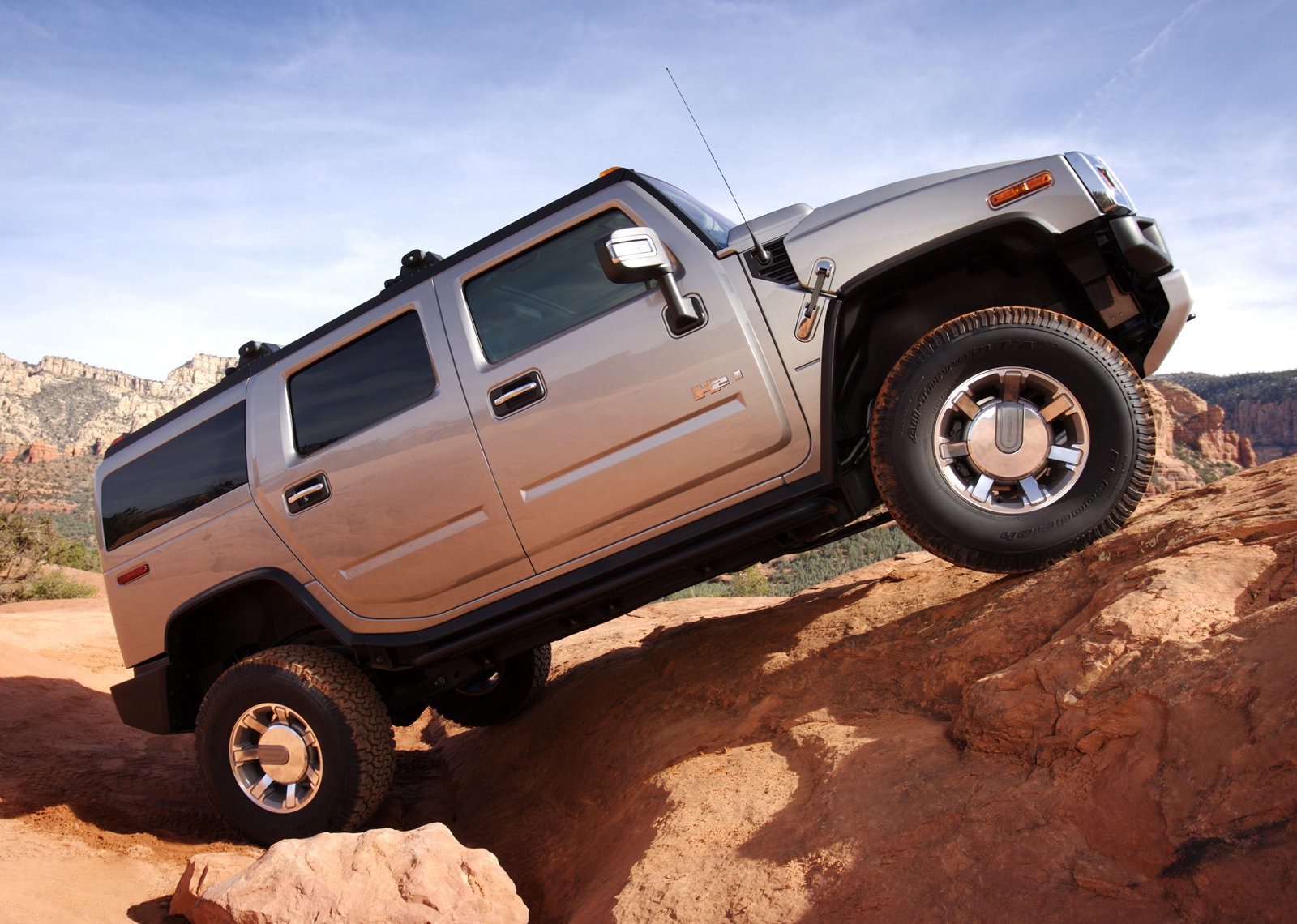
Following the announcement of the imminent arrival of the new all-electric Hummer, we are going to take a look back at the rise, fall and remarkable return of the Hummer.
Arnold Schwarzenegger and General Motors set the stage for the return of an electric pickup truck based on the legendary Hummer, and the history of Hummer is unique in the automotive industry.
Born out of war, the vehicles it made available to civilians were developed with a single use case in mind: off-road. This approach to designing an SUV made the Hummer a brief cult icon in the early years of the 21st century before it became something of a pariah just a few years later.
A series of factors converged to wipe out the automaker in 2010, but, a decade later, it is poised to make a return as a champion of electric technology.
AM General (1971)
The Hummer brand has its roots in 1970, when AMC bought Jeep from Kaiser to finalise the latter’s exit from the automotive industry. The following year, AMC renamed Jeep’s General Products Division AM General Corporation. In particular, it manufactured the rear-wheel-drive, CJ-based DJ, which was used for decades by the United States Postal Service (USPS).
High Mobility Multipurpose Wheeled Vehicle (1979)
In 1979, the US Army began looking for what it described as a High Mobility Multipurpose Wheeled Vehicle (HMMWV) to replace its aging fleet of similar off-roaders based on the Jeep. Authorities described a one-size-fits-all truck capable of going anywhere while carrying troops, cargo or both.
The final prototypes were presented by AM General, Chrysler and Teledyne, who had bought the aborted Cheetah project from Lamborghini. After thousands of miles of testing, AM General won the lucrative contract in 1982.
Separate paths (1983)
US regulations forced AMC to get rid of AM General after the merger process with Renault began in 1979. The White House prohibited foreign governments from owning defence contractors, and the French government held a majority stake in Renault at the time.
The LTV Corporation conglomerate bought AM General in 1983, one year before the Humvee entered production to serve in the US Army. At the time, nobody imagined that the AMC connection would force the designers of Jeep and Hummer into a bitter legal battle.
The Humvee goes to war (1989)
The Humvee made its combat debut when the United States invaded Panama in 1989, but it really stood out as a symbol of the nation’s military might during the Gulf War of 1990-1991. Nearly every news channel in the world broadcast countless hours of footage that showed the Humvee carrying soldiers and weapons through the desert, parked at military bases alongside fighter jets and even carrying then-President George HW Bush when he visited US troops on Thanksgiving in 1990, alongside General Norman Schwarzkopf, in the photo.
In hindsight, Hummer didn’t need to advertise. The Gulf War did far more to forge the brand’s burly image than any media campaign, and off-roaders already knew exactly what their trucks were capable of.
The Terminator’s request (1991)
Many Americans begged AM General for the chance to buy a Humvee with civilian specifications, an unexpected side effect of the Gulf War. The company likely considered the idea of selling its truck to the public, but initially answered every request with a simple “no”. There was one person whose pleading it could not ignore: Arnold Schwarzenegger. Long before becoming an environmental activist, the Austrian-born actor fell in love with the Humvee and tried to persuade AM General to sell him one. And, once again, the firm said no. Making it street-legal would cost a fortune.
Fortunately, Schwarzenegger had a fortune (he was paid $15 million for his appearance in Terminator 2: Judgment Day alone in 1991), and something more. He persuaded AM General executives to sell him a sand-coloured Humvee by signing a thick stack of liability waivers, and had it sent to a shop in Michigan that made it street-legal before shipping it to Los Angeles. Schwarzenegger drove it regularly, usually while smoking a thick cigar, which turned more than a few heads around town.
The original Hummer (1992)
Schwarzenegger got his way but nobody else did; at least not initially. Reportedly, the actor pestered and pressured AM General executives until they relented and made a civilian Humvee available to the general public. Launched as the Hummer in 1992, it was closely related to its war-hardened sibling, but gained a marginally more comfortable interior and wasn’t offered with a Browning .50-calibre machine gun.
The Hummer’s basic platform was the same as that of the Humvee, so it remained strictly a four-seater. Power came from a 6.2-litre V8 mounted up front and in the centre that sent 144 hp to all four wheels through an automatic transmission.
The VIP’s SUV (1990s)
AM General viewed civilian sales of the Hummer as a small concert; it never really expected to reach significant volume. Annual sales totalled 1,374 units in 1996, a high-water mark the original Hummer would never reach again. Its high price limited its appeal, but it was popular among movie stars living in Hollywood: many of the same people who drove Toyota Prius hybrids and Tesla Model S cars in 2020. Athletes and rappers happily paraded behind the wheel of a Hummer; Dennis Rodman and Tupac Shakur both owned one.
Hummer joins General Motors (1999)
General Motors bought the marketing rights to the civilian Hummer in 1999 and renamed it the H1. In hindsight, it was not primarily interested in the truck, which had become an iconic off-roader that remained a low-volume niche model largely due to its exaggerated size and high price.
Executives saw the brand as the ideal asset to capitalise on growing demand for SUVs in the United States. The nameplate §h69h70§ read; General Motors took less than a year to proudly illustrate how it planned to recoup its investment by taking Hummer into new segments.
Hummer H2 concept (2000)
Big, bold and yellow, the Hummer H2 concept was one of the stars of the 2000 Detroit Motor Show. It carried a more modern interpretation of the H1’s design that blurred the line between a Tonka truck and an SUV. Officially, it hinted at what an entry-level Hummer model could look like. In reality, it was already on its way to production behind the scenes and would reach showrooms with few major changes.
Daimler Chrysler vs. General Motors, and vice versa (2001)
The front design of the H2 sent shockwaves through Jeep’s headquarters. The resemblance between the Humvee and the CJ-7 bothered nobody in the early 1980s because AM General wasn’t competing for a slice of Jeep’s market share, and the H1 had somehow gone unnoticed. But fast-forward to the 2000 Detroit Motor Show and Daimler Chrysler’s legal team was not willing to let a new competitor use distinctive design features, especially the seven-slot grille framed by round headlights, without a fight.
In 2001, DaimlerChrysler and General Motors sued each other eleven minutes apart over the design of the H2. The US Court of Appeals for the 7th Circuit ultimately ruled in favour of Hummer, citing the shared heritage of Jeep and Hummer as one of the main reasons behind its decision.
Hummer H2 SUT concept (2001)
Hummer revisited the H2 at the 2001 New York Auto Show with a second concept called the H2 SUT. While the first design study took the form of an SUV, the second ushered in an acronym standing for sport utility truck. Note that inventing names for segments was a popular trend in the early 2000s; BMW argued that the X5 stood out as the only sports activity vehicle (SAV), not an SUV.
The SUT received a sharper evolution of the front of the original concept modified with input from Arnold Schwarzenegger: he notably requested a more raked windshield and larger tyres. It accurately previewed the production model General Motors promised to launch in 2002 as a 2003 model.
Hummer H2 (2002)
The second Hummer model debuted in 2002 very much like the earlier concepts. It was smaller than the H1 but dwarfed nearly everything else on the road. Its boxy body concealed a more robust evolution of the GMT820 platform underpinning other full-size General Motors SUVs, such as the Chevrolet Tahoe and Cadillac Escalade, and suspension components sourced from the heavy-duty 2500-series Suburban. It was so massive that its gross vehicle weight rating (GVWR) of 3,909 kg exempted it from fuel economy testing.
The end of Hummer, what’s next?
Rumours of a Hummer revival are growing louder. While they first pointed to Hummer returning as a standalone brand, the newer batch describes a single model, probably a pickup truck, sold by GMC. And, in a strange but predictable twist of fate, the off-roader will return with electric power. It will share powertrain parts with the battery-powered pickup that General Motors is simultaneously developing. An advertisement scheduled to air during the 2020 Super Bowl on 2 February will unveil the model, industry insiders claim.
It is still unknown what shape the model will take, but we doubt it will be as big as the H1. Heritage-inspired styling cues that will once again irk Jeep are a given, and sales could begin in 2022.
The reborn Hummer is unlikely to enlist in the US Army, and we have no reason to believe it is ready for combat, but it will once again rely on a celebrity for publicity. Unverified reports claim basketball star LeBron James will star in adverts for the model.


 Peugeot E-208 GTi: a battery-powered toy that revives the spirit of the 1980s sports cars
 New Lexus ES: luxury grows and goes electric
 First contact with the Dacia Sandero Hybrid 155: power and efficiency from €19,890
Comentarios cerrados