The STLA FRAME platform becomes the new architecture for Stellantis SUVs
 Victor Alós Yus @sepelaci
20 November 2024
2 min.
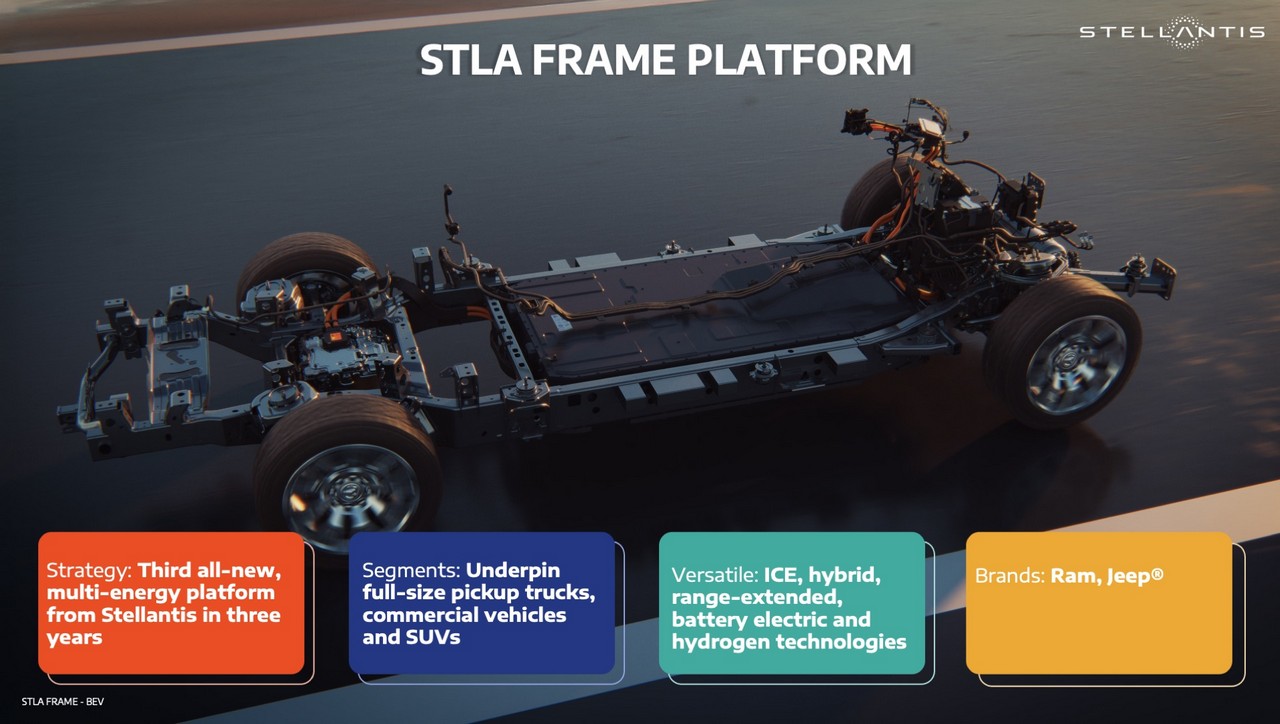
Stellantis’ new platform, designed for future pick-ups and electric SUVs, will also allow the use of range-extender systems.
The market for electric SUVs and pick-ups is growing unstoppably, and this is expected to continue in the coming years. However, it should not be forgotten that these types of vehicles still have a long way to go to match the functionality of a combustion-engine vehicle. Therefore, manufacturers use options that allow them to design these vehicles with several types of drive systems.
Stellantis knows this, which is why it has just unveiled its new platform, called STLA FRAME, capable of serving as the basis for both electric models and range-extender electric systems. This allows the batteries to always hold the charge needed to fulfil their task, which is usually hard work during a long working day.
Electric versions will offer a range of up to 800 kilometres, although versions with a range extender will extend that range to 1,100 kilometres. The good news is that this platform can also accommodate combustion-engine, hybrid and even hydrogen-powered drive systems, so it is a platform that can serve several models and variants, depending on needs.
In the case of the electric system with the range extender, it consists of two electric motors, an electric generator and a combustion engine. This system makes it possible to carry loads and perform work without sacrificing range. The combustion engine is reserved for generating electricity, not for driving the wheels, so its consumption is greatly reduced and emissions are tightly controlled.
As for charging capacity, this platform allows fast battery charging at 350 kW thanks to its 800-volt architecture. In the case of the range-extender technology, the battery can be charged with a maximum power of 175 kW using 400-volt technology. In addition, it supports bidirectional charging, so it can supply energy to external devices, something many models already offer.
As for the electric motors, up to 250 kW each can be achieved, allowing acceleration from 0 to 100 km/h in 4.4 seconds. As for the platform’s dimensions, it has a length of between 5,488 and 5,941 mm, a width of between 2,062 and 2,124 mm, and a wheelbase ranging from 3,143 to 3,690 mm. Ground clearance is 168–262 mm, a particularly interesting height for this type of vehicle, designed for difficult terrain and hard rural work.


 Peugeot E-208 GTi: a battery-powered toy that revives the spirit of the 1980s sports cars
 New Lexus ES: luxury grows and goes electric
 First contact with the Dacia Sandero Hybrid 155: power and efficiency from €19,890
Deja un comentario