Bigster Dacia Hybrid Cars Uncategorized
We drive the Dacia Bigster, the new large SUV with a sharp price
 Rafa Guitart @GuitartRafa
28 March 2025
9 min.
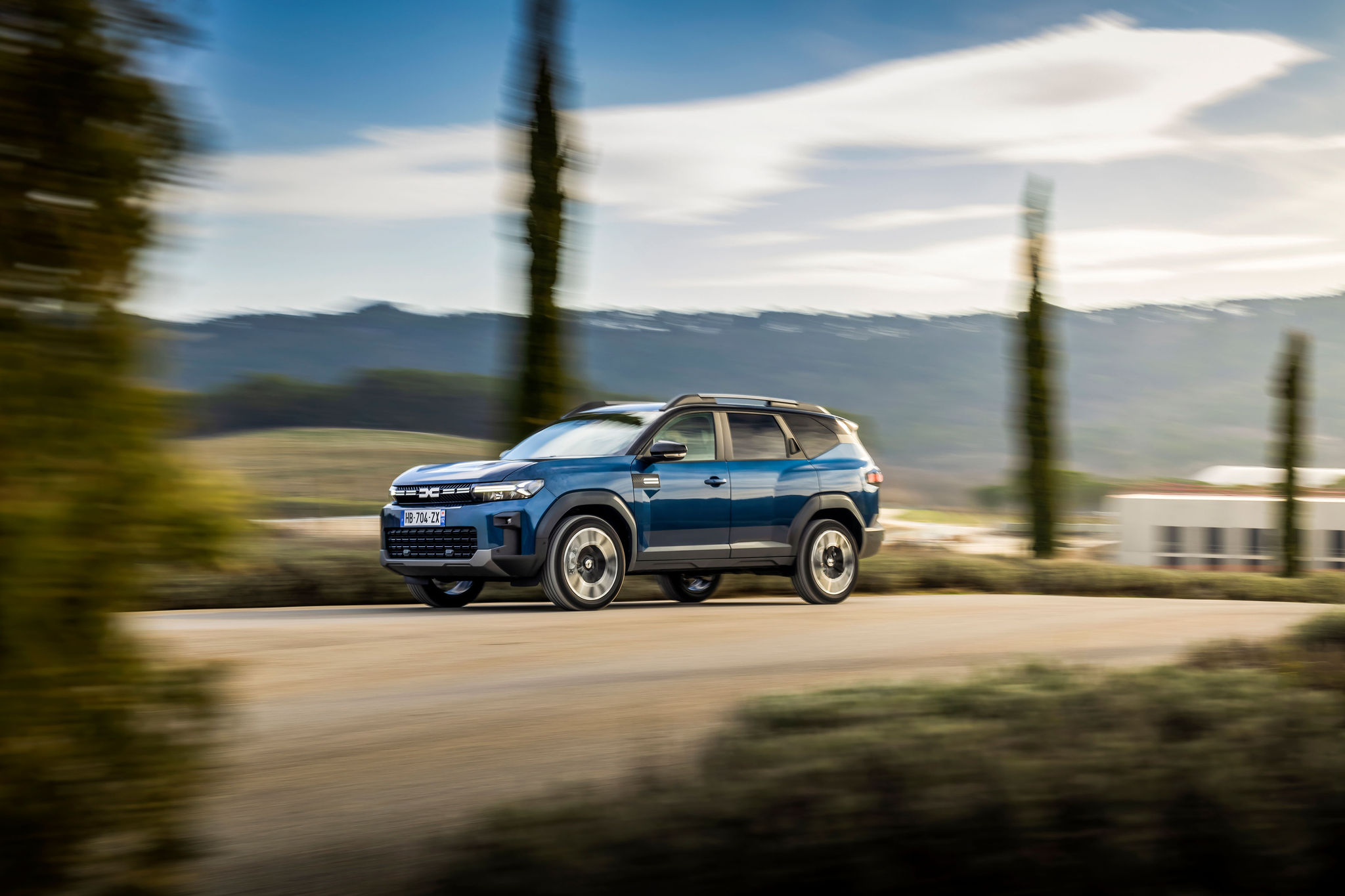
Dacia sets out to conquer the C-segment with a product capable of standing up to many of its competitors, as it is very compelling in terms of comfort, performance, roominess and running costs.
The values of Dacia fit especially well with the Bigster and the demands of the C-SUV segment: design, robustness and capability, now also with electrification, but at prices far below what competitors offer. Basically, it means being able to get into a higher-segment car without having to spend much money on it.
So, on the Duster CMF-B platform, Dacia has stretched its length to 4.57 metres, which has allowed for rear seats of excellent comfort and a boot with a cargo capacity of 702 litres and a maximum interior cargo length of 2.7 metres.
No expense has been spared on some comfort aspects that are unusual for Dacia, such as the acoustic windscreen with thicker glazing, panoramic sunroof with electric opening, and rear tailgate with electric opening “hands-free”, front passenger lumbar adjustment seats, 40/20/40 modular rear bench, an armrest with two cup holders and a smartphone holder, two-zone climate control at the front and rear air vents.
Striking design
It features a front design characteristic of Dacia with its gloss black grille, a very horizontal bonnet and reinforced wheel arches and front and rear protectors made from a robust, recycled material that does not need painting, called Starkle.
It comes as standard with 17 or 18-inch alloy wheels, and 19-inch wheels are available as an option on the Journey trim. The top versions offer a two-tone body with a black roof, and a new body colour exclusive to the model, Indigo Blue.
The modular roof bars are standard equipment on the Bigster Extreme. They are positioned longitudinally in the standard position, but can be converted into crossbars very easily.
Spacious interior
The interior features a
very upright and tall dashboard, with a 7 or 10-inch digital instrument cluster (depending on the trim), and all multimedia system information is located on the 10-inch central touchscreen, which comes as standard on all Bigster models.
Depending on the trim level, it offers three types of centre console for the front seats: low, intermediate or, for the first time on a Dacia, a high console featuring a armrest with a cooled compartment, an induction charger and ample storage space.
The Easy Fold function allows the rear seatbacks to be folded down easily from the boot, using two controls in the boot, while the boot organiser makes it easy to store luggage.
The YouClip system is also clever, allowing numerous accessories to be fitted in different places: dashboard, side of the passenger console, rear of the centre console, boot and inside the tailgate. A tablet holder, a storage bag, a smartphone holder with or without induction charger, a hanger or a clever “3-in-1” device that combines a cup holder, a hook and a portable torch can be attached to them.
Full equipment
The
essential and expression trims include the Media Display multimedia system with 4 speakers and wireless Apple CarPlay and Android Auto™ connectivity. Extreme and Journey receive the Media Nav Live multimedia system, which also offers connected navigation, integrating real-time traffic condition information and maps updated for 8 years.
In the Journey trim, seat height and backrest recline are electrically adjustable as standard, and the seat has manually adjustable lumbar supports. The Bigster Journey and Extreme also feature adaptive cruise control as standard on the hybrid versions.
The new Bigster comes as standard across all trims with an advanced emergency braking system that detects vehicles, pedestrians, cyclists and motorcycles, a speed assistant with traffic sign recognition, rear parking aid, emergency stop signal, lane change alert, lane keeping assist, driver fatigue alert and emergency call (eCall). These systems are combined with a button called “My Safety” that allows the driver to set certain ADAS to a personalised mode.
New engines
The new model offers
different levels of hybridisation with ECO label, which brings significant advantages when driving in urban environments. The Bigster Hybrid 155 is the first model from the Renault Group to benefit from the new Hybrid 155 powertrain, consisting of a 4-cylinder petrol engine producing 107 CV, two electric motors (a 50 CV motor and a high-voltage starter/generator), a 1.4 kWh battery (230 V) and an electrified automatic gearbox. This has 4 gears dedicated to the thermal unit, plus two more for the electric motor, with no clutch.
This new engine offers more power (+15 CV), more torque (170 Nm for the combustion engine alone) compared to the 140 CV of the Duster and Jogger, allows greater towing capacity and reduces consumption and emissions by 6%.
Thanks to regenerative braking, combined with the battery’s energy recovery capability, up to 80% of urban driving time can be spent in fully electric mode. In addition, starting always takes place in 100% electric mode.
The Mild Hybrid 140 variant derives from the TCe 130 available on the Duster. It combines a 1.2-litre 3-cylinder turbocharged Miller-cycle petrol engine with a 48 V mild hybrid system and a 6-speed manual gearbox. The hybrid system supports the combustion engine during starting and acceleration phases, reducing average consumption by around 10% and emissions compared to a combustion engine of equivalent power.
The Mild Hybrid-G 140, running on petrol and LPG, combines bi-fuel operation and 48 V mild hybridisation, also with regenerative braking. When running on LPG, it emits on average 10% less CO2 than an equivalent non-hybrid petrol engine and offers up to 1,450 kilometres of range thanks to its two tanks holding a total of 99 litres of fuel (50 litres of petrol and 49 litres of LPG). Installed beneath the boot floor, the LPG tank preserves cargo volume.
The four-wheel drive version features the Mild Hybrid 130 4×4, designed for more off-road use. It combines a 1.2-litre turbocharged three-cylinder engine with 48 V mild hybridisation and a 6-speed manual gearbox. It offers 5 driving modes: Auto, which automatically distributes torque between the front and rear axles depending on grip and speed; Snow, which applies specific adjustments to traction control and ESC; Mud/Sand, specifically for driving on muddy or sandy tracks; Off-Road, which automatically distributes torque between the front and rear wheels depending on grip conditions; and Eco, which improves consumption by acting on the climate control and performance. It also comes as standard with a hill descent control system from 0 to 30 km/h, which works in all gears.
Good handling
This is a very honest model that
performs well in every area and disappoints in nothing. It is not the biggest, the fastest or the most economical, but we can assure you it is a very interesting model for a wide audience, especially for families who need space and comfort without having to spend a lot of money.
We have only had the opportunity to drive the 155 CV hybrid variant, which proves quick and smooth overall. Although it has oversized windows, a little more refinement at high revs wouldn’t go amiss. Its operation is very similar to other models in the group, since on certain occasions the engine revs a little high to recharge the battery, which isn’t particularly pleasant.
This is clearly noticeable when the combustion engine supports the electric motor, although at low speeds and in favourable conditions, the push from the electric motor is very pleasant.
On the chassis side it scores well, as the Bigster holds the road firmly despite having relatively narrow 205/55 tyres for 19-inch wheels. It does not roll excessively and gives the driver great confidence, thanks to comfortable suspension that keeps body movements in check on linked bends.
Although it is not overflowing with power, the automatic gearbox makes good use of the mechanical potential. Acceleration and recovery are sufficiently brisk for dynamic and safe driving, without consumption suffering.
Range and prices
The range
offers up to 12 different versions, combining essential, expression, extreme and Journey trims with the MHEV 140, MHEV 130 4×4, MHEV-G 140 and HEV 155 engines, and prices start at €24,590 for the MHEV 140 essential version up to €31,290 for the HEV 155 in extreme or Journey trim. Meanwhile, the MHEV 130 4×4 versions are priced at €27,790 in expression trim and €29,790 in extreme trim.
The essential trim includes 17″ alloy wheels, fixed roof bars, Media Display with a 10.1″ central screen, a 7″ digital instrument cluster, manual air conditioning, rear parking aid with camera, and electric front and rear windows.
The expression adds to the essential two-zone automatic climate control, automatic parking brake, rain sensors, electrically foldable mirrors, 40/20/40 modular rear seats with Easy Fold function, etc.
The extreme adds to the expression equipment 18″ alloy wheels, modular roof bars, panoramic sunroof, hands-free card, washable TEP upholstery, rubber floor and boot mats, a 10-inch digital instrument cluster, Media Nav Live system with 10.1″ central screen and connected navigation, Arkamys 3D sound system with 6 speakers, and hill descent control.
The Journey trim adds to the expression 18-inch alloy wheels, two-tone paint, electric tailgate, hands-free card, cooled high centre console with armrest, driver’s seat with electric adjustments, 10-inch digital instrument cluster, Media Nav Live system with 10.1″ central screen and connected navigation, Arkamys 3D sound system with 6 speakers, wireless smartphone charger and adaptive cruise control.
Dacia Bigster image gallery
Technical specifications of this car
 Peugeot E-208 GTi: a battery-powered toy that revives the spirit of the 1980s sports cars
 New Lexus ES: luxury grows and goes electric
 First contact with the Dacia Sandero Hybrid 155: power and efficiency from €19,890
Deja un comentario