Audi S3 Compact Sports Cars Tests
We drive the new Audi S3 and check that it lives up to its promise: more fun behind the wheel
 Antonio Roncero @roncero_antonio
29 May 2024
6 min.
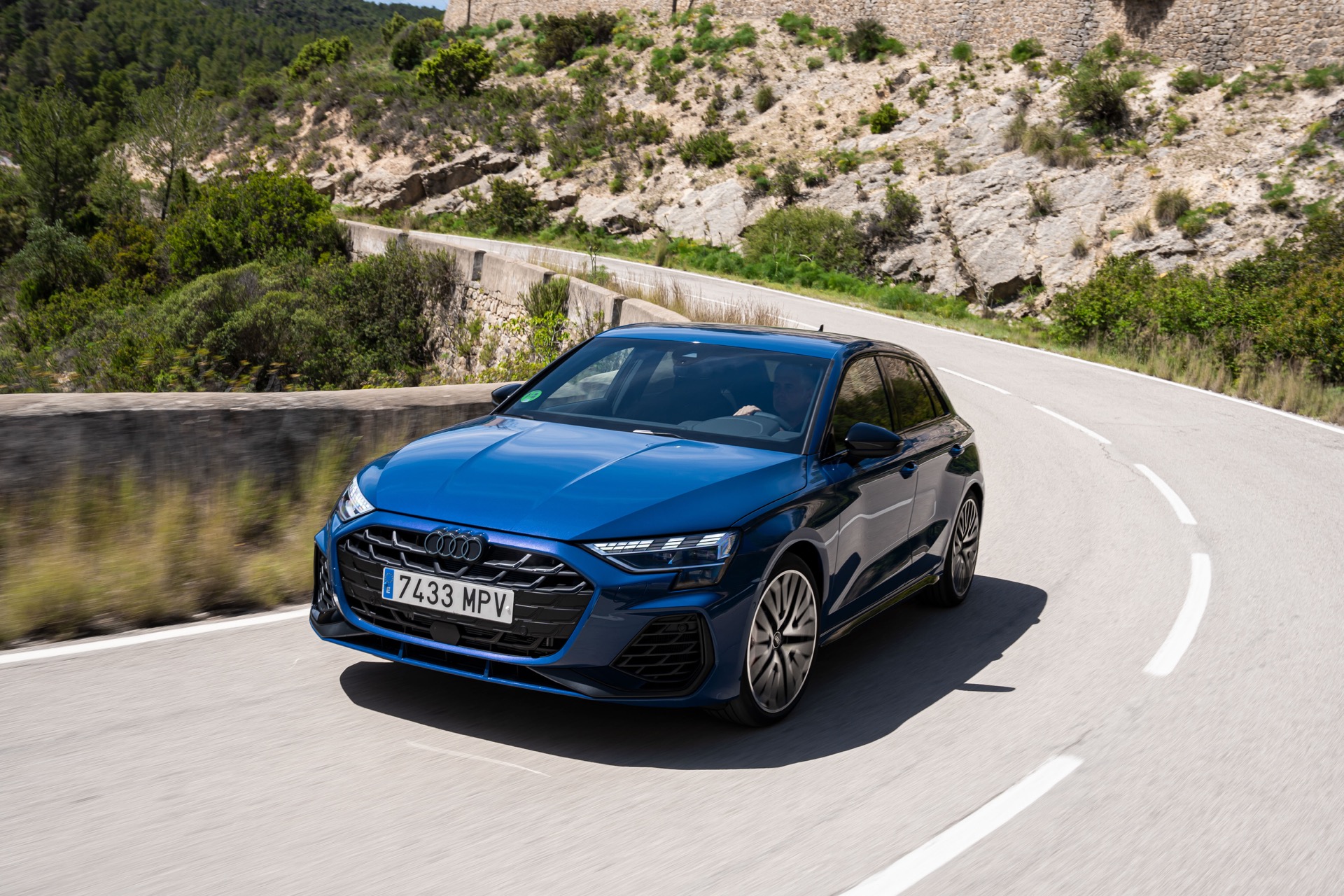
Not long ago we told you that, with 333 CV and the addition of the torque splitter, the new Audi S3 promises more fun behind the wheel than ever. Now I’ve been able to check it for myself on a short but intense first drive on all kinds of roads. And if the previous generation already seemed like a “well-rounded” car to me, I can tell you in advance that the new S3 has won me over. Fine, you’re right, it’s an expensive car: 65,260 “euro-bucks” straight off the bat. And if you want to personalise it or add a few extras, such as the Navigation Package, the Plus assistance package, adaptive damping and the alarm (the least you’d expect), you’re almost at 70,000. But that’s the market we’re in.
One of its most direct rivals, the Mercedes AMG A35 4MATIC, with 306 CV, costs practically the same; another, the Volkswagen Golf R 20 Anniversary, technically the S3’s “first cousin” but in different clothes, goes past 70,000 euros, although it’s fair to say that with the R-Performance package fitted as standard, which includes, among other things, the Akrapovic exhaust with titanium silencer; that option alone on the S3 already adds 5,840 euros… Only the BMW M 135i xDrive, which has nothing to envy in any of the above when the bends arrive, is cheaper, coming in below 56,000 euros.
I don’t need to tell you that I’d take any of them with my eyes closed, and I’m sure you would too. But today we’re talking about the new S3. And I’m going to tell you why I think the improvements it brings over the previous generation, which already shone at a very high level, are noticeable when driving it, especially the more twisty the stretch of road ahead.
2.0 TFSI engine: more power… and more usable
The first hallmark of the S3 is found under the bonnet: its 2.0 TFSI engine. The same as the previous generation, true, but “vitaminised” with 23 CV more power and 20 Nm more torque, reaching 333 CV (245 kW), available between 5,600 and 6,500 rpm, and a maximum torque of 420 Nm available from as low as 2,100 rpm, held constant up to 5,500 rpm. In short: the engine pulls hard, and a lot. I’d say even more than the acceleration gain suggests, a “mere” tenth, with the stopwatch now stopping at 4.7 seconds to reach 100 km/h from a standstill.
To achieve that increase in power without sacrificing flexibility, but in fact improving it, Audi has made several changes. As a first measure, turbo boost pressure rises to 1.8 bar, which is the easiest route when you want to gain power from a turbo engine. But a small “trick” improves performance: depending on the driving situation, the turbo can be kept pre-spooled at a constant speed, so power delivery is quicker on acceleration and there is no turbo lag. Add to this a sportier setting for the seven-speed dual-clutch S tronic gearbox, which has a greater capacity to transmit torque and halves gear-change time when the engine is under full load, and the response of the 2.0 TFSI is fantastic.
An engine that can be silky smooth and genuinely frugal if you drive in “efficiency” mode or select comfort mode, but which transforms and “unleashes” itself in the dynamic modes (I’ll tell you more about these later) to deliver a truly sporty driving experience, responding to the throttle with force and pushing relentlessly until the fuel cut-off. A real marvel, especially with the icing on the cake of the sound from the Akrapovic exhaust fitted to the unit I was able to drive. Its sound is captivating… but some loves are expensive, and this is one of them.
Torque splitter and dynamic plus mode: attack!
And now on to the second major novelty of this new S3: the introduction of the torque splitter differential, replacing the simpler and more limited Haldex differential used until now. Yes, it is the same differential debuted on the Audi RS 3 (which will soon have a successor too), and which the aforementioned Golf R 20 Anniversary also uses, under a different name. Without going into too much technical detail, it uses two electronically controlled clutches, one for each rear driveshaft, with the capacity to variably and continuously distribute the torque reaching each rear wheel by opening and closing the clutches. This is what is called “torque vectoring”, or dynamic torque vectoring.
Once you have a system capable of doing this, the idea is very clear: it means applying more driving torque to the outside rear wheel in a bend, thereby generating a difference in driving forces that helps the car turn into the corner, improving agility and precision. Of course, you then have to make it work, and on the S3 it does so very well. To that end, there are specific sensors and a control unit on each clutch, and how the clutches open or close (that is, the torque reaching each rear wheel) depends on factors such as speed, longitudinal and lateral acceleration, the car’s rotation around its vertical axis and, of course, the selected gear or steering angle.
I couldn’t say what percentage of the credit the torque splitter deserves for how good the S3 is, or how much can be attributed to the other changes Audi has made to the chassis, notably the new steering knuckles to increase negative camber or the optimised progressive steering; let’s remember that here the S sport suspension is standard and lowers the body by 15 mm. But the truth is that the S3 devours bends as if by magic, especially with the optional adaptive damping, which offers a wider margin between the softer comfort-oriented mode and the more sporty one. And here’s the good part.
It’s called “dynamic plus”, and it is an additional programme on top of dynamic mode, set up for very sporty driving. It automatically activates the least restrictive mode of the ESP, and the torque splitter works to deliver a “plus” (quite literally) of agility with a slight tendency to oversteer. In addition, the engine’s idle speed rises by 200 rpm, and the S tronic gear-change times are shortened. Don’t be fooled, it is not a radical programme designed for circuit driving; but it will make you change your reference points on your favourite mountain road. By the way, the brakes have also been improved: on the front axle they now measure 18 inches instead of 19, with 357 mm thicker discs, and they show no sign of struggling to keep up with the S3’s new dynamic qualities. Few cars are as easy to drive really quickly with so little effort as the new Audi S3.
Audi S3 – Photo gallery
Technical specifications of this car


 Peugeot E-208 GTi: a battery-powered toy that revives the spirit of the 1980s sports cars
 New Lexus ES: luxury grows and goes electric
 First contact with the Dacia Sandero Hybrid 155: power and efficiency from €19,890
Deja un comentario