We drive the Renault 4 E-Tech, the new electric reinterpretation of the legendary “4L”
 Rafa Guitart @GuitartRafa
7 August 2025
7 min.
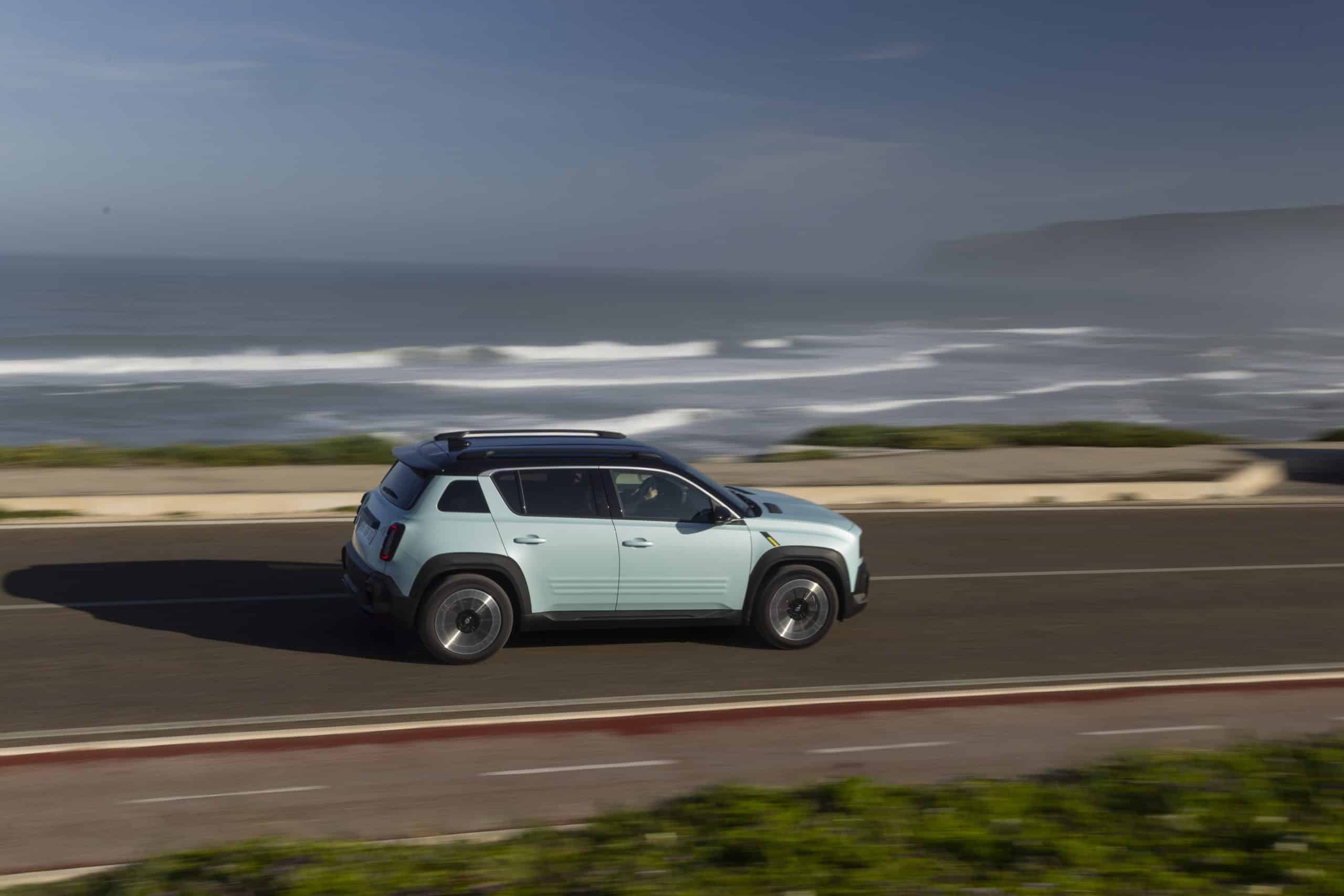
A new, popular electric version that shares many components with the successful R5 arrives on the Spanish market, offering more space, greater functionality and an SUV-style look. It promises over 400 km of range.
Renault wants to make a strong entry into the popular electric segment. After gaining experience in the field with products such as the Fluence, the Twizy and the Zoe, it continued with the R5 E-Tech, available from 25,000 euros, and now does so with the R4 E-Tech, starting at 28,600 euros, and next year it will do so with the new Twingo, which aims to start in the 20,000-euro bracket.
Above this segment it offers models such as the Mégane E-Tech, Scénic E-Tech and Kangoo E-Tech, all of them with very advantageous financing offers for anyone wishing to get started in electric mobility, since, apart from the instalments, the option of installing a home charger is also offered.
Original design
For the development of this model they started from the AmpR-Small platform, and most of the mechanical and electrical components installed in the Renault 5 E-Tech, although the proportions are not the same, since in this case the length is 4.14 metres and the height is considerably greater (1.55 m), as the aim of the new model was to provide generous interior space, a boot of greater volume and a body that allowed greater versatility of use, evoking the principles of the original model. The dimensions change noticeably, since the Renault 4 E-Tech has a wheelbase 8 centimetres longer, and is 12 cm wider than the Renault 5 E-Tech (1.81 m), and has a total height of 1.55 metres.
What has not been planned is a Combi or van-type variant, as existed in the ’60s, derived from the original body of the model. Although it does not reflect as faithful a design to the original as the R5 does, this model retains some identity features of the R4 of 60 years ago, such as the front grille surrounding the light units, the rear light clusters, the tailgate — less vertical than on the original model — or the shapes of the rear pillar; small nods that give it a friendly, carefree look. Later it will also go on sale with an electric fabric sunroof that can be opened.
It is currently offered in two different power and battery capacity levels: a basic one, called Evolution, with a 40 kWh battery and a 90 kW motor, or the more powerful and performance-oriented version, with a 52 kWh battery and a 150 kW motor, offered in Evolution, Techno and Iconic trims.
The performance level it announces is very reasonable for a model of this type, since the less powerful 40 kWh battery variant accelerates from 0 to 100 km/h in 9.2 seconds and has a top speed of 150 km/h. It is homologated for a range of 308 km WLTP, while the 52 kWh variant accelerates one second faster, keeps its limited speed at 150 km/h as well, and improves its range up to 409 km under WLTP homologation.
It allows AC charging at 11 kW, and DC charging at 80 kW in the version with the 40 kWh battery and at 100 kW in the versions with the 52 kWh LFP battery, which would mean charging from 10 to 80% of capacity in around 30 minutes. In addition, it offers a bidirectional charging system with V2L function at 3.6 kW, as an external power supply for auxiliary devices.
The consumption figures, overall, appear quite modest, around 15.5 kWh/100 km; it is true that it has a heat pump heating system and that the temperatures at which we tested it during the first contact were very mild, around 20 degrees. The “one pedal” function also helps, which acts from the third level of regeneration selected via the paddles, and can bring the car to a stop during deceleration.
It comes as standard with Comfort, Eco and Sport driving modes, which limit engine power and some consumer functions, such as the air conditioning.
Pleasant cabin
The interior design is similar to that of the R5 E-Tech in terms of technology, as it features two digital screens: a 10.3-inch instrument display (7 inches on Evolution), and a 10.1-inch display for the multimedia system.
The driving position is comfortable and all the controls and instruments are easy to reach, many of them linked to the central screen. As in other models in the group, it has a switch to disable the driver assistance systems, which we do not want operating during the journey, physical controls for the climate system, and steering-wheel controls for some everyday functions.
The rear seats, while not a model of spaciousness, can comfortably accommodate two adults, as the flat floor and the headroom available to the roof are appreciated. For its part, the boot performs its function well, offering 373 litres of capacity, with a very wide tailgate that makes loading easier, and a compartment under the boot floor for storing the charging cables. If the rear seatback is folded down, a maximum capacity of 1,149 litres and a loading length of over 2.2 metres are achieved, enough space to carry a surfboard, a ladder or any long object.
Very comfortable
Apart from the absence of noise and vibration, as is typical of an electric car, the R4 E-Tech provides a comfortable ride, as it filters road imperfections exceptionally well. This is partly thanks to the multi-link system it uses, with a soft yet effective suspension setup, capable of easily absorbing small potholes and keeping the body well controlled through linked bends. The position of the battery, under the floor of the car, also helps lower the centre of gravity and provides precise and sufficiently quick steering, while the brakes do their job with good marks.
Its total weight is 1,537 kg, which is very reasonable, which helps ensure no unpleasant inertia is felt when tackling linked bends at lively speeds.
Prices from 28,600 euros
It is not a bargain, but it is in line with models of its characteristics, since the starting price is for the Evolution version with a 40 kWh battery and a 90 kW motor, without counting possible financing discounts, Moves plans, energy-saving certificates or income tax (IRPF) incentives.
If we want the more powerful version, at this same trim level, an additional 3,000 euros must be paid (31,600 euros), 2,000 more for the Techno trim and 5,000 more to reach the Iconic. All of them include 18-inch alloy wheels with 195/60 tyres.
Among the optional equipment available are the Safety & Easy Drive Pack, which includes — for an extra 650 euros — the rear collision warning system with emergency braking and safe exit for occupants, Level 2 semi-autonomous driving system and blind-spot detection.
Another optional pack available is the Extended Grip, which for 300 euros includes Grip Control traction control system and all-season tyres, while the electric hands-free tailgate costs 450 euros; the bonnet painted in black, 100 euros; the two-tone paint (roof and B-pillar in gloss black) 1,000 euros; the Harman Kardon premium sound system with 9 high speakers, 600 euros; the home charging cable, 300 euros, and the Mennekes-Schuko V2L adapter, 200 euros.
Image gallery
Technical specifications of this car
 Peugeot E-208 GTi: a battery-powered toy that revives the spirit of the 1980s sports cars
 New Lexus ES: luxury grows and goes electric
 First contact with the Dacia Sandero Hybrid 155: power and efficiency from €19,890
Deja un comentario