Skoda Superb Sedans Hybrid Cars Family
We drove the new Skoda Superb and can confirm it: it is the best saloon in its class
 Antonio Roncero @roncero_antonio
11 July 2024
11 min.
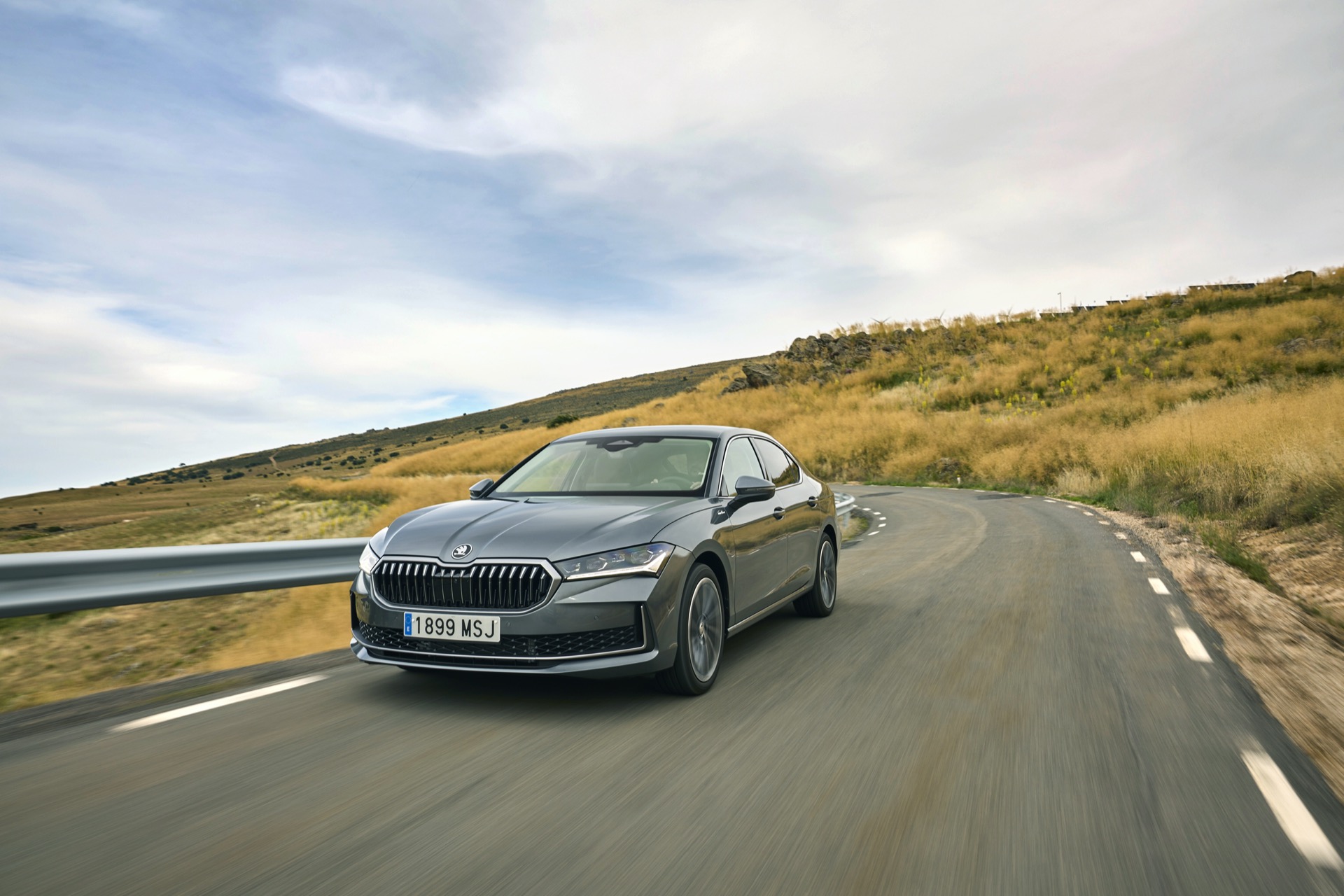
Skoda is flying. In 2023 it closed with record revenue, and so far in 2024 it is following the same path. In five European countries it is the best-selling brand, with five more where it ranks second and three more where it ranks third, totalling 13 “podiums”. Specifically, in the Spanish market, in the cumulative figures from January to June, Skoda grows more than 11%, twice the market, setting a new record. Furthermore, Skoda is the most profitable within the so-called “core brands group” (the mainstream brands, leaving the premium ones aside) of the Volkswagen Group.
And what is the secret behind these results? Well, “well-rounded” cars, with an excellent balance between what they offer and what you pay for them, like the new Skoda Superb. Although in reality, we could just as well apply the same to an entire range that, moreover, today is among the most complete… and what is yet to come. Because just around the corner is the new Epiq, the first Skoda to be manufactured in Spain, specifically at the Volkswagen factory in Navarre. And the electric push will continue with the Elroq, whose launch is planned for this same year.
But let’s focus on the new Skoda Superb, which we have already been able to drive in a first test drive. A model that reaches its fourth generation, and of which more than 1.6 million units have been sold since the launch of the first series in 2001. Since then, the Superb has evolved in design, quality and technology, while always maintaining and even enhancing its main attributes: it is a car that stands out for the space it offers passengers in the rear seats, and for the capacity of its boot. In fact, in my opinion the Superb is currently the best option in its category for anyone who needs a car to travel many kilometres with passengers and luggage. And as we will see, not only because of its generous interior space and its large boot.
The design of the new Superb: more aerodynamic
Each in their own time, externally this new Superb seems to me the most successful of the four generations. Compared to the previous one, launched in 2015, it clearly gains presence thanks, above all, to the new front end, with a grille and headlight design that are already a true brand signature. But there are many more changes: wheels, rear light clusters, mirrors, air intakes… And the dimensions grow slightly: 4 centimetres longer, reaching 4.91 metres (10 mm less for the Combi estate), while keeping the wheelbase at 2.84 metres. The height barely varies by 5 mm and stays at 1.48 metres, while the width is reduced by 15 mm and becomes 1.85 metres.
Beyond the visual impression, which is magnificent, the new Superb stands out for something that is not so obvious: the work carried out to improve aerodynamics. For example, the A-pillar and the windscreen are more inclined, the underbody of the car is flat, flaps and air inlets are strategically added to create an “air curtain effect” to reduce turbulence around the wheels… The result is an improvement in the drag coefficient of 15%, with a Cd of 0.23 for the saloon (0.25 in the case of the Combi), a benchmark in this category.
Interior: more space and more quality
As for interior space, there is no need to grab a tape measure: just take a seat in the rear and reflect for a moment to see that no other car in this category offers so many centimetres for passengers’ legs; the closest would be its “first cousin”, the Volkswagen Passat. Other saloons in this segment that we can consider alternatives to the Superb -there are fewer and fewer of them, as you know, unfairly displaced by SUVs- are the Mazda 6, the Citroën C5 X or the Peugeot 508.
And as for the boot, more of the same: it grows by 20 litres in the saloon to reach 645 litres (1,795 litres with the rear seats folded down), and offers 30 litres more in the Combi, which goes up to 690 litres (1,920 litres with the seats folded), simply the best figures in its class, with the added versatility that the saloon’s roof-hinged tailgate provides. The plug-in hybrid version, the Superb Combi iV (a PHEV variant for the saloon will also be offered later), reduces capacity notably to 510 litres, which is no longer a benchmark, but is still a very good figure.
All versions come with electric tailgate, and on the estate it is optionally possible to install an electrically operated retractable luggage cover. Skoda has paid special attention to the cargo area, with trims that convey a sense of quality, handles to conveniently fold down the seats from the boot itself, sturdy tie-down hooks, and the option of a floor that allows the loading height to be adjusted.
No, I am not forgetting the driver’s position, which conveys more quality than ever, although the dashboard design may seem somewhat “baroque”. The instrumentation is always digital, with a 10-inch screen. I don’t really like how it is integrated under the hood, as it looks like a kind of “add-on”. Personally, I would do without the hood itself, or would have placed the instrumentation inside it. In any case, it is a minor detail. What matters is that it works very well and, moreover, for the first time in the Superb a HUD instrumentation projected onto the windscreen is offered.
Skoda has moved the gear-change control to the steering column, thus clearing the centre console. The central screen of the multimedia system becomes up to 13 inches, and above the large climate controls there are “Smart Dials”, a series of haptic and digital buttons that provide quick and intuitive access to the main infotainment functions.
As always at Skoda, attention to detail is maximal: up to four USB ports offering fast charging for mobile devices (45 W power) are available, a tray for inductive charging with 15 W, and a practical accessory for cleaning the huge screen, stored under the central armrest. At the rear, the folding armrest includes a tablet holder with adjustable length, and a QR code in the boot provides direct access to videos with a quick user guide to the car’s main features.
To finish with the interior novelties, the sound system is by Canton, with 14 speakers. The front and rear windows include the acoustic package with special soundproofing, and you can opt for seats with AGR certification, which include heating, ventilation and massage.
Six engines: three petrol, two diesel and one plug-in hybrid
The Superb range offers six mechanical options to choose from: three petrol, two diesel and the interesting Superb iV plug-in hybrid. Except for the latter, which for now is only offered in the Combi, all engines are available for both the saloon and the estate, which carries a surcharge of 800 euros.
In petrol, the offer starts with the 1.5 TSI with 150 PS, which brings the ECO label to the Superb, as it features a 48-volt MHEV mild hybrid system. It is followed by the 2.0 TSI, now with a C label, in versions with 204 and 265 PS, the latter with four-wheel drive.
In diesel, the 2-litre TDI unit comes in versions with 150 PS and 193 PS, again with the most powerful one paired with all-wheel drive. There is no hybridisation here, so all the diesels carry a C label. For all petrol and diesel engines, the transmission is a seven-speed dual-clutch gearbox.
As I mentioned, the plug-in hybrid version, the Superb iV, seems particularly interesting to me because, thanks to a 25.7 kWh battery that almost doubles the capacity of the previous generation, it is homologated for an electric range of up to 133 km. Beyond what this means for daily use in electric mode, it allows the Superb iV to benefit from up to 7,000 euros in purchase grants under the MOVES III Plan when scrapping an old car, or up to 4,500 euros without scrapping one. We will comment later on what this entails, which is quite a surprise. By the way, the Superb PHEV comes standard with AC charging of up to 11 kW and DC charging of up to 50 kW, which allows it to recover from 10 to 80% of battery capacity in about 25 minutes.
Behind the wheel, the Superb makes clear what it is designed for: devouring kilometres in complete comfort. The 2.0 TDI engine with 150 PS is the one I find most suitable for this car if you have chosen it for that purpose, to devour kilometres. The 1.5 TSI has the advantage of the ECO label, and its operation is somewhat more “refined”, but its driving is more pleasant because it pushes harder and can pull better in long gears. And if you want the best of petrol -smoothness- and diesel -pulling power and low consumption-, with the added bonus of being able to use the car in electric mode day to day, then the plug-in hybrid Superb needs to be considered as a very serious option. Even if you lose boot capacity… and even if you have nowhere to plug it in day to day.
Dynamically, the feel behind the wheel is good, with a suspension that absorbs bumps efficiently -optionally there is a new electronically controlled variable-damping suspension, which I do not consider essential-, steering that conveys precision and composure, and well-achieved insulation from road, mechanical and wind noise. The operation of some assistance systems has also been improved. Specifically, thanks to new cameras and sensors, Side Assist, Front Assist, traffic sign recognition and the new-generation matrix headlights are enhanced. In addition, the remote parking assistant, exit assist and road assist are new to the range. A new airbag between the rear seats is also included, bringing the total to up to 10 airbags.
Range and prices of the Skoda Superb
The Superb is offered in three trim levels: the entry-level Selection; the sportier Sportline with suspension lowered by 15 mm and specific damper settings, which will go on sale later; and the luxurious Laurin & Klement.
From the Selection version onwards, a very complete level of equipment is included as standard, and at launch the 13-inch multimedia screen is added, instead of the 10-inch one that comes with this variant. Also, as a launch offer, both the Selection and Laurin & Klement trims include adaptive cruise control and lane keeping assist with traffic jam assist at no extra cost. When it goes on sale, the price jump from the basic trim to the sporty one will be 4,500 euros, while the Laurin & Klement costs 1,000 euros more than the Sportline and therefore 5,500 euros more than the Selection.
With the discounts currently in force on the list price, which are around 5,000 euros, the Superb with the 1.5 TSI 150 PS engine starts from 40,850 euros, and from 38,250 euros when financing the purchase. The 2.0 TDI with 150 PS is priced from 43,600 euros (40,950 financed). The next step up is the 2.0 TDI 4×4 with 193 PS, starting from 46,800 euros (44,150 euros with financing); no price has yet been announced for the 2.0 TSI with 204 PS. The 2.0 TSI 4×4 with 265 PS is the top of the range, priced from 48,150 euros (45,450 financed).
And we leave the Superb iV plug-in hybrid aside because, as we said, it deserves a special mention. Its list price benefits from being exempt from the registration tax, and it starts from 47,600 euros (45,000 euros when financing the purchase). And since exceeding 90 km of electric range makes it possible to access the maximum MOVES plan aid, this means that with financing and the aid you can have a Superb Combi PHEV with 204 PS and ECO label from 38,000 euros… 900 euros less than the entry-level version of the range, the 1.5 TSI with 150 PS!
Skoda Superb – Image gallery
Technical specifications of this car


 Peugeot E-208 GTi: a battery-powered toy that revives the spirit of the 1980s sports cars
 New Lexus ES: luxury grows and goes electric
 First contact with the Dacia Sandero Hybrid 155: power and efficiency from €19,890
Deja un comentario