Coches clásicos Hybrid Cars Curiosities
Cars with History: Lohner-Porsche Electromobile
 Fernando Alvarez
6 April 2013
3 min.
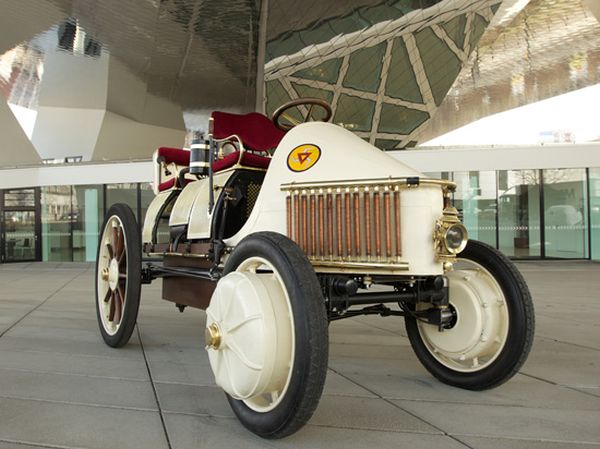
Just as electric vehicles are not a product of our days, since they existed from the early twentieth century, hybrids are not a product of modern times either. If not, let the proof speak for itself: the Lohner-Porsche Electromobile, the first hybrid car in history, built in 1900.
As you may have noticed from its name, Ferdinand Porsche was one of the mentors of this vehicle. Built together with the manufacturer Jacob Lohner, it was not only the first hybrid in the history of the engine, but also the first all-wheel-drive vehicle and the first to feature front-wheel drive.
This vehicle was not technically very far from today’s hybrids. We are talking about electric batteries working together with two combustion engines, the same principle used in the Lohner-Porsche Electromobile. Of course there are differences when compared with a hybrid of today, because the batteries weighed 1.8 tonnes. Nevertheless the principle was the same: an electric motor in each front wheel and a single-cylinder De Dion-Bouton petrol engine acting as a generator.
The weight of the batteries remained a major problem for the narrow wheels of the time, so the main goal of Porsche was to lighten the batteries so that the vehicle would weigh less. Porsche managed to reduce the total weight to 1,200 kilograms across successive prototypes, and even competed in several races, while the royal families of Central Europe showed interest in acquiring it.
You may be wondering why it was the first to have front-wheel drive and the first to have all-wheel drive. The answer is that it is said that the first unit sold had four electric motors, while the following units had only two motors on the front wheels.
Despite these displays of interest, sales of the Lohner-Porsche Electromobile were lower than expected. In two years only 11 vehicles had been sold, and the returns did not offset the enormous cost, for the time, of developing each car. Moreover, the price was excessive: between 14,400 and 34,000 crowns were being asked, depending on the design ordered by the customer, more than double the cost of a petrol-engined car. Maintenance costs were also high. Fully electric cars were becoming very popular at that time, so the Lohner-Porsche Electromobile gradually became merely a curiosity. A total of 65 units were sold until 1905.
The Lohner-Porsche, also known as Semper Vivus (always alive), had a range of between 64 and 200 kilometres, depending on the size of its batteries, somewhat better than many electric cars of today. In recent years, Porsche has managed to build a unit using original plans preserved in its archives, the model we show you in this article.
Source | Porsche


 Peugeot E-208 GTi: a battery-powered toy that revives the spirit of the 1980s sports cars
 New Lexus ES: luxury grows and goes electric
 First contact with the Dacia Sandero Hybrid 155: power and efficiency from €19,890
Deja un comentario