Classic cars with history: Jaguar XJ220
 Fernando Alvarez
10 February 2012
2 min.
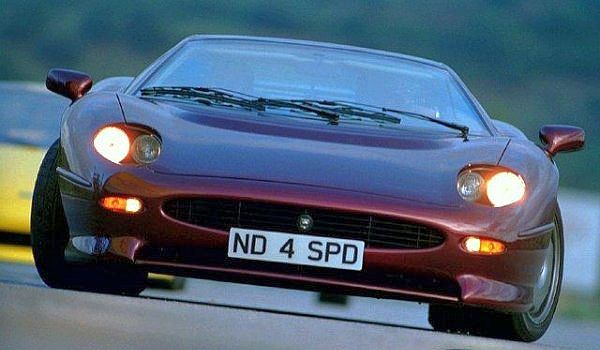
In classic cars, today we remember the Jaguar XJ220, the fastest production car in the world at the time.
Those were not good times for Jaguar in the mid-1980s. The financial situation of the jaguar brand left little room for luxury; it had become a state-owned company in 1966 and then passed into private hands in 1984. And it was precisely in those years of change that Tom Walkinshaw and Jaguar joined forces to create one of the most striking sports cars the traditional brand has ever produced.
Unveiled in 1989, critics quickly fell in love with its distinctive design, which looked ready to take the start at Le Mans. Less observant enthusiasts, more inclined toward direct action, soon succumbed to the twin-turbo V6 engine and its 550 horsepower, and to the possibility of holding the title of the fastest car in the world, with its 350 km/h top speed.
The Jaguar XJ220 was originally meant to be even more brutal than it turned out to be. When Ford acquired Jaguar in 1988, it also took charge of all the brand’s projects that were waiting for a better opportunity. One of them was a supercar with permanent all-wheel drive, four-wheel steering, intelligent suspension and a V12 engine producing more than 500 CV. The Americans found it simply excessive and too expensive to build, so all-wheel drive was eliminated and an engine that was half of what had been planned was used instead.
One of the most expensive cars on the market without a V12 engine was a complete absurdity for those who had to pay around 500,000 euros (at current values) for it, and it was said to use the plastic interiors of the Ford Escort to cut costs. Faced with the broken promise of the V12 engine, many future owners ultimately refused to buy the car, and Jaguar had to take them to court.
With the V6 engine, the XJ220 was ultimately the fastest car in the world and the one with the quickest acceleration. Despite all its problems and the limited number of units built (350), it was the dream of many for some years, until the McLaren F1 appeared on the horizon.


 Los siete finalistas al Coche del Año en Europa 2027 (COTY) son exclusivamente eléctricos
 Peugeot E-208 GTi: a battery-powered toy that revives the spirit of the 1980s sports cars
 New Lexus ES: luxury grows and goes electric
Deja un comentario