For less than 30,000 euros, this 4.7-metre Chinese SUV with a 1.5 Turbo petrol engine and a dual-clutch gearbox boasts of being a "masterful buy"
 Antonio Roncero @roncero_antonio
8 May 2026
9 min.
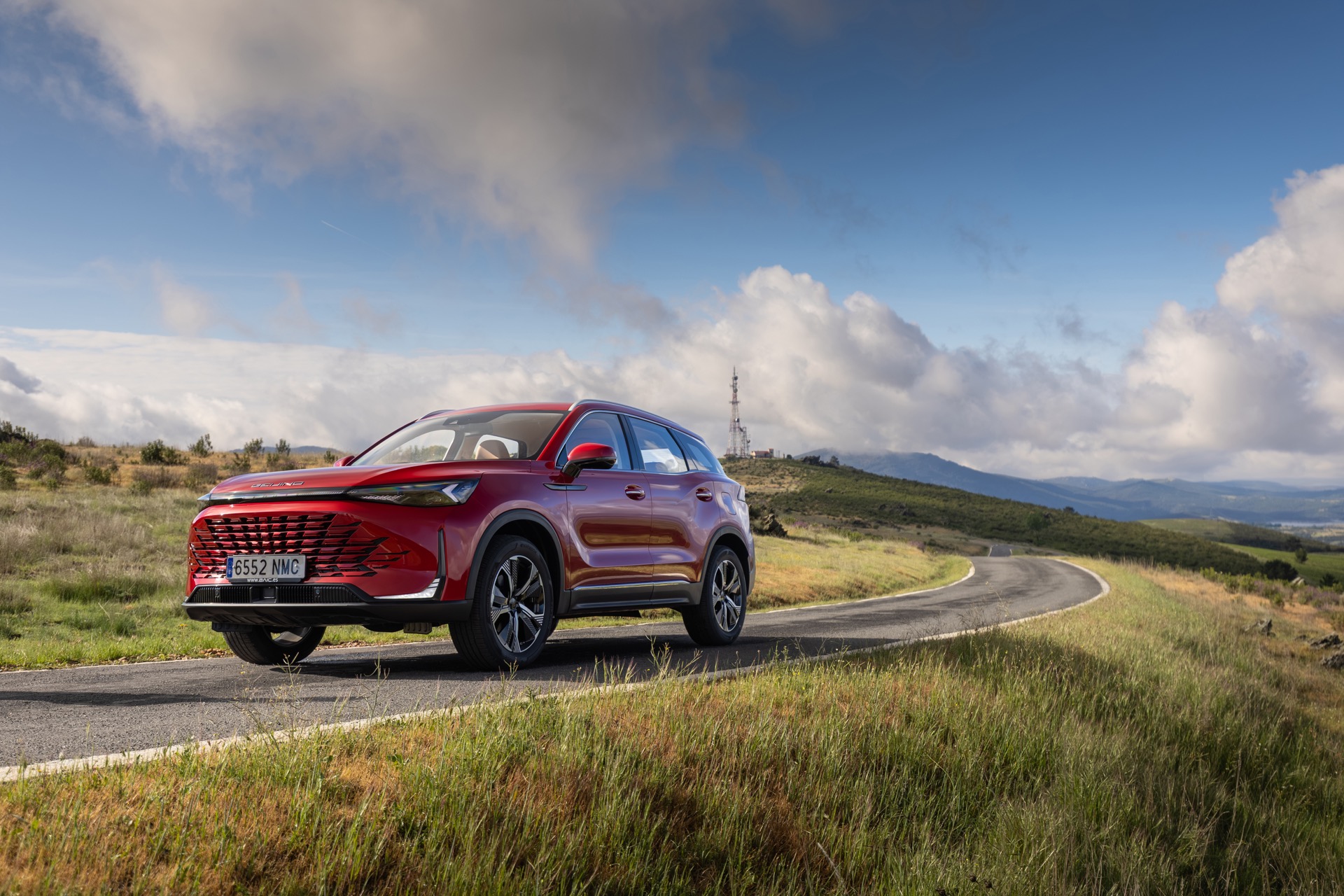
An attractive design and plenty of equipment are the main strengths of the Baic X75, an SUV that delivers what you expect from a family-oriented car if you don’t need more than a DGT C environmental label
BAIC arrived in our market without making much noise with the BAIC X55, and now adds a second SUV to its line-up, the BAIC X75, which we have also been able to drive. It is the prelude to a range that shows promise, and in which the most interesting part is yet to come, with 4×4 models such as the BJ30, BJ40 and BJ60, the latter an alternative to the very Toyota Land Cruiser. at half the price. But that is another story. The protagonist of today’s is the X75, an SUV 4.75 metres long with an eye-catching design and a very complete standard equipment list, powered by a 177 CV petrol engine with a dual-clutch automatic gearbox. The best part? Its favourable value for money. The least good? That it only carries a C label and its consumption can be high, depending on driving style and terrain. Let’s look at it in more detail.
A design that catches the eye
Not only because of its dimensions (4.74 metres long, 1.89 wide and 1.75 high), the X75 has presence. The huge frameless grille with the design the brand calls “Kyling Wing”, very much on trend in many current Chinese cars, reminds me, at least, of models such as the Hyundai Tucson or the Omoda 5. BAIC says it is inspired by a mythological Chinese creature… The result, with the headlights flanked by a light strip beneath the bonnet running across the front, is pleasing.
In profile, the roofline descends gently, giving it a more dynamic touch, and the 19-inch two-tone alloy wheels help sustain that robust look. The chrome trim on the upper and lower lines that frame the glazed area adds a certain touch of elegance. At the rear, another light strip serves as a visual signature. The trapezoidal exhaust outlets are meant to add a sporty note, although I can already say that the car’s spirit goes in another direction. In fact, what you see here is purely for show: the twin exhaust outlets on each side are not functional, they are merely decorative.
Both at the front, prominently on the bonnet, and on the rear light strip, and also inside – on the steering wheel, for instance – the word “BEIJING” appears, the name of the brand under which the BAIC X75 is sold in China. The importer is already working so that, sooner rather than later, the cars arriving in Spain will bear the BAIX badge. As for colours, there are five shades available: white, black, two greys and red. Metallic paint is the only option. And I must say that the red, as seen in the images in this article, suits it wonderfully.
The interior: plenty of equipment and plenty of space
As soon as you open the door you are greeted by an interior that Chinese brands have already accustomed us to: lots of screens, elegant two-tone finishes and materials that aim to convey the visual effect of a modern, technology-focused car. And it achieves this. Specifically, the X75 has three screens: two of 12.3 inches – instrumentation and multimedia, one after the other – and a third 7-inch one on the centre console to manage everything related to climate control, which in its layout recalls that used by models of Audi before they moved to the new “panoramic display”. It does not work badly, but I still prefer physical buttons.
The standard equipment is very good considering its price. What, you haven’t been told yet? Here it is: from 34,995 euros cash, which drops to 29,995 euros when financing the purchase. With everything – except metallic paint – as standard, as there is only one trim level. And everything is included, from perforated “eco-leather” seats with heating, ventilation and electric adjustment, dual-zone air conditioning, an air purification system, wireless smartphone charging, ambient lighting and even a panoramic roof of 1.3 square metres, which closes automatically if it starts to rain.
So far, nothing to object to. Nor regarding habitability: the 2.8-metre wheelbase and flat floor allow plenty of space in the rear seats. In addition, the backrests can be reclined in two positions, something passengers will appreciate on long journeys. The boot starts at 410 litres according to official figures, although the measuring method used does not tell us much when making a direct comparison with its rivals. In reality, the capacity is good for the size of the car, average for the category, with the advantage of carrying an emergency spare wheel under the floor. The tailgate is electric and has height-adjustable opening. There is a 12-volt socket in the boot, and the floor can be set at two heights.
What I liked least about the X75 is that when you start touching the surfaces, you discover that hard plastic is more present in the cabin than it might seem at first glance. The result does not reach the sense of quality perceived, for example, in equivalent models from other Chinese brands such as BYD or Geely, which are ahead of BAIC in this respect.
1.5 Turbo petrol engine of 177 CV and dual-clutch gearbox
Under the X75’s bonnet there is no sophistication or hybridisation of any kind. The engine is a 1.5 Turbo petrol with direct injection and variable-geometry turbo that operates on the Miller cycle. It boasts, as virtually all Chinese brands do with their combustion engines, of high thermal efficiency and countless awards, and in this case also German engineering, if only through the collaboration with the company Meta in its development. It delivers a maximum power of 177 CV at 5,500 rpm and a maximum torque of 305 Nm between 1,500 and 4,000 rpm, allowing the X75 to reach 200 km/h and accelerate from 0 to 100 km/h in 8.3 seconds.
In practice it does the job and moves the X75 well, which weighs just over 1,600 kg. It is well insulated and delivers its power progressively, although the gearbox has a lot to say here. It is a seven-speed dual-clutch gearbox that does its job correctly, but don’t expect the speed that characterises, for example, the DSG gearbox of Volkswagen. Chinese manufacturers have already accustomed us to DCT gearboxes that work well in relaxed driving but fall somewhat behind when agility is sought, which in a way prevents the engine from showing all it could. In this case there are no paddle shifters on the steering wheel, but the gearbox can be operated in “manual-sequential” mode via the gear lever, from which you can also select “D” or the sport “S” programme.
Since it has no hybridisation, there are two “buts” to pin on the X75, which will affect you more or less depending on what you need the car for. The first is that the X75 comes with a C label; if you need the advantages that today are associated with an ECO label, you will have to forget about it. The second is high consumption. Bear in mind that it homologates an average of more than 8 l/100 km on the WLTP cycle, and you know that in real use you must add between 1.5 and 2 litres. Something that in practice was confirmed during our first contact. Getting below 9 l/100 km is possible, but only on a very favourable route and driving in Eco mode.
If we talk about dynamic behaviour, the X75 is, above all, a car oriented towards comfort. The suspension is tuned to absorb bumps well, and overall insulation is good. If you want a family SUV to travel comfortably, the X75 delivers. But don’t get too excited when the bends arrive, because agility is not exactly its strong point. The steering is light and very assisted even in sport mode, and the damping setup makes the car “dive” at the nose and understeer if you want to take a corner with enthusiasm. In short, a behaviour that prioritises comfort and safety. This is not bad in itself, but there are other Chinese cars with a more European tuning that achieve a more precise driving feel without sacrificing comfort.
Price as an argument… depending on what it is compared with
Price works in a similar way: it is BAIC’s main argument when positioning the X75, which offers a lot of car for little money if the comparison is with European alternatives in this segment, which tend to be more expensive, less equipped, or both.
In the case of the X75 it is 29,995 euros when financing the purchase
(34,995 euros cash), with all standard equipment and a 5-year or 100,000 km warranty. The problem comes when the comparison is with other Chinese – or Chinese-origin – brands. There, the X75 faces cars such as the Ebro S800, with a cash price from 32,600 euros for the 1.6 TGDI version with 147 CV and a C label. Or the newcomer Geely Starray EM-i, which costs 33,490 euros in its entry version, but has a launch offer that brings the final price, when financing, to under 27,000 euros. And here we are talking, no less, about a plug-in hybrid with a ZERO label, 262 CV and more than 80 km of electric range.
BAIC X75 – Image gallery


 Kia offers an electric range of 10 models, 50 versions and 400 possible combinations
 The seven finalists for the 2027 European Car of the Year (COTY) are exclusively electric
 Peugeot E-208 GTi: a battery-powered toy that revives the spirit of the 1980s sports cars
Deja un comentario