Ford Kuga 2.5 T 200 CV, test drive (part III)
 Javi Vicente @javivicente
10 September 2009
7 min.
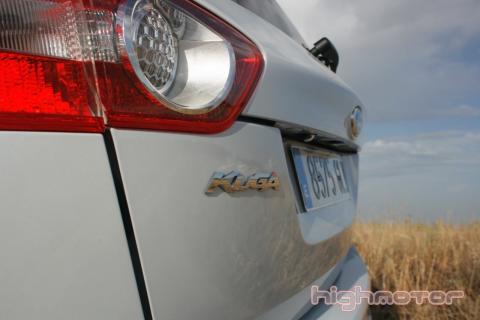
Mixing sportiness with an SUV a priori may seem rather strange, but Ford does it, and in a special way; personally, it is one of the brands I like most (I can’t stop looking at every Fiesta that passes me by). And with the Kuga, it could not be any other way.
The sporty trim level that Ford has named for its models is Titanium, and we have been able to try it on both the Kuga and the Mondeo. It features plenty of aluminium inserts, both in the interior cabin and on the exterior, mainly at the front and rear. It is a personal taste that may seem flashy a priori (many people have commented on it to me), but to me it does not.
Equipment
Regardless of the trim level you choose for the Kuga, whether Trend or Titanium, the safety equipment it includes is the same. If we consider permanent all-wheel drive as a safety element (I do, which is why I mention it here), there is a difference between one version and another, since the 2WD does not include it and the 4WD does. Everything else is identical.
Of course, active and passive safety is up to the task in these well-equipped models, and it features the latest technology in ABS brakes, traction and stability control (ESP), rollover risk mitigation (ARM), electronic brake force distribution (EBD), and brake assist with hazard lights activation during emergency braking. As an extra, Titanium trim can be fitted with low tyre pressure detection for 180 euros.
As for passive safety, it includes 6 airbags (front, front side and curtain), seatbelts with head restraints and, in the front, pretensioners. ISOFIX anchor points are only fitted on the rear seats. All of this, backed by the 5-star Euro NCAP rating, places the Kuga in an enviable position compared with many other SUVs.
In terms of comfort equipment, we find quite a few standard features such as cruise control, puddle lights in the exterior mirrors, a FordPower start button, and a rain sensor, standard on the Titanium and optional in the visibility pack on the Trend trim. Other standard and optional features have already been discussed in the interior and exterior design section. As the most interesting option, I would choose the panoramic roof (650 euros), xenon HID headlights (850 euros) if you will be driving a lot at night, and the dual-zone air conditioning (400 euros on the Trend). The 19-inch alloy wheels are an aesthetic choice that does not greatly affect handling or comfort, but for 600 euros they are quite acceptable. Of course, when it comes to replacing the tyres, those costs must also be taken into account.
The operation of the equipment is generally quite simple and intuitive, and once you have understood one system, the rest are similar, whether from the same brand or not, although there are always small details. But when we get used to something and it gets changed… That is the case with switching between the on-board computer displays. Normally it is on the end of the right-hand stalk, where we also control the front and rear wipers, but in this case it was on the left, and it is rather embarrassing to switch on the front wipers with the car spotless. It is something you don’t forget, yet you end up doing it again. The speed and rev counter gives it that sporty character we mentioned earlier.
I have to say the voice recognition is excellent, since it can recognise a radio frequency from any voice (and that’s after we really put it to the test…). Simply say “Frequency”, then “ninety-three point nine”, and the radio automatically tunes to that frequency. One of the best, if not the best, I have tried, and without needing to teach it your voice tone first. What human ingenuity!
For the first time I was able to try a rear-view camera for a week (it requires the 7-inch touchscreen navigation system), and I can say it is an effective aid against poor rear visibility, but at 2,750 euros I do not recommend it. It is located above the rear number plate, with a glass coating to prevent damage, and hidden in a moulding on the tailgate (see image). I understand the price, but it raises the car up too much, although the camera and the navigation system are a joy, and the latter is among the best I have tried.
I did not like the front bonnet system at all. You have to open it with a key (see image), which is fine and secure up to that point, but then you have to hold the bonnet up by hand while looking for the prop to support it. It does not have a hydraulic system like other cars in its range, nor any heat protection, as it is bare metal with no thermal foam, so in summer, with the engine hot, there is no way to hold it up (see image).
The FordPower button is located next to the hazard lights (see image), so in case of emergency braking or similar, when we try to activate those lights, we can press it by accident. On the positive side, it only switches off if the car is stationary, and it requires several constant presses to stop, provided we are in first gear. With the higher gears engaged, it is impossible to turn it off. We have also had some problems with the key detection inside the vehicle, but not with the Mondeo we tested. I understand it is still the same system.
Versions and trim levels
With so much variety of models and versions that brands have accustomed us to, it is hard to choose one over another, although in the case of the Kuga, things are fairly straightforward. There are two engines, a diesel (2.0 with 136 CV) and a petrol (2.5T with 200 CV), which is the one we tested. The first one comes in Trend and Titanium trim levels, although the Trend only includes the 2WD and 4WD diesel versions, whereas the Titanium can be chosen with either of the two 4WD engines, that is, diesel or petrol. Below is a list of versions and base prices to make it more visual (the tested version in bold):
- Ford Kuga Trend 2.0 TDCi 136 CV 2WD – 25,500
- Ford Kuga Trend 2.0 TDCi 136 CV 4WD – 29,600
- Ford Kuga Titanium 2.0 TDCi 136 CV 4WD – 31,600
- Ford Kuga Titanium 2.5 Turbo 200 CV 4WD – 32,800
The price of the tested unit comes to around 41,000 euros, including extras worth 8,000 euros.
Once again I can say that Ford is on the right track, and we were able to see that with the Mondeo. It is a brand I have always liked, and it is now targeting a fairly broad customer profile, given how wide its range is. The Kuga is not designed for much off-road frills, since its all-wheel drive is permanent but limited, and we did not want to push it too far in that respect. We know there are other options that perform better off-road. What we have no doubt about is its behaviour on tarmac, which is excellent. The feeling is truly impressive, and the suspension tuning is appropriate (although it may seem firm at times). The steering and driving position are very pleasant, and proof of this is that more and more units are seen on the streets.
That said, I have not yet seen the petrol version, and I look out for all of them. Perhaps they rushed its launch, since it targets too small an audience, one that often opts for other brands given their nature. They have wanted to go after them, but they still have work to do. I miss some additional engine options, especially diesel, and I have no doubt they will bring them later on (the 175 CV unit offered by the Mondeo would be ideal), but it must be acknowledged that, at least in Europe, Ford had not yet set foot on this terrain of SUVs or 4x4s. We will see how it performs and how it deals with the competition, which has a good few years’ head start.
Photos | Javi Vicente


 The seven finalists for the 2027 European Car of the Year (COTY) are exclusively electric
 Peugeot E-208 GTi: a battery-powered toy that revives the spirit of the 1980s sports cars
 New Lexus ES: luxury grows and goes electric
Deja un comentario