Geely Starray Hybrid Cars Tests Review SUV
Geely Starray EM-i review: why the Chinese plug-in hybrid SUV redefines the price-to-product ratio in 2026
 Iván Navarro
16 August 2026
6 min.
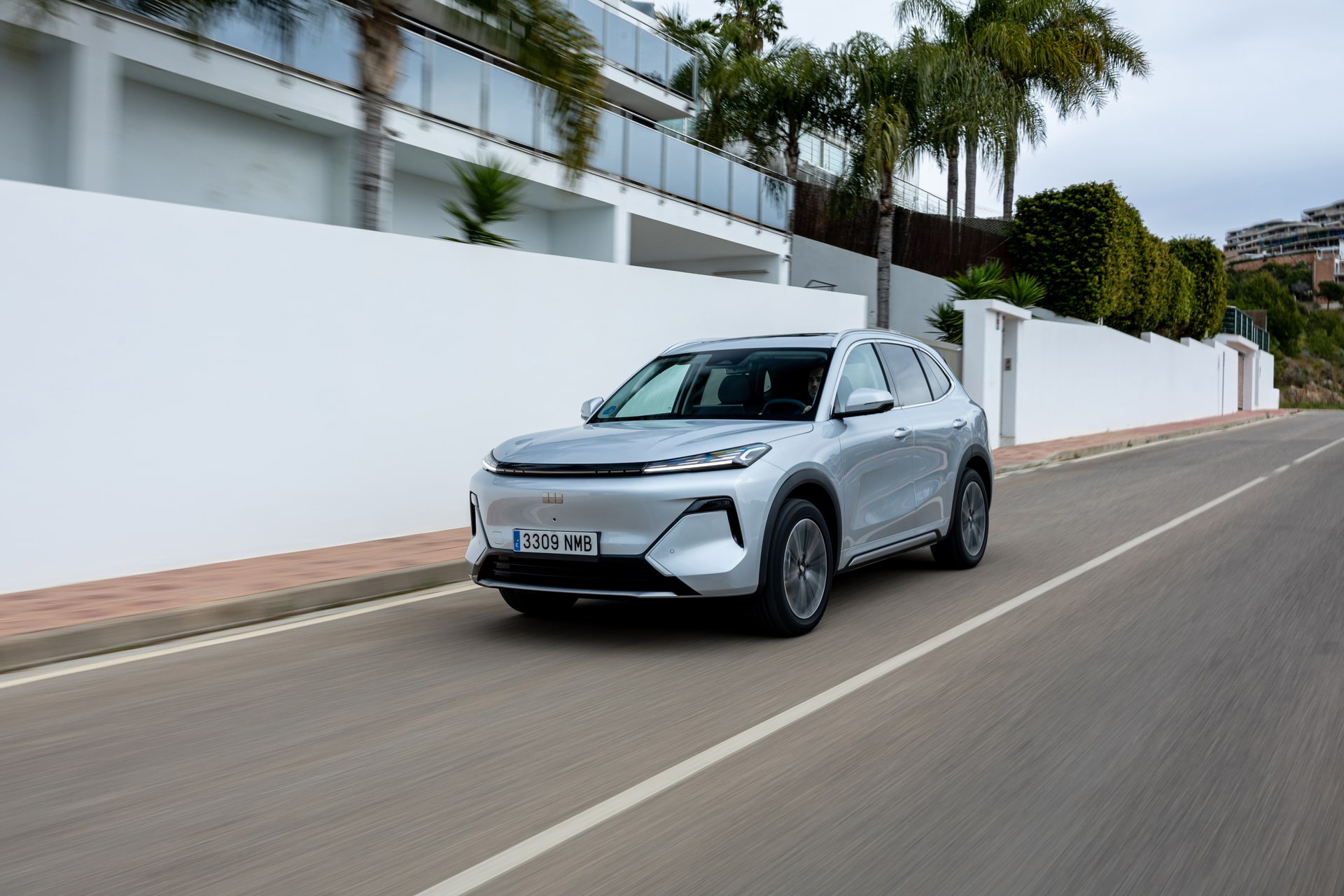
We analyse the Geely Starray EM-i, a 260 CV combined PHEV SUV with 2.5 l/100 km and a starting price from ≈€33,500 that reshuffles the segment in Spain. Road test, data and comparison with direct rivals.
Every segment reaches a moment when one model forces the rest to look at its price. The Geely Starray EM-i is that car in Spain’s 2026 PHEV SUV segment. Not because it reinvents anything — it doesn’t — but because it delivers 260 CV combined, a homologated consumption of 2.5 l/100 km and a CERO label on a body almost 4.7 metres long for under €34,000. And that, today, changes the conversation.
Geely lands in Spain with a PHEV aimed straight at the heart of the market
The Hangzhou brand is not here to test the waters. It arrives with a dealership network, after-sales support leveraging local partners and a product designed for the European buyer who until now was torn between a conventional hybrid and a “proper” plug-in. The Starray EM-i is the model that opens that conversation in the C-SUV segment, exactly where volume is cooked.
Exterior design: European proportions with its own signature
Stylistically the Starray EM-i plays the clean-SUV card. No baroque flourishes or oversized grilles. Sharp headlights, a flat bonnet and a horizontal waistline give it a restrained, almost sober presence for something that usually comes from China. At 4.74 metres long it sits at the level of a previous-generation Tiguan, with a width that helps on motorways and 18–19-inch wheels that don’t overdo the overall look.
In my view, the rear is the best part: connected light signatures, a double-volume tailgate and that clean look that ages well. It’s not a car that shouts. And in 2026, that’s almost a virtue.
Interior and perceived quality: the leap nobody expected at this price
This is where the Starray surprises. The 15.4-inch central screen dominates the dashboard, but the overall package doesn’t surrender to absolute minimalism: there’s a physical volume knob, well-resolved steering-wheel controls and a crisp digital instrument cluster. Soft-touch plastics cover the contact areas, the faux-leather upholstery feels convincing and the stitching is where it should be. The level of a Terramar? No. Above what a HS offers at the same price? In our opinion, yes.
Space, habitability and boot for family use
The 2.75-metre wheelbase shows in the rear seats: two adults of 1.85 m travel without negotiating knees. The boot is around 500 litres, enough for a Madrid–Cádiz weekend with four people’s luggage. The low central tunnel and flat floor behind make a third passenger easier on short trips. Watch the parcel shelf: it uses a conventional roller blind, no frills, and it’s appreciated that it works without fuss.
PHEV powertrain: 260 CV combined and smart energy management logic
The heart of the Starray EM-i is a 1.5 petrol Atkinson-cycle engine coupled to an electric motor and a battery that allows urban trips in zero-emission mode. The declared combined output is approximately 190 kW (≈260 CV), enough to move the ≈1,800 kg of the package with ease. Delivery is typical of a well-executed PHEV: electric pull-away, clean transitions to the combustion engine and energy management that prioritises the electric motor in town.
| Power kW | Power CV | Top speed | Range | Consumption | Label | Fuel |
|---|---|---|---|---|---|---|
| ≈190 kW | ≈260 CV | ≈170 km/h | Between 83 and 136 km depending on version | ≈2.5 l/100 km | CERO | Petrol PHEV |
Electric range and real-world consumption: what to expect day to day
The homologated consumption of 2.5 l/100 km and 50 g/km of CO₂ are the starting figures. In practice — and here’s the honest caveat — a PHEV only achieves those numbers if it’s plugged in. A driver with a garage space and a 40 km daily commute can go weeks without refuelling. Those who don’t plug in will see real consumption closer to 6–7 l/100 km, perfectly acceptable for an SUV of this size, but far from the official headline figure.
Road behaviour: comfort over sportiness
The Starray doesn’t pretend to be a sports car. The steering is light, the suspension filters city expansion joints well and the sound insulation, especially with the electric motor working, is surprising. On the motorway at 120 km/h the noise level is contained and the combustion engine only kicks in under firm acceleration or when the battery runs low. In fast corners, however, the chassis makes itself known: it stays flat but lacks the surgical precision of a European product in the same segment. It’s a car for travelling comfortably, not for attacking a mountain pass.
Standard equipment and technology
Standard features include Level 2 ADAS, 360-degree camera, wireless charging, dual-zone climate control, heated front seats and an interface that — pleasantly — runs smoothly. Wireless CarPlay and Android Auto integration comes ready, something not every rival at this price offers. OTA updates are planned, so the software can improve after delivery.
Safety and ADAS: Level 2 with reliable sign reading
Lane-change warning, active lane keeping, autonomous emergency braking with pedestrian and cyclist detection, and adaptive cruise control with stop&go. The package is complete. In short tests the alerts are reasonable — neither intrusive nor passive — although it’s worth disabling the speed-limit warning after each start if it annoys you, a European regulatory change that affects everyone.
Verdict: when it makes sense to buy it
The Starray EM-i makes sense for anyone wanting a large, modern, well-equipped PHEV SUV without going above €35,000. If you have a space with a charging point, the annual saving compared with an equivalent petrol car is real. If you don’t, it remains a competent SUV with a CERO label — useful for ZBE low-emission zones — but you lose half the economic argument. For those seeking premium European finish or sporty dynamics, there are better and more expensive options. For everyone else, it’s hard to find so much car for this money today.
Frequently asked questions
What is the price of the Geely Starray EM-i in Spain?
The starting price is around €33,500 manufacturer’s suggested retail price, excluding dealer discounts, campaigns or aid schemes such as Plan Auto+.
What power does the Geely Starray EM-i have?
The declared combined output is approximately 190 kW, around 260 CV, thanks to the combination of the 1.5 petrol engine and the electric motor of the PHEV system.
What consumption does the Geely Starray EM-i have?
The homologated consumption is approximately 2.5 l/100 km with emissions close to 50 g/km of CO₂, provided the battery is charged regularly.
Does the Geely Starray EM-i have a CERO label?
Yes, as a plug-in hybrid with sufficient homologated electric range, it carries the DGT CERO label, with access to ZBE zones and associated tax benefits.
Technical specifications of this car

 Kia offers an electric range of 10 models, 50 versions and 400 possible combinations
 The seven finalists for the 2027 European Car of the Year (COTY) are exclusively electric
 Peugeot E-208 GTi: a battery-powered toy that revives the spirit of the 1980s sports cars
Deja un comentario