Hyundai Kona vs Toyota C-HR: which hybrid SUV-B offers better equipment for under €32,000
 Iván Navarro
16 August 2026
6 min.
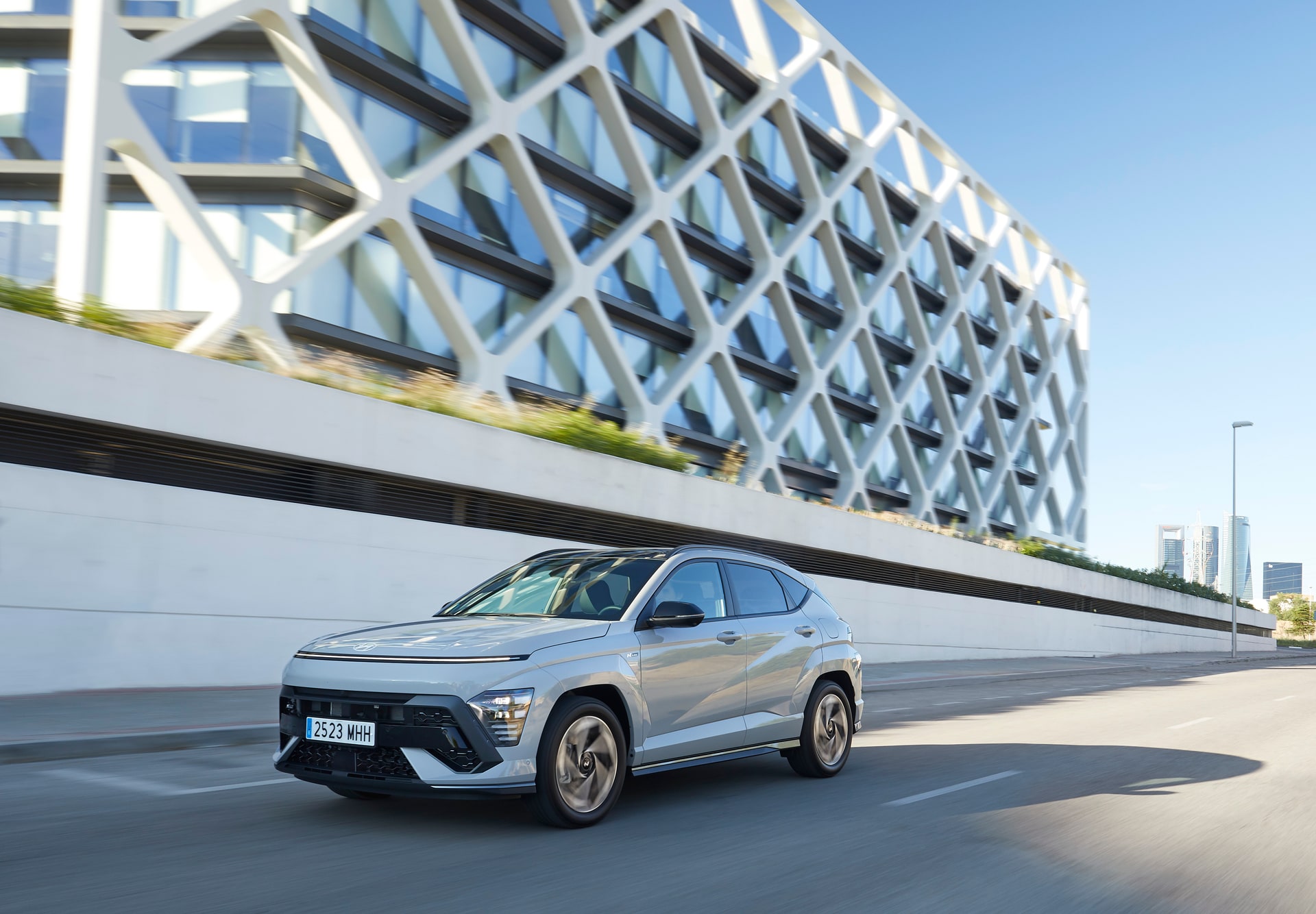
We compare the Hyundai Kona and the Toyota C-HR hybrids to find out which SUV-B offers the best equipment-to-price ratio below €32,000 on the Spanish market.
The hybrid SUV-B segment has for years been the most logical entry point into electrification for those who don’t want (or can’t) plug in their car every night. And within that pack, two names dominate the Spanish registration charts: Hyundai Kona and Toyota C-HR. Both have renewed their ranges, both sit in that sweet spot below €32,000 with a hybrid engine, and both target the same buyer. But they are less alike than they seem.
Why is the hybrid SUV-B still the king of the city?
The fact that a segment survives the electric offensive says a lot about it. The hybrid SUV-B is the middle ground between pure petrol and plug-in: it requires no charging infrastructure, keeps consumption below five litres per 100 km in urban driving and retains the DGT ECO label, with everything that implies for access to the low-emission zones (ZBE) of Madrid, Barcelona or Valencia. None of this is new. What stands out is that, in 2024, the equipment gap between brands has widened. And that is where this duel becomes interesting.
Hyundai Kona hybrid: from ≈€27,500 indicative RRP
The third-generation Kona has grown. It now measures 4.35 metres and it shows inside: two 12.3-inch screens under a single glass panel, wireless phone charger, dual-zone climate control and a slightly higher driving position than its rival. The hybrid version pairs a 1.6 GDi engine with an electric motor for a combined output in the region of 138 CV. In town it moves with the smoothness expected of a modern full hybrid, although its dual-clutch gearbox has a different character — more “conventional car” — than the Japanese eCVT. In my view, it works better on open road.
| Power kW | Power CV | Top speed | Range | Consumption | Label | Fuel |
|---|---|---|---|---|---|---|
| 101 kW | 138 CV | ≈165 km/h | ≈900 km | ≈5.0 l/100 km | ECO | Hybrid |
Toyota C-HR hybrid: from ≈€31,000 indicative RRP
The C-HR is a different kettle of fish. Toyota goes for a disruptive design — sharp lines, almost hidden rear windows, coupé-style rear end — and a fourth-generation hybrid powertrain with 140 CV in its entry version, rising to 197 CV in the 2.0 variant. The interior gains in perceived quality over the previous model; the feel of the upper-grade plastics matches cars a segment above. That said, rear three-quarter visibility is still tight. And the boot, at 388 litres, trails the Kona (466 litres). A matter of priorities.
| Power kW | Power CV | Top speed | Range | Consumption | Label | Fuel |
|---|---|---|---|---|---|---|
| 103 kW | 140 CV | ≈170 km/h | ≈950 km | ≈4.8 l/100 km | ECO | Hybrid |
Technology equipment: where does the Korean offer more?
Here Hyundai plays at home. Its mid-range trim already includes as standard the two 12.3-inch screens, wireless Apple CarPlay and Android Auto, inductive phone charging, mixed upholstery and keyless entry with push-button start. The C-HR also offers a 12.3-inch central screen, but leaves out of its more affordable versions some details — the large digital instrument cluster and the JBL sound system, for example — that the Kona provides earlier.
One detail that, in our view, tips the balance considerably for everyday use: the Kona features V2L (Vehicle-to-Load) sockets as standard in several versions, something unusual in a non-plug-in hybrid at this price. Charging an electric bike or a portable fridge from the boot on a weekend in the mountains stops being an eccentricity.
ADAS and safety: Toyota Safety Sense packs a punch
The Toyota Safety Sense package comes complete from the base trim: emergency braking with pedestrian and cyclist detection, adaptive cruise control with sign recognition, active lane keeping and traffic jam assist. Hyundai SmartSense is no slouch — in fact, in parking ADAS and 360º vision it goes even further in its top trims — but below €32,000, the Toyota’s standard specification is hard to beat. If the criterion is “how much comes as standard without moving up a trim”, the C-HR wins this round.
Real-world efficiency: Toyota’s home turf
Toyota has spent almost thirty years perfecting the HSD system, and it shows. In town, the C-HR effortlessly sits around 4.5-4.8 l/100 km in real conditions. The Kona, with its dual-clutch architecture, operates in the range of 5.0-5.4 l/100 km in the same scenario. A small difference on paper, but significant if you do 20,000 km a year in traffic. On the motorway the gap narrows, and there the Kona even responds with more ease when asked for sustained acceleration.
We cover this urban-versus-road dilemma in detail in our guide on how to choose a compact hybrid SUV for the city, if your intended use is mostly metropolitan.
Summary table and score
| Model | Price from | Power | Consumption | Equipment | ADAS | Efficiency | Overall score |
|---|---|---|---|---|---|---|---|
| Hyundai Kona HEV | ≈€27,500 | 138 CV | ≈5.0 l | 9/10 | 8/10 | 7.5/10 | 8.4/10 |
| Toyota C-HR HEV | ≈€31,000 | 140 CV | ≈4.8 l | 7.5/10 | 9/10 | 9/10 | 8.3/10 |
Verdict: which one is worth more for under €32,000?
A technical draw, with nuances. The Hyundai Kona offers more car for less money: it enters the range earlier, with more visible equipment and more usable space. The Toyota C-HR asks for a slightly bigger budget and in return delivers a design that will age better, flawless urban consumption and the most generous standard ADAS package. If you live in the city and value fuel savings over ten years, C-HR. If you are after the most aggressive equipment-to-price ratio and a genuinely large boot, Kona.
The prices shown are manufacturer’s recommended retail prices (RRP) and are indicative only, excluding dealer discounts, one-off campaigns and Plan Auto+ aid.
Frequently asked questions
Which hybrid SUV-B consumes less, the Kona or the C-HR?
The Toyota C-HR consumes slightly less in town, around 4.8 l/100 km in real conditions compared with 5.0-5.4 l/100 km for the Hyundai Kona hybrid. On the motorway the difference narrows.
Do both models have the DGT ECO label?
Yes. Both the Hyundai Kona HEV and the Toyota C-HR HEV carry the ECO label, which allows them to enter the ZBE zones of Madrid, Barcelona and other major Spanish cities without time restrictions.
Which offers better standard equipment below €32,000?
The Hyundai Kona includes more visible features (dual 12.3-inch screens, wireless charging, V2L sockets) in its more accessible trims. The Toyota C-HR wins on standard ADAS specification thanks to the Toyota Safety Sense package.
Which boot is more practical?
The Kona offers 466 litres, clearly ahead of the C-HR’s 388 litres. For family use or long journeys, the Korean has an objective advantage.


 Kia offers an electric range of 10 models, 50 versions and 400 possible combinations
 The seven finalists for the 2027 European Car of the Year (COTY) are exclusively electric
 Peugeot E-208 GTi: a battery-powered toy that revives the spirit of the 1980s sports cars
Deja un comentario