Civic Honda Compact Technology
Honda equips the Civic with the active safety technology suite Honda SENSING
 Francisco Javier
14 December 2016
3 min.
Honda equips the tenth generation Civic, which will go on sale in Spain from March 2017, with a suite of safety technologies called Honda SENSING. In this way, the Honda Civic 5-door becomes one of the safest C-segment compacts on the market.
Honda SENSING
The evolution of active and passive safety has grown exponentially over the years. Many of these safety systems are now present in most of today’s cars, making them far safer vehicles. The new generation of the Honda Civic, which will go on sale in Spain from March 2017, comes as standard across the whole range with advanced active and preventive safety systems.
This suite of safety technologies called Honda SENSING, is the result of developing intelligent systems derived from information processing carried out by the new Civic. This is achieved through its radar system, cameras and a set of sensors that constantly read driving situations and traffic conditions. In this way, the tenth generation Honda Civic 5-door becomes one of the safest C-segment compacts on the market.
The active safety technology suite Honda SENSING is very comprehensive and consists of the following elements:
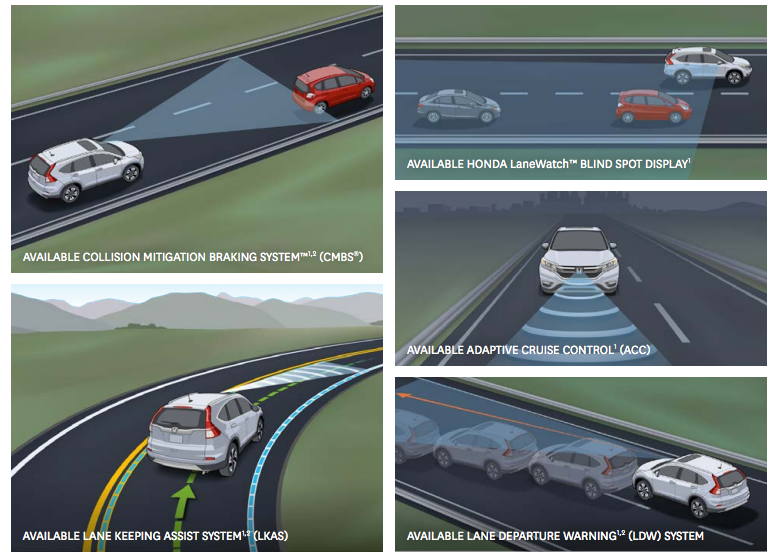
- Collision Mitigation Braking System (CMBS): helps stop the car if the system determines that a collision with a vehicle ahead is unavoidable.
- Lane Departure Warning (LDW): detects whether the car is drifting out of its lane without the indicator having been activated.
- Road Departure Mitigation (RDM): uses data from the camera mounted on the windscreen to detect whether the car is leaving the road. It uses electric power steering (EPS) to apply small corrections to keep the vehicle in its lane. In some situations it can also apply braking force.
- Lane Keeping Assist System (LKAS): helps keep the car centred in its lane by detecting road markings and making small steering adjustments so the vehicle does not cross the side lines.
- Adaptive Cruise Control (ACC): allows the driver to set the desired speed as well as a distance from the vehicle ahead.
- Intelligent Adaptive Cruise Control (i-ACC): predicts the movement of other vehicles merging directly in front of us on multi-lane roads and reacts automatically.
- Traffic Sign Recognition System (TSR): automatically detects and recognises road signs and displays them on the car’s instrument cluster.
- Low-speed Follow-up Function (ISA): combines the automatic speed limit set by the driver with the TSR system so that the vehicle’s speed adjusts automatically to traffic signs.
The following video shows how the different elements that make up Honda SENSING work:
[jwplayer file=”https://www.youtube.com/watch?v=gkgWy6Qd9ss” autostart=”false” mute=”off”]
In addition, the new Honda Civic will incorporate this other safety technologies with the following functions:
- Blind Spot Warning: uses radar-based technology to automatically detect and warn of vehicles in the driver’s blind spots.
- Rear Cross Traffic Alert: uses rear radar sensors to warn the driver of possible approaching vehicles when reversing.
- Multi-angle rearview camera: gives the driver options for full visibility when reversing or turning with complete peace of mind: a normal 130-degree view, a wide 180-degree view and a full top-down view.
Source | Honda
Technical specifications of this car


 Kia offers an electric range of 10 models, 50 versions and 400 possible combinations
 The seven finalists for the 2027 European Car of the Year (COTY) are exclusively electric
 Peugeot E-208 GTi: a battery-powered toy that revives the spirit of the 1980s sports cars
Deja un comentario